Where will Microsoft's Green Path Lead? InfoWorld article

InfoWorld joins the press in discussing Microsoft's Green IT efforts.

Microsoft goes greenFor months now, many of the hardware technology heavyweights -- HP, IBM, Sun, Dell, AMD, Cisco, and Intel, for example -- have gone to great lengths to highlight their green products, plans, and corporate visions. Other green IT benefits not withstanding, this strategy makes sense from a marketing standpoint: By demonstrating and accentuating the greenness of their wares, they're better positioned to sell processors, PCs, servers, and other gear to customers hungry for leaner, greener operations.

Now the software behemoth Microsoft has stepped forward to loudly proclaim its support for the sustainable IT movement. The company's off to a good start: Beyond a list of notable green credentials already under its belt, Microsoft has a newly appointed chief environmental strategist in Rob Bernard, charged with guiding and promoting the evolution of the company's green agenda. The company's newly released server platform Windows Server 2008 is garnering praise for its energy efficiency. The company is even starting to share, for free, its best practices for datacenter management.

By shining a green spotlight on itself, Microsoft is calling attention to the fact that it understands the role that it -- and the software and platform industry as a whole -- has to play in the complex green-tech ecosystem. What remains to be seen is how that seemingly newfound green religion will manifest itself in future product offerings, particularly, in my mind, with respect to the successor to Vista.

Green in Redmond
Microsoft CEO Steve Ballmer used the Cebit stage to not only tout the energy-efficiency features loaded in Windows 2008 Server and other Microsoft products; he told the world that the company would soon release a set of best practices for datacenter management, drawing on energy-saving strategies the company has adopted in its own operations. The first set of best practices, in fact, is already available for download.

A friend forwarded on IBM''s direct email response to Steve Ballmer's Cebit presentation. Here is the IBM Green IT product spin. 

IBM System p in conjunction with IBM Middleware provides a massively powerful, scalable solution that lowers Total Cost of Ownership with one of the major components of that savings being power consumption and cooling. Using System p, IBM clients have consolidated 50 or more individual servers onto just one System p server, reducing power consumption by over 90% and floor space requirements by 80%.

With System p, you get improved utilization of the hardware you purchase, and along with the benefits IBM Middleware enjoys on this system, you have an unbeatable combination. Less power, less cooling, more throughput with fewer materials and lower costs - this is the IBM definition of Green IT.

Finally, Ballmer did say that Microsoft still has a lot more work to do when it comes to driving green IT initiatives. We agree. But the answer is NOT moving your data centers to cooler climates or near hydroelectric plants. The answer is consuming less. And IBM Middleware on System p delivers more value with less resource.

So, IBM Green IT consultants are going to focus #1 on upgrading the hardware, and data center power efficiency (PUE) becomes a non-issue?  Actually, it does make sense. The more inefficient your data center is, the more energy you will save when you install an IBM energy efficient hardware upgrade.  These IBM guys are brilliant.  Keep energy costs high to justify hardware purchases.

Which brings up a great point I need to add to a future paper.  Make various PUE assumptions on a data center when calculating an energy efficiency project, and don't assume the PUE is a static number.  PUE is dynamic and changes.
Read more

Feng Shui and the Art of Data Centers, News.com

News.com's Michael Kannellos chooses an interesting term for data centers design to flow with the environment, Feng Shui and the Art of the Data Centers.

Large multinational companies are building data centers designed to flow with their environment. There's something you probably didn't expect to hear five years ago.

Microsoft, for instance, is building a data center in Ireland in which the server rooms and other facilities will be cooled with devices called air side economizers, which pipe outside air inside.

"It uses fresh air aggressively to keep your building cool," said Rob Bernard, Microsoft's chief environmental strategist, in a phone interview. "The ideal scenario is that if Ireland continues to develop wind power and hopefully wave power, you have the best of both worlds: you're minimizing kilowatt consumption, and the kilowatts you use are sustainable."

The company, he pointed out, also has a data center in Quincy, Wash., powered by hydroelectric dams. (We've got an earlier post with Bernard about Microsoft's plans to move into building automation and other green industries.)

Similarly, Google analyzes the availability of renewable power when it builds data centers. Centers built in Oregon and North Carolina are located near hydroelectric power. Google also has 1.6 megawatts' worth of solar power at its headquarters. Applied Materials, the Air Force, and Sharp own even larger solar arrays.

Read more

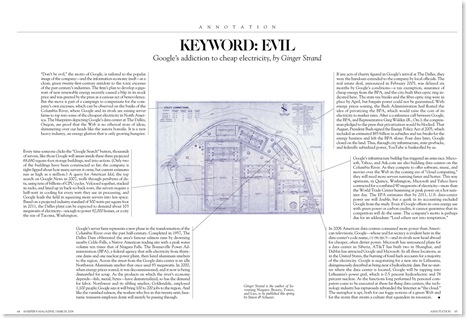
Harper's Magazine- Keyword: Evil, Google's addiction to cheap Electriticity

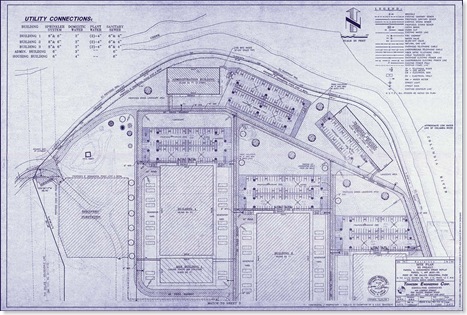
DataCenterKnowledge wrote a post that Harper's Magazine has published a copy of the site plan for Google's data center in The Dalles, OR.

The Dalles

Google The Dalles

In reading the Harper's article (which isn't totally accurate), I was curious what motivated the writer to write and use Keyword Evil Google in her title.  It turns out the Author Ginger Strand lists her obsession as Hydroinfrastructure.  And, she is about to publish a book Inventing Niagara: Beauty, Power, and Lies.

Most of us take infrastructure for granted but we shouldn't; it tells us a lot about ourselves. The massive investment in designing, building and maintaining infrastructure is one of a society's most utopian actions: through it we seek to remake the world. Hydroinfrastructure, for example, shows our conviction that the perfect world has easy access to cold drinks and hot showers. It also links country and city through the flow of one of earth's most elemental substances, demonstrating that the worlds of “nature" and “culture" are not as separate as we often believe.

A great book on infrastructure generally is Infrastructure: The Book of Everything for the Industrial Landscape by Brian Hayes.

I looked up the book she references and it looks like an interesting read.

Read more

Green IT spend to Outstrip Y2K within 2 years, reports S2 Intelligence

Computerworld Australia reports on research from S2 Intelligence.

Within two years, most big businesses will be on their way to spending three times as much on systems for carbon accounting and sustainability reporting compared to what they spent on Y2K, according to analyst and research firm, S2 Intelligence.

Businesses will collectively spend at least US$595 billion on systems to support green accounting.

Releasing forecasts on what businesses will spend on systems to support green accounting through to 2015, S2 Intelligience estimates Australian business will spend at least US$6.5 billion.

The research firm's managing director, Dr Bruce McCabe, said to reduce the carbon footprint of businesses we first need to measure it, but green accounting today is shallow, with lots of window dressing and little actual measurement.

"By 2010 all types of businesses will be investing in systems that support detailed and continuous information collection."

It's interesting that they think Carbon Labelling will drive purchasing behavior.

"Carbon labelling in supermarkets is a good example. Led by chains such as Tesco in the UK, this will soon impact what makes it into the shopping basket.

"Even schemes that follow a simple star rating will cascade into new accounting requirements for every business in the supply chain," he said.

" The primary producer, manufacturer, wholesaler and transport provider will all need to be able to report their contribution--or lose business to someone that does."

Read more

11th Best Practice hidden in Microsoft's 10 Best Practices

I've been staring at the Microsoft's Best Practices for Energy Efficiency in Microsoft Data Center Operations that they published as part of Steve Ballmer's announcement at Cebit, thinking about how to use the document. I checked with some Microsoft friends and there have been 640 downloads of this document from the press release site in one week. The number will go up significantly when the content gets hosted in a higher traffic Microsoft area like TechNet. The early feedback has been good and customers are asking for more.

For those of you haven't downloaded the document here are the 10 best practices:

  1. Engineer the data center for cost and energy efficiency.
  2. Optimize the design to assess multiple factors.
  3. Optimize provisioning for maximum efficiency and productivity.
  4. Monitor and control data center performance in real time.
  5. Make data center operational excellence part of organizational culture.
  6. Measure power usage effectiveness (PUE).
  7. Use temperature control and airflow distribution.
  8. Eliminate the mixing of hot and cold air.
  9. Use effective air-side or water-side economizers.
  10. Share and learn from industry partners.

The one thing I really liked about the list is the order. The order in which you run a Green Data Center project is the most important best practice and can be listed as the 11th Best Practice.  You can fine tune the order for your organization, but you get the idea of looking at the big picture first, putting in your green infrastructure, implement, and learn more.

    • Big Picture
      • Engineer the data center for cost and energy efficiency.
      • Optimize the design to assess multiple factors.
      • Optimize provisioning for maximum efficiency and productivity.
    • Green Infrastructure
      • Monitor and control data center performance in real time.
      • Make data center operational excellence part of organizational culture.
      • Measure power usage effectiveness (PUE).
    • Implement
      • Use temperature control and airflow distribution.
      • Eliminate the mixing of hot and cold air.
      • Use effective air-side or water-side economizers.
    • Learn More
      • Share and learn from industry partners.

This is the first step anyone should take in Greening their data center.  Answer the question:

In what order will you implement Best Practices?

This will have the largest effect on the success or failure of the project.

Read more