Delaying Data Could Cut net's Carbon footprint

I've been staring at this article by NewScientistTech, Delaying data could cut net's carbon footprint.  And, after seeing some other places the article show up, it seemed worth posting.

People may think putting the network to sleep isn't worth the energy savings, but they need to think about the possibility that now that the network is in sleep, the rest of the hardware  on the network can be in a sleep state as well. Which is probably why Intel is part of the research group, as this will help to sell energy efficient processors in servers and demonstrate a higher energy savings.

As energy prices soar, and governments and organisations start to sweat over their carbon footprint, the energy consumption of the internet is coming under scrutiny.

US academics and researchers from companies Intel and Microsoft are developing strategies to cut the consumption of computer-network hardware.

While most personal computers adjust how much energy they use depending on their workload, and shut down when unused, network hardware does not.

The servers, routers and other components of networks are designed to cope with much larger amounts of data than they do day-to-day, and use roughly the same amount of energy whether idle or busy.

But subtly tweaking the flow of network traffic to allow routers and servers to work less hard, or spend more time "sleeping" in a resting state could make dramatic savings.

The writers of the referenced research are:

Sergiu Nedevschi of the University of California in Berkeley, US, and colleagues at Intel Research labs in Berkeley and Seattle, have worked out how to make energy savings of around 50%, by delaying data flowing into a network by just a few milliseconds.

That is long enough to smooth out bursts and lulls in the data flow, and allows network hardware run at a consistently lower speed. Alternatively, information can be grouped into fewer, larger bursts to let the hardware sleep between chunks.

With today's hardware, either strategy could save between 40 and 80% of the energy used by a network's hardware, according to the researchers' simulations.

Read more

Mike Manos Provides Reasons for Microsoft's use of Containers, writes Response to ComputerWorld Article

For those of you who want to know more about why Microsoft (MSFT) is using Containers, Mike Manos just posted a response to the ComputerWorld article, "6 reasons why Microsoft's container-based approach to data centers won't work."

Mike's post, titled "Stirring Anthills ... A response to the recent Computerworld Article"

The stirring anthills is a good description of how fired up Mike is in his response to accusations Microsoft is not listening to the industry.

Again, I highly suggest you read his post, and here are some nuggets.


clip_image001

When one inserts the stick of challenge and change into the anthill of conventional and dogmatic thinking they are bound to stir up a commotion.

That is exactly what I thought when I read the recent Computerworld article by Eric Lai on containers as a data center technology.  The article found here, outlines six reasons why containers won't work and asks if Microsoft is listening.   Personally, it was an intensely humorous article, albeit not really unexpected.  My first response was "only six"?  You only found six reasons why it won't work?  Internally we thought of a whole lot more than that when the concept first appeared on our drawing boards. 

My Research and Engineering team is challenged with vetting technologies for applicability, efficiency, flexibility, longevity, and perhaps most importantly -- fiscal viability.   You see, as a business, we are not into investing in solutions that are going to have a net effect of adding cost for costs sake.    Every idea is painstakingly researched, prototyped, and piloted.  I can tell you one thing, the internal push-backs on the idea numbered much more than six and the biggest opponent (my team will tell you) was me!

...

Those who know me best know that I enjoy a good tussle and it probably has to do with growing up on the south side of Chicago.  My team calls me ornery, I prefer "critical thought combatant."   So I decided I would try and take on the "experts" and the points in the article myself with a small rebuttal posted here:

...

The economics of cost and use in containers (depending upon application, size, etc.) can be as high as 20% over conventional data centers.   These same metrics and savings have been discovered by others in the industry.  The larger question is if containers are a right-fit for you.  Some can answer yes, others no. After intensive research and investigation, the answer was yes for Microsoft.

...

However, I can say that regardless of the infrastructure technology the point made about thousands of machines going dark at one time could happen.  Although our facilities have been designed around our "Fail Small Design" created by my Research and Engineering group, outages can always happen.  As a result, and being a software company, we have been able to build our applications in such a way where the loss of server/compute capacity never takes the application completely offline.  It's called application geo-diversity.  Our applications live in and across our data center footprint. By putting redundancy in the applications, physical redundancy is not needed.  This is an important point, and one that scares many "experts."   Today, there is a huge need for experts who understand the interplay of electrical and mechanical systems.  Folks who make a good living by driving Business Continuity and Disaster Recovery efforts at the infrastructure level.   If your applications could survive whole facility outages would you invest in that kind of redundancy?  If your applications were naturally geo-diversified would you need a specific DR/BCP Plan?   Now not all of our properties are there yet, but you can rest assured we have achieved that across a majority of our footprint.  This kind of thing is bound to make some people nervous.   But fear not IT and DC warriors, these challenges are being tested and worked out in the cloud computing space, and it still has some time before it makes its way into the applications present in a traditional enterprise data center.

As a result we don't need to put many of our applications and infrastructure on generator backup. 

...

In my first address internally at Microsoft I put forth my own challenge to the team.   In effect, I outlined how data centers were the factories of the 21st century and that like it or not we were all modern day equivalents of those who experienced the industrial revolution.  Much like factories (bit factories I called them), our goal was to automate everything we do...in effect bring in the robots to continue the analogy.  If the assembled team felt their value was in wrench turning they would have a limited career growth within the group, if they up-leveled themselves and put an eye towards automating the tasks their value would be compounded.  In that time some people have left for precisely that reason.   Deploying tens of thousands of machines per month is not sustainable to do with humans in the traditional way.  Both in the front of the house (servers,network gear, etc) and the back of the house (facilities).   It's a tough message but one I won't shy away from.  I have one of the finest teams on the planet in running our facilities.   It's a fact, automation is key. 

...

The main point that everyone seems to overlook is the container is a scale unit for us.  Not a technology solution for incremental capacity, or providing capacity necessarily in remote regions.   If I deploy 10 containers in a data center, and each container holds 2000 servers, that's 20,000 servers.  When those servers are end of life, I remove 10 containers and replace them with 10 more.   Maybe those new models have 3000 servers per container due to continuing energy efficiency gains.   What's the alternative?  How people intensive do you think un-racking 20000 servers would be followed by racking 20000 more?   Bottom line here is that containers are our scale unit, not an end technology solution.

And, Mike closes with

I can assure you that outside of my metrics and reporting tool developers, I have absolutely no software developers working for me.   I own IT and facilities operations.   We understand the problems, we understand the physics, we understand quite a bit. Our staff has expertise with backgrounds as far ranging as running facilities on nuclear submarines to facilities systems for space going systems.  We have more than a bit of expertise here. With regards to the comment that we are unable to maintain a staff that is competent, the folks responsible for managing the facility have had a zero percent attrition rate over the last four years.  I would easily put my team up against anyone in the industry. 

I get quite touchy when people start talking negatively about my team and their skill-sets, especially when they make blind assumptions.  The fact of the matter is that due to the increasing visibility around data centers the IT and the Facilities sides of the house better start working together to solve the larger challenges in this space.  I see it and hear it at every industry event.  The us vs. them between IT and facilities; neither realizing that this approach spells doom for them both.  It’s about time somebody challenged something in this industry.  We have already seen that left to its own devices technological advancement in data centers has by and large stood still for the last two decades.  As Einstein said, "We can't solve problems by using the same kind of thinking we used when we created them."

Ultimately, containers are but the first step in a journey which we intend to shake the industry up with.  If the thought process around containers scares you then, the innovations, technology advances and challenges currently in various states of thought, pilot and implementation will be downright terrifying.  I guess in short, you should prepare for a vigorous stirring of the anthill.

Now if we can get someone to get Mike fired up like this once a month, we'll learn a lot more.  Enjoy Mike's post.

Read more

Obsolescence of Microsoft's Container Data Center, Nakagin Capsule Tower

Kisho Kurokawa was a leading Japanese Architect, Famous for the Nakagin Capsule Tower. There are many concepts Kurokawa used in the Capsule Tower that parallel Microsoft's Container Data Center.

The Nakagin Capsule Tower' (中銀カプセルタワー, Nakagin Kapuseru Tawā?) is a mixed-use residential and office tower designed by architect Kisho Kurokawa and located in Shimbashi, Tokyo, Japan. Completed in 1972, it has thirteen floors which house prefabricated modules (or "capsules") which are each self-contained units.

Construction took place in two separate places: on-site and off-site. On-site construction included the two towers and their energy-supply systems and equipment, while the capsule parts were fabricated and the capsules assembled at a factory.

The capsules were prefabricated and fitted out with utilities and interior fittings before being shipped to the building site, where they were attached to the concrete towers. Each capsule is attached independently and cantilevered from the shaft so that any capsule may be easily removed without affecting the others.

Here is a video of Kurokawa where he talks about a recyclable, sustainable design, creating the first building of its kind in the world. The capsule's life cycle was designed to be 25 years. Kurokawa emphasizes everything is designed to be maintained.

Another perspective is from a Dwell Article by Tom Vanderbilt.

In his own writings, Kurokawa, a Buddhist, offered a fitting and, especially now, quite haunting encomium to the capsule tower: "We used to consider things that could live forever to be beautiful. But this way of thinking has been exposed as a lie. True beauty lies in things that die, things that change."

35 years after the Nakagin Tower, Microsoft's First Container Data Center are the latest efforts to apply Kurokawa's concepts of a recyclable, sustainable design using containers.

The Nakagin tower didn't change the way the designer intended. Which is why it reached its obsolescence, and will be demolished.

Can Microsoft's first container data center avoid the same fate?

Is the container a new unit of maintenance for Microsoft's data center?

Read more

Economist Article on Problems with Energy Conservation, the "Rebound Effect"

The Economist has a well written article on the issues with Energy Conservation. It gives a good perspective from the holistic view of the potential energy savings from conservation and dives into details of implementing programs and energy saving appliances.

Anyone who is thinking of Green Data Center projects should read this article to get a good perspective on the issues on saving energy.

Here are a few highlights from the article.

Energy efficiency

The elusive negawatt

May 8th 2008
From The Economist print edition

If energy conservation both saves money and is good for the planet, why don't people do more of it?

IN WONKISH circles, energy efficiency used to be known as “the fifth fuel”: it can help to satisfy growing demand for energy just as surely as coal, gas, oil or uranium can. But in these environmentally conscious times it has been climbing the rankings. Whereas the burning of fossil fuels releases greenhouse gases, which contribute to global warming, and nuclear plants generate life-threatening waste, the only by-product of energy efficiency is wealth, in the form of lower fuel bills and less spending on power stations, pipelines and so forth. No wonder that wonks now tend to prefer “negawatts” to megawatts as the best method of slaking the world's growing thirst for energy.

The problem, analysts explain, is a series of distortions and market failures that discourage investment in efficiency. Often, consumers are poorly informed about the savings on offer. Even when they can do the sums, the transaction costs are high: it is a time-consuming chore for someone to identify the best energy-saving equipment, buy it and get it installed. It does not help that the potential savings, although huge when added up across the world, usually amount to only a small share of the budgets of individual firms and households. Despite recent price increases, spending on energy still accounts for a smaller share of the global economy than it did a few decades ago.

For all these reasons, homeowners, as Lord Stern pointed out in his climate-change report, tend to demand exorbitant rates of return on investments in energy efficiency—of around 30%. They generally want new boilers or extra insulation to pay for themselves within two or three years, says Mark Hopkins, of the United Nations Foundation, an NGO. Businesses are not quite so demanding, he says, but they still tend to put greater emphasis on increasing revenues than on cutting costs.

Similar stories crop up in the markets for new homes and offices, appliances and vehicles. Builders are not the ones who end up paying the utility bills, so have little reason to add to the construction costs—and hence the price of a home or office—by incorporating energy-saving features. The makers of appliances and cars also know that not all consumers and drivers will think as carefully about running costs as about the purchase price. By the same token, landlords have scant incentive to invest in energy efficiency on their tenants' behalf. And power companies are usually keen to encourage their customers to consume as much power as possible.

And, as Microsoft's Christian Belady has pointed out increasing efficiency does not necessarily decrease demand.  The Economist reinforces the idea of the "rebound effect."

However, no matter what methods governments adopt to encourage energy efficiency, the results may not be as impressive as they imagine. The culprit is something called the “rebound effect”. Falling demand for electricity or fuel brought on by an efficiency drive should lead to lower prices. But cheaper energy, in turn, is likely to prompt greater consumption, undermining at least some of the original benefits. What is more, consumers with lower electricity or fuel bills often put the money they have saved to some other use, such as going on holiday or buying an appliance, which is likely to involve the consumption of fuel and power.

Economists disagree about the size of the rebound effect, which is hard to measure. The British government commissioned two studies of the effect, from two different universities. The first found that it cancelled out roughly 26% of the gains from energy-efficiency schemes; the other put the figure at 37%. Either way, negawatts are worth pursuing. But they are unlikely to satisfy the world's thirst for energy to the extent their advocates assume.

Another good example of the rebound effect is in virtualization projects.

Read more

Microsoft's Data Center Purchases Influencing Hardware Efficiencies, Dell joins Container Vendor List

Data Center Knowledge and The Register report on Dell joining the Container list of suppliers, Rackable, Sun, and Verari.

Dell Inc. (DELL) is building a data center in a shipping container for a customer, and will follow with a container product line. "We have (a container system) in the works for a customer," a Dell insider told The Register. "We are looking at that space very, very closely." The Register's Ashlee Vance said it appears Dell has "geared up a container for Microsoft's late April RFP."

The "data center in a box" concept has been embraced by Microsoft, which plans to pack between 150 and 220 40-foot containers into the first floor of its new Chicago data center. Microsoft executives say the new facility will house up to 300,000 servers.

Dell joins a growing herd of hardware vendors offering container solutions, including Sun Microsystems (JAVA), Rackable (RACK) and Verari Systems all report strong interest in their container products. Last month IBM said its new iDataPlex series of cloud computing servers is being offered in a 40-foot trailer, marking IBM's first foray into container-based systems.

Dell squeezes cloud into a shipping container

By Ashlee Vance in Santa Clara → More by this author

9 May 2008 19:22

® [Printer] [Mobile]

Exclusive Sun Microsystems endured a lot of ribbing when it first popped out a data center in a shipping container. Now, however, it looks like all the majors are heading in that direction, including Dell, which The Register has learned has a containerized data center in development.

"We have (a container system) in the works for a customer," said a Dell insider. "We are looking at that space very, very closely."

All of the focus on containers is highlighting an interesting change Microsoft has made on the Data Center hardware industry. In the past, Microsoft has written hardware specification documents like this one.

This publication is the first in the Hardware Support and Directions for Windows Server series, which shares the Microsoft intention and investment direction for support of specific hardware technologies in current and future releases of the Windows Server operating system. This series focuses on Windows Server features that are relevant to the hardware capabilities of a server.

This is soft pitch to server OEMs and other hardware vendors to build good Windows Server boxes. This document will not drive big changes.

Given the purchasing by Microsoft's data center properties (search, hotmail, maps,etc.) are now driving Server OEMs with custom RFPs like the CBlox RFP, OEMs are building exactly what Microsoft wants to run a more efficient data center. And, versus Google's model of requiring exclusive designs no one else in the industry can purchase, the Microsoft skus spill into the rest of the market.

To confirm the idea, here is speculation on ask.com's sku being marketed by Dell.

One system, however, really caught our attention and is worth some ink now. It's the XS23, which regular folk cannot buy.

Dell refuses to comment on the server publicly, although we managed to work some information about the hardware out of source.

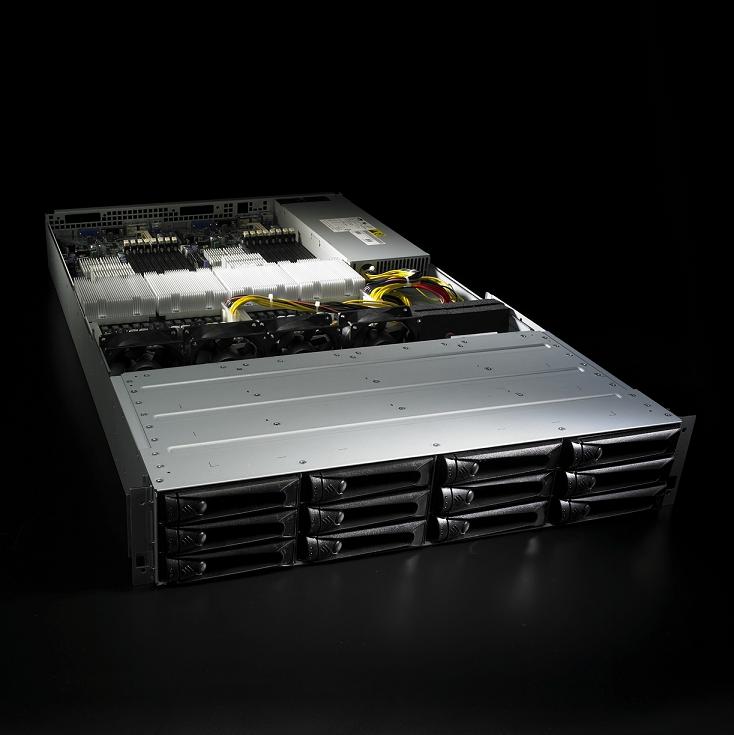
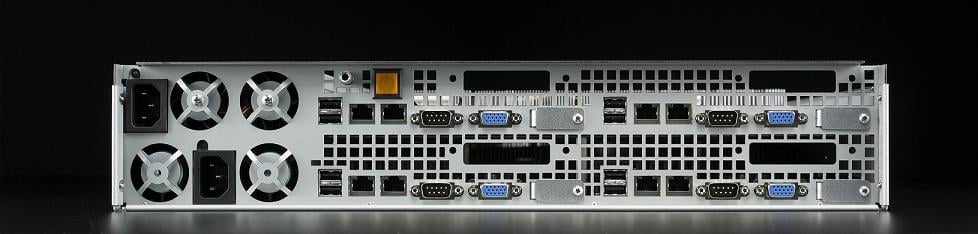
The XS23 squeezes 4 two-socket servers (in a 2X2 stack) in a 2U chassis along with twelve 3.5 inch SAS/SATA drives across the front of the system. It was designed for a search company, which we believe was Ask.com.

As we understand it, the disk to DIMM count was very important for this search customer, who wanted three drives for every server. This design was enough for the unnamed customer to buy tens of thousands of systems, according to our source.

The Dell system consumes 25 per cent less space than your general purpose blades, which do about 16 two-socket servers in 10U. Dell, of course, stripped out the redundant power supplies and fans to get that density, but these cloud folks have software that can deal with failures just fine.

We even managed to obtain a couple photos of the XS23. The big daddy shots are here and here.

One of the most valuable lists would be Microsoft's data center equipment RFPs and the equipment they chose, but don't hold your breath waiting for Microsoft to make this publicly available. It would be a PR disaster with almost every Server OEM screaming. 

Read more