Modular Data Center Cooling Plant – McQuay & TAS

Mission Critical had a post on Modular Cooling plants. The post is written by a McQuay employee, so of course it discusses their equipment.

water-cooled chiller <br>

The modular central plant combines a water-cooled chiller with pumps, cooling tower and interconnected piping.

Since June 2007, a total of six Modular Central Plants have provided chilled water to 59 computer room air conditioning units in the 52,500 square foot data center. Each of the modules consists of a 500-ton centrifugal compressor water chiller pre-engineered and pre-assembled with pumps, piping, cooling tower, control panel and associated water treatment system.


Kirchner’s original goal of increased cooling capacity to meet Herakles Data’s projected growth was not only achieved, but also surpassed. “We provide N+1 business solutions for our customers, meaning we meet their needs plus provide redundancy,” he said. “Today, however, we have surpassed that goal because we typically run only two of the four original modular central plants. That results in 2N cooling capacity today available to our data center customers.”


In addition to fast-track construction and commissioning, the new central plants resulted in impressive energy savings compared to the old system. “Our old system used 3,600 kilowatt-hourwatt-hour (kWh)h/ton a day; the new system uses 2,800 kWh/ton a day for a 22 percent reduction in energy,” Stancil said. That reduced energy usage earned Herakles Data a $50,000 rebate from the Sacramento Municipal Utility District.
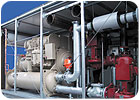
Another alternative is TAS’s system.

Chilled Water Comfort Cooling Systems

TAS designs, manufactures, installs / commissions and services modular chilled water plants.  Standard product designs range from 200 to 8000 tons for individual units.  TAS' highly engineered chilled water plants are designed to facilitate ease of installation and maintenance.  TAS takes a holistic systems approach to standard product design.  We engineer our chilled water systems for optimized efficiency performance and since we are a single source provider from design to commissioning, we guarantee efficiency performance at system commissioning.

Chilled Water PlantProduct scope includes all components normally found in a chilled water plant.  Key components include chillers, chilled water pumps, condenser water pumps, MCCs, digital controls, full enclosure, cooling tower and cooling tower support structure.  TAS manufactures its chilled water systems in an ISO 9001:2000 quality process factory environment.  Given our ability to control all facets of product manufacture and mitigate project schedule risk, such as weather delays and skilled labor shortages, TAS is able to guarantee delivery schedule with LDs (liquidated damages) for non-performance.

Given the economic environment to cut costs, every data center operator should evaluate a modular cooling system as alternative.

Read more

Gartner’s Green Data Centre Press Release

Gartner has a press release on Green Data Centre.

It’s good to hear Gartner is thinking beyond power.

Gartner Says a Green Data Centre Means More than Energy Efficiency
Analysts to Examine the Concept of the Data Centre as a Living Organism at Gartner's Data Center Summit 2008, 21-23 October in Amsterdam, Netherlands

Egham, UK, October 20, 2008 —

Power and cooling will drive the evolution of data centres into becoming conceptual models of intelligent “living organisms” as organisations need to improve energy efficiency and become ‘greener’, according to Gartner, Inc. 
“If ‘greening’ the data centre is the goal, power efficiency is the starting point but not sufficient on its own,” said Rakesh Kumar, vice president at Gartner.  “’Green’ requires an end-to-end, integrated view of the data centre, including the building, energy efficiency, waste management, asset management, capacity management, technology architecture, support services, energy sources and operations.”

Then they go on to discuss Ideas I put in my Living Data Center post.

“Data centre managers need to think differently about their data centres.  Tomorrow’s data centre is moving from being static to becoming a living organism, where modelling and measuring tools will become one of the major elements of its management,” said Mr Kumar. “It will be dynamic and address a variety of technical, financial and environmental demands, and modular to respond quickly to demands for floor space.  In addition, it will need to have some degree of flexibility, to run workloads where energy is cheapest and above all be highly-available, with 99.999 per cent availability.”

They make 6 points.

Achieving an optimised, reliable and efficient data centre environment requires a holistic and integrated approach, which can be broken down into six stages:
1. Pick the location according to a strategic facility strategy.  High-bay, warehouse-type buildings provide more efficient rack layout and airflow
2. Develop the site on a modular basis
3. Include chillers and high-ventilation air conditioning units (HVACS).  Build all new large facilities with chilled fluid plumbing at the outset
4. Introduce some recycling and alternative energy sources
5. Put in monitoring tools
6. Manage the server efficiencies.  Move away from the ‘always on’ mentality and look at powering equipment down

and, promote their Gartner Data Center Summit on Oct 21 – 23.

No surprises in this press release, nothing really revolutionary.  Just common sense when you think about the problems.

Read more

Not a Bogus Green Data Center Initiative, says Intel

Intel’s Brently Davis, manager of Intel’s data center efficiency project is quoted in Baseline Magazine.

This isn’t some bogus green data center initiative, executives say. This is an efficiency exercise that saves the green that matters most in these tough economic times.

“Our main concern is not about being green,” says Brently Davis, manager of Intel’s data center efficiency project. “It is more so about being efficient, figuring out how we can run our computing environment better.

The problems Intel face are the same as any company.

Intel developed Davis’ group within its IT operations department just so it could tackle such issues. “You’ve always got to pull people in to help look horizontally,” he says. “A lot of times, the focus of IT groups is myopic: They like to concentrate on their own vertical. But you’ve got to have a horizontal overview, and I think that’s what we try to help them do.”

Their solution was to get finance people on board.

One of the first things that Davis did to make that happen was to bring in the financial folks to get a clear picture of spending beyond the overarching price tag—to see where the dollars were going. That’s the key step in any efficiency project, he says.

“You can’t do this if you don’t understand what you’re spending,” Davis says. “We brought in our finance team and said, ‘Pull all of this stuff together so we can figure out what we’re spending. Put these numbers together, get it validated and make sure it makes sense.’”

Intel reconciles issues with standardization.

Standardization Begets Better Utilization

With the business case laid out and the “but why-ers” on board, Intel is now putting all the logistical puzzles into place. The first step has been to work on standardizing the environments and practices to reduce redundancies and improve the way all the data centers work together. Because, as Davis says, when Intel surveyed the data center landscape in 2006, it had 150 centers and “there was no synergy to anything; we were all over the place.”

And executes with specific goals.

This was enabled through a number of strategies, including virtualization, grid computing and cloud computing. And it was coupled with efforts to do a better job refreshing servers—replacing them with fewer servers along the way.

Before the program started, Davis reported that by 2014, Intel was on track to move up from 90,000 servers to 225,000 servers. The goal, he says, is to keep that number at 100,000 in six years’ time and reduce the cost and power draw of each of these servers significantly.

“The only way we could do that was by getting off the old hardware,” he recalls. “We were just as guilty as everyone else. We were sitting on servers that were possibly seven or eight years old. We needed to start refreshing those servers to reduce the power consumption in the data center.”

Read more

Australia Gov’t To Consolidate 130 Data Centres to 2

Australia IT has an article about NSW gov’t project to consolidate 130 data centres to 2 facilities.

NSW plans data-centre revamp

Fran Foo | October 21, 2008

THE NSW Government has decided to consolidate its 130 data centres into two facilities in a bid to put a lid on maintenance costs and energy consumption, according to the state's chief information officer Emmanuel Rodriguez.

The rationalisation was expected to be completed in 2021, with the Departments of Health and Education as anchor tenants, he said.
The procurement process will kick-off at the end of next year, with work set to begin in mid-2011.
"We have 130 data centres and counting and migration will probably take about 10 years because there are many factors to consider including energy requirements," Mr Rodriguez said.

Creating green data centers is a top priority.

Ms Tebutt was also the NSW Minister for Climate Change and the Environment, a boon for the state's data-centre rationalisation initiative, Mr Rodriguez said.


"We're going to push the green agenda as far as we can," he said.

"At the moment there are fragmented facilities housing these data centres," he said.
"Consolidation will deliver more up-to-date facilities, and increase efficiency, security and ultimately consume less power."

Part of the problem for Australia though is the vast majority of power comes from coal. Australia has the largest Uranium deposits in the world, but is nuclear free as a country.  Solar is difficult due to dust deposits.  And, wind power generation is far from the consumption.

Apart from an approved site in Sydney, TRE's proposal to build a $2 billion, 130,000sqm gas-powered data centre facility across two sites in Hume and Belconnen is still awaiting approval from the ACT's development and environment authorities.

Read more

Sun’s Software Labs Has a PUE of 1.28

I had blogged before about Sun’s Modular Data Center.

What I missed was their entry on page 15 of the document where  Sun discussed how they consolidate 32 different server labs into one space and achieve a a PUE of 1.28.

Efficiency in Sun’s Santa Clara Software Datacenter
In 2007 Sun completed the largest real-estate consolidation in its history. We closed our Newark, California campus as well as the majority of our Sunnyvale, California campus shedding 1.8 million ft2 (167,000 m2)from our real-estate portfolio. One example in this consolidation is the Software organization’s datacenter, where 32,000 ft2 (2,973 m2)of space distributed across 32 different rooms was consolidated into one 12,769 ft2 (1,186 m2) datacenter. In the end, 405 racks were configured in this space, using an average of 31.5 ft2 (2.9 m2) per rack. The initial power budget was 2 MW (out of 9 MW overall), with the ability to expand to 4 MW in the future. This design supports today's current average of 5 kW with the ability to grow to 9 kW average per rack. Keep in mind that even though the averages are 5 kW and 9 kW, racks ranging from 1 kW to 30 kW can be deployed anywhere in this datacenter.


We measured the power usage effectiveness of the Santa Clara Software organization’s datacenter, and if any single number testifies to the value of our modular design approach, it is the PUE of 1.28 that we were able to achieve. By using our modular approach, which includes using a high-efficiency variable primary-loop chiller plant, close-coupled cooling, efficient transformers, and high-efficiency UPS, an astonishing 78 percent of incoming power goes to the datacenter’s IT equipment.
Figure 4. Our Santa Clara Software organization’s datacenter achieved a PUE of 1.28, which translates to a savings of $402,652 per year compared to a target datacenter built to a PUE of 2.0.

image


In traditional raised floor datacenters the efficiencies worsen as densities increase. Our Pod design is efficient from day one, and remains efficient regardless of density increases.

Even though Sun compares its savings to a PUE of 2.0.  Most likely the PUE was over 2.0 given the 32 labs were scattered in conventional office spaces, not in a data center.


Note that the Santa Clara datacenter is a Tier 1 facility, by choice, with only 20 percent of the equipment on UPS. Choosing Tier 1 was a corporate decision to match the datacenter with the functions that it supports. The design approach is the same for our Tier 3 datacenters with one exception: the amount of redundancy. As you increase the redundancy (to N+1 or 2N) you can lose efficiency. If you make the correct product and
IT LoadChiller PlantRC/CRAC LoadsUPS/Transformer LossLighting78.57% PUE=1.28
16 The Range of Datacenter Requirements Sun Microsystems, Inc.
design decisions that make efficiency the highest priority, you can maintain a PUE of 1.6 or less in a Tier 3 datacenter.

Read more