YaWho? Is this end of Yahoo?

Yahoo’s CEO Yang steps down.

Hitting the reset button
"I think it's the right move for the company," said Eric Jackson, an activist Yahoo shareholder who has pressured the company for big changes. However, he added, "It's really too little too late. This is a board failure more than it is Jerry's failure. These problems have been around at Yahoo for well over two years now."

Who will benefit most from Yahoo’s failure?  Microsoft or Google?  If Google gains the most market share though, watch for the DOJ to become more focused on Google as a monopoly.

At some point someone is going to move into Yahoo’s Purple data center in Eastern Washington.  I wonder if the new tenants will want the building painted.

big_quincyexterior.jpg

Read more

HyperPUE, Maximizing Data Center Efficiency

I ran into Google’s Christopher Malone at Data Center Dynamics London.  I was surprised to see Christopher come all the way from Mountain View, CA to London.  I just ran across a term that may describe Christopher’s behavior.  New Oxford American Dictionary’s word of the year is HyperMiling.

Hypermiling is a term used in North America that refers to a set of techniques used to maximize fuel economy. Those who practice the techniques are referred to as "hypermilers." The term was originally coined by Wayne Gerdes, who is considered by the media to be one of the top hypermilers in the world,[1] and is known to hold the record for gas mileage in some common vehicles, including 30 miles per gallon (mpg) in an Acura MDX and 59 mpg in a Honda Accord.[2] In 2008, the word hypermiling was selected as the word of the year by New Oxford American Dictionary.[3]

Hypermiling, which can be practiced in any vehicle regardless of its fuel economy, has gained in popularity as a result of the rise in gasoline prices during the 2000s.[4] While common techniques can be carried out by average motorists making minor changes in their driving habits, some expert hypermilers use more advanced techniques, some of which may be illegal in some jurisdictions.[5]

With all the hype from PUE, HyperPUEing seems like a new term that could describe those set of techniques used to maximize data center efficiency.

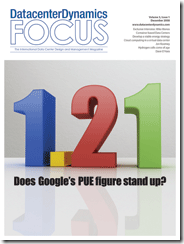
DataCenterDynamics even chose to make Google’s PUE 1.21 its cover page to launch its new data center magazine.

image

A few people I can think of in the HyperPUE club are Microsoft’s Mike Manos & Christian Belady, Lee Technologies’s Lee Kirby, Google’s Christopher Malone, Skanska’s Robert Bellatoni, and OSIsoft’s Martin Otterson,

Are you a HyperPUEing?

Stephen Worn – add this to the list of sessions for a future DataCenterDynamics.

Read more

Side Benefit of Monitoring Obsession, Guaranteed to Pass Auto Emissions Test

I just got back from Data Centre Dynamics London, and I have tons of posts and observations from the conference I need to write up.  One of the things I figured out watching OSIsoft’s Martin Otterson and Iberdola’s Miguel Chavero present on

Command & Control
Connecting the Dots in Data Centre Automation (DCA): Controlling the building and integrating IT systems
Martin Otterson - OSIsoft
Miguel Chavero – Iberdrola

is few people are driven almost to an obsession to monitor systems. As all of you know monitoring a data center is no easy task.  Even though the group of people came to the session to hear Martin and Miguel discuss data center monitoring it was amazing how few people had monitoring in place.  I think I am hanging out with too many people who take for granted using PUE as one of their tools to measure data center efficiency.

One guy who stuck around to ask questions was from http://www.syska.com/, but otherwise it seemed like users want the monitoring, but it is too hard to add instrumentation/monitoring after the fact.  Could you imagine how hard it would be to add the equivalent of the Prius hybrid monitoring system after the fact.  Isn’t it more cost effective to have monitoring built in as part of construction?  Of course yes.  This is what Google and Microsoft do, but why don’t others make monitoring part of their RFP?

I had previously mentioned the auto monitoring device scan gauge in a post, and decided to buy one as neither of my cars have a MPG gauge.  After 3 weeks of using the device it gave me better information about my cars that typically only the mechanics get to.

I needed to take my car into local Washington State Emissions test site for an emissions test.  I was standing in the safety area waiting, and the technician was taking a long time, then I realized he was having a hard time finding the OBD connector.

On-Board Diagnostics, or OBD, in an automotive context, is a generic term referring to a vehicle's self-diagnostic and reporting capability. OBD systems give the vehicle owner or a repair technician access to state of health information for various vehicle sub-systems. The amount of diagnostic information available via OBD has varied widely since the introduction in the early 1980s of on-board vehicle computers, which made OBD possible. Early instances of OBD would simply illuminate a malfunction indicator light, or MIL, if a problem was detected—but would not provide any information as to the nature of the problem. Modern OBD implementations use a standardized fast digital communications port to provide realtime data in addition to a standardized series of diagnostic trouble codes, or DTCs, which allow one to rapidly identify and remedy malfunctions within the vehicle.

I told him he needed to unplug the scan gauge and then he could plug in his test equipment.  He asked what it was and what it did.  He said, “it’s too bad more people don’t have devices like this.” He’s seen people drive for 18 months with engine codes blinking and they don’t get their car fixed as they don’t know what the blinking light means, and their car will have a higher probability of failing the emissions test. At the end of the test, he continues “you pass of course, as you know everything is working.”

I used a similar device to figure out the evaporative fuel system had caused the check engine light to go on in my wife’s car.  Talked to our car mechanic, and he suggested trying to tighten the fuel cap.  Ridiculously simple to fix with the right tool.

Just like a car has built in instrumentation, data centers need to have built in instrumentation.  Slowly more and more people are starting to get this, and the good thing is some of my friends are getting permissions from customers to tell their stories.

Read more

Another Choice for Nuclear Reactor Data Center

DataCenterKnowledge has another alternative for nuclear power.

Are Nuclear Powered Data Centers Possible?

November 14th, 2008 : Rich Miller

A New Mexico company has announced plans to begin selling compact nuclear power “modules” for commercial use, which are projected to generate about 27 megawatts of energy. The announcement by Hyperion Power Generation of Santa Fe has prompted some tech watchers to wonder whether these mini-nuke installations could be a workable solution for the data center industry.

Hyperion licensed the original reactor design from Los Alamos National Laboratory (LANL). The Hyperion Power Module is a hydride reactor that is approximately the size of a hot tub and can drive a steam turbine for seven to 10 years. The reactor uses a uranium hydride core, surrounded by hydrogen gas, and the fuel is not enriched to weapons-grade, meaning it can’t be used for building a nuclear device.

I blogged about this idea before, and I waiting for when there is a data center that chooses a small nuclear power plant.  Right now some companies are evaluating new power plants for remote locations as power generation is limited in many markets.  Why not nuclear.

One alternative to the not in my backyard problem for nuclear plants is to float the nuclear plant offshore.

Russia is already building floating nuclear power plants for Arctic operations.

Given that we are already supposed to be facing the twin threats of terrorism and environmental meltdown, you might think the last thing the world needs is a fleet of floating nuclear power plants (NPPs). Russia disagrees, and confirmed this week that construction has started on the first of seven ships carrying a 70MW nuclear reactor. The ships will provide power to remote coastal towns, or be sold abroad, with 12 countries, including Algeria and Indonesia, said to have expressed interest.

Read more

Embodiment Living Data Centers, The Future of Data Center Design

Microsoft James Hamilton has a post about Butler Lampson, The Uses of Computers: What's Past is Merely Prologue -- Butler Lampson

Butler Lampson, one of the founding members of Xerox PARC, Turing award winner, and one of the most practical engineering thinkers I know spoke a couple of days ago at the Computing in the 21st Century Conference in Beijing. My rough notes from Butler’s talk follow. Overall Butler argues that “embodiment” is the next big phase of computing after simulation and communications. Butler defines embodiment as computers interacting directly with the physical world. For example, autonomously driven vehicles. Butler argues that this class of applications are only possible now due to the rapidly falling price of computing coupled with systems capabilities driven by Moore’s law.

Embodiment is something I think can also describe where data center design is going, “interacting directly with the physical world.”  Data center design in the past isolated itself from the physical which made it environmentally and financially expensive.  The future of data centers are designed for the site and to reduce its impact on the environment, while reducing its financial costs at the same time.  As Google, Microsoft and many other data center operators focus more on the environmental impact of their data centers, embodiment as a concept works for what they are striving to build.

This is a sustainable future which will have pressures from various areas. One of the top pressures is going to come from ISO 26000.  The ISO 26000 standard should:

  • assist organizations in addressing their social responsibilities while respecting cultural, societal, environmental and legal differences and economic development conditions;
  • provide practical guidance related to operationalizing social responsibility, identifying and engaging with stakeholders, and enhancing credibility of reports and claims made about social responsibility;
  • emphasise performance results and improvement;
  • increase confidence and satisfaction in organizations among their customers and other stakeholders;
  • I’ve written about Skanka’s efforts in Living Data Center, and here is another little know fact. A Skanska employee is co-chair of the ISO 26000 standard along with a Petrobas employee.  Sweden represents the developed countries and Brazil is the developing countries.

    Awareness of how ISO 26000 will change social responsibility ahead of the competition. If you agree with this, you need to think about who can build a Living Data Center, an embodiment data center that interacts directly with the physical world.

    Read more