NYTimes Data Center Story, Breaking The Rules

I had some friends check out DataCenterKnowledge’s post on a NYTimes feature article, “Data Center Overload” coming out this Sunday in the Magazine.  Rich Miller has a great quote from the article.

Trying to chart the cloud’s geography can be daunting, a task that is further complicated by security concerns. “It’s like ‘Fight Club,’ ” says Rich Miller, whose Web site, Data Center Knowledge, tracks the industry. “The first rule of data centers is: Don’t talk about data centers.”

image

The above is from a slide show.

This article must have been in the works for a while as Mike Manos is in the article as a Microsoft employee and “Manos” show up 9 times in the article.

As I pulled up to it in a Prius with Michael Manos, who was then Microsoft’s general manager of data-center services, he observed that while “most people wouldn’t be able to tell this wasn’t just a giant warehouse,” an experienced eye could discern revelatory details. “You would notice the plethora of cameras,” he said. “You could follow the power lines.” He gestured to a series of fluted silver pipes along one wall. “Those are chimney stacks, which probably tells you there’s generators behind each of those stacks.” The generators, like the huge banks of U.P.S. (uninterruptible power supply) batteries, ward against surges and power failures to ensure that the data center always runs smoothly.

Google is mentioned 12 times.

Microsoft is mentioned 22 times.

Yahoo  - 3

Amazon - 4

Facebook – 13

Microsoft wins with the positiong battle, and has the last 2 paragraphs.

“Our perspective long term is: It’s not a building, it’s a piece of equipment,” says Daniel Costello, Microsoft’s director of data-center research, “and the enclosure is not there to protect human occupancy; it’s there to protect the equipment.”

From here, it is easy to imagine gradually doing away with the building itself, and its cooling requirements, which is, in part, what Microsoft is doing next, with its Gen 4 data center in Dublin. One section of the facility consists of a series of containers, essentially parked and stacked amid other modular equipment — with no roof or walls. It will use outside air for cooling. On our drive to Tukwila, Manos gestured to an electrical substation, a collection of transformers grouped behind a chain-link fence. “We’re at the beginning of the information utility,” he said. “The past is big monolithic buildings. The future looks more like a substation — the data center represents the information substation of tomorrow.”

Articles like this are exposing data centers and making it hard to abide by the rule - “The first rule of data centers is: Don’t talk about data centers.”

This is just the beginning of breaking the rules in data centers.
Read more

HP Proliant Z6000 G6, 28% Power Savings, 31% lighter - Higher Performance per Pound

When you look at HP’s new scale out servers ProLiant Z6000 G6.

image

you don’t see any fans or power supply. 

The module plugs into the power and cooling infrastructure

image

In this fact sheet.

Delivering unrestricted airflow through a shared power and cooling infrastructure in a 2U chassis lessens fan load, resulting in a 28 percent power decrease per server compared to traditional rack-based servers.(1)

and HP put the server on a scale

Removing up to 31 percent of weight per server and up to 838.5 tons of data center weight,(2) while reducing shipping as well as construction costs with a standardized, shared infrastructure.

the cabling’s been moved to front to improve access and airflow.

Reducing service and maintenance costs with front system cabling that allows easy access to key system components.

There are power sensors.

image

And air pressure sensors.

image

Read more

HP High Efficiency Cloud Infrastructure Servers, Moving Away from Blades, Learning from Data Center Operation

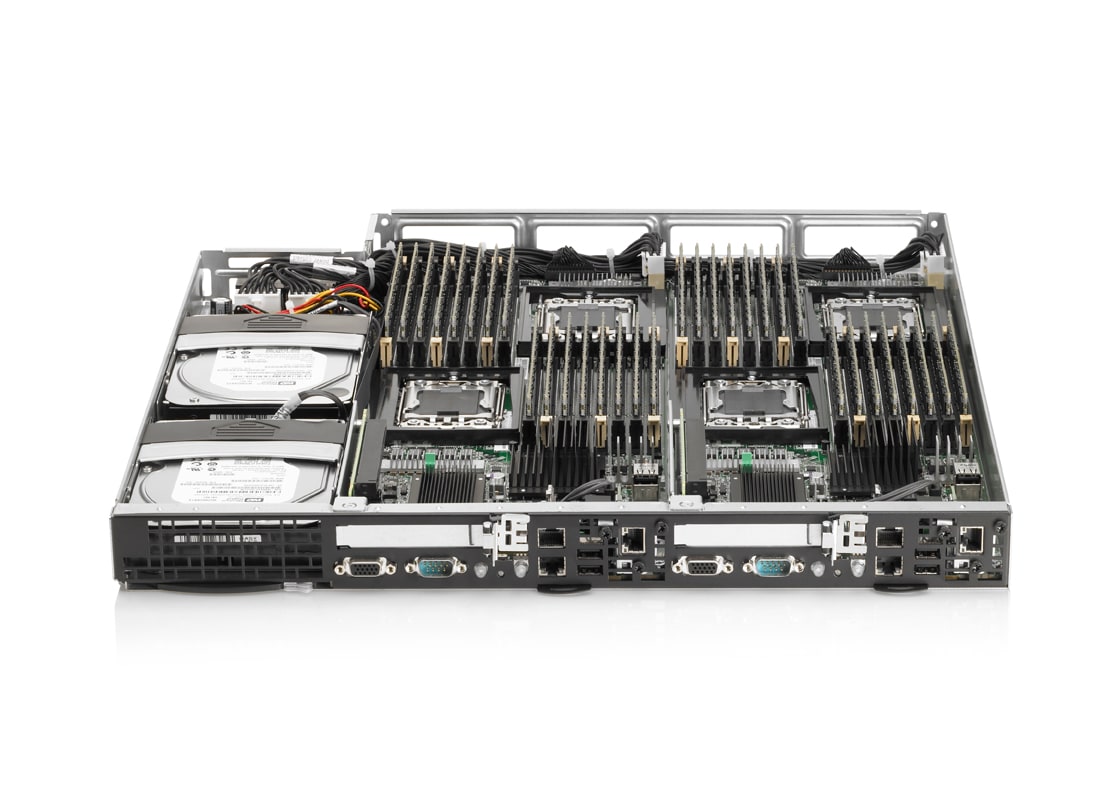
Notice how IBM, Dell, Rackable, and Dell’s high efficiency cloud infrastructure servers are not blade enclosures?  Maybe it’s because HP’s data center design group who creates solutions like this

image

are figuring out how inefficient blades are for Cloud Computing. Quoting HP’s press release.

With the HP ProLiant SL portfolio, customers can cut acquisition costs by 10 percent and power draw by 28 percent, while doubling their compute density.(2)

“Customers with scale-out business models need solutions that make every dollar, watt and square foot in the data center count,” said Christine Reischl, senior vice president and general manager, Industry Standard Servers, HP. “The HP ProLiant SL offers pioneering customers like these the most significant design innovation since the blade form factor, allowing them to achieve an economy of scale never before possible.”

And, HP includes an IDC quote.

“Businesses built on extreme scale-out environments, such as cloud, Web  2.0 and HPC, operate at maximum transaction volume and low margins,” said Michelle Bailey, research vice president, IDC. “These customers have very distinct and unique data center requirements, specifically around energy efficiency, cost and time to market. The introduction of technology solutions such as the ExSO portfolio from HP are specifically addressing customer requirements for optimizing capitol expenditures while lowering ongoing operating costs. As a result, these solutions are helping to redefine data center economics.”

The problem with blades is high density computing created hot spots with problems airflows.  But, this behavior to use blades was driven by chargeback models that used rackspace occupied.  Which artificially can bring down IT costs when in reality it increases costs. Just read the above quotes again, on how these latest servers are the most efficient.

Note in this picture how the removal of a Proliant SL is similiar to a what a blade removal picture would be.

image

One great thing about Sun, HP, Dell, and IBM all getting into the data center design business is these companies are learning what the impact is  of their hardware.

Wow think about this. For the first time many Server OEMs are building data centers to host their hardware, and they need to build hardware that works best in their data centers. Whoever can create the most efficient systems has a competitive advantage.

This is what Google does.

There is a new competition in data centers, and has a higher probability of a green data center.

Hey this will make a great white paper/presentation.

Read more

Little and Large, Extremes of Nehalem-EX vs. Via Nano, the Struggle for Power Efficiency

Just posted this blog entry with Adam Bogobowicz.

Little and Large

When you hear the phrase “green IT”, you know that the word virtualization will usually appear shortly afterwards. Virtualization provides the ability to consolidate your IT infrastructure from several physical computers (each of which has a basic power overhead) onto virtual computers running on significantly fewer host computers. The increase in power consumption for each virtual computer you run on the host is considerably less than the power overhead for each replaced physical computer.

http://www.intel.com/pressroom/archive/releases/20090526comp.htmAt this point, you can usually hear the sounds of hardware manufacturers rubbing their hands with glee. This enthusiasm results from the prevalent association that virtualization (and especially consolidation) requires multi-core processing capacity with associated power consumption rates. A good example of this type of hardware would be the recently announced Nehalem-EX processor from Intel. Everything is larger and more numerous on this chip when compared to the previous generation:

  • 8 cores
  • 9 times the memory bandwidth
  • 16 simultaneous threads
  • 24MB of cache
  • 2,300,000,000 transistors

If consolidation is the route you want to take and you have multiple physical computers to consolidate, then this processor would certainly be a good choice. But what if you see virtualization as an aid to manageability rather than consolidation and you want to conserve power?

O Fortuna

clip_image002[5]At the opposite end of the spectrum from Nehalem-EX systems is the diminutive Dell XS11-VX8, better known by its codename of “Fortuna.” If you are having trouble with the scale of this devices, that silvery part with the white label on the back of the server is the 3.5” hard disk. Yet this pocket-sized computer is no toy, but a true, enterprise-ready, 64-bit, hardware virtualization enabled, self-contained server with dual NICs and 2GB RAM that supports IPMI and iSCSI. The processor is the Via Nano, one of the most economical processors on the market with full hardware virtualization support for Hyper-V.

The post is a bit longer at http://blogs.msdn.com/the_power_of_software/archive/2009/06/08/little-and-large.aspx

Read more