Microsoft, Yahoo Close to Search Deal

WSJ reports that Microsoft and Yahoo are close to sealing a a search partnership to compete against Google.

Microsoft, Yahoo Near Search Deal

By JESSICA E. VASCELLARO and NICK WINGFIELD

Yahoo Inc. and Microsoft Corp. are moving toward sealing a search partnership, say people familiar with the matter -- a deal that ends a protracted dance and unites the pair against Google Inc.

Microsoft, which had made a failed $47.5 billion takeover bid for Yahoo, appears to have finally won a piece of what it wanted from the Internet player -- the volumes of search queries that run through Yahoo's engine.

Ballmer

In exchange, Yahoo is getting an opportunity to expand its own position in the market by remaining a force in search-advertising sales.

The agreement, which could be reached as soon as Wednesday but could be delayed, involves Yahoo agreeing to use Microsoft's Bing search engine on its own sites, these people say.

In a shift from earlier discussions, Yahoo would handle selling the text ads that appear next to the search results for its sites and some Microsoft sites, say these people.

The financial arrangement and terms under consideration couldn't be learned.

I wonder if the Yahoo folks who joined Microsoft’s data center group were used to help instill confidence at Yahoo in Microsoft’s data center infrastructure.

Read more

California Green Data Center, add a Stop to your Sonoma Wine Tour

At DataCenterDynamics SF, there were many people who planned a wine tour on the Saturday after the conference.  One stop that most missed though is a a stop at the Sonoma Mountain Data Center in Rohnert Park at HP/Taligent’s old site.

image

If you aren’t familiar with the Sonoma area here is a pdf map. The Sonoma Mountain Data Center (aka California Green Data Center) is located at the bottom of this map in Rohnert Park.

image

I had the pleasure of meeting Tod Stebbins who represents the California Green Data Center while at DCD SF, and I usually go to Healdsburg 3 – 4 times a year, so stopping off at Tod’s data center is easy to add to my next trip in October.

DataCenterKnowledge just posted more information on Tod’s data center as well with a large solar array installation.

Sonoma Project Features Large Solar Array

July 27th, 2009 : Rich Miller

sonoma-array

This 83,000 square foot solar array produces more than 1 megawatt of power for the Sonoma Mountain Village development.

The developers of Sonoma Mountain Village will dedicate more than 1 megawatt of solar power to a data center project at its Rohnert Park, Calif. campus, a sustainable mixed-use community combining offices, retail and housing. The Sonoma Mountain Data Center becomes the latest in a series of data center projects to incorporate on-site solar generation into their energy supply.

The first phase of the data center will be powered by an existing 83,000 square foot solar array, which has been online since 2006 and currently powers office buildings housing AT&T and Comcast. The building can switch between energy from the solar array and grid power from an on-site PG&E substation with 9 megawatts of capacity.

Read more

What is the First Greenpeace Data Center Target? Apple? Google? Microsoft?

Datacenterknowledge blogs on how quickly Apple is building its $1 billion dollar data center.

Apple Moving Quickly on NC Project

July 28th, 2009 : Rich Miller

apple-ncApple is known for keeping its new technology secret prior to launch. So it’s not surprising that the company has had little to say about its $1 billion data center project in North Carolina. The new iData Center may not get the fanfare of a MacWorld keynote when it launches, but one thing is clear: Apple plans to move quickly to the construction phase.

“It’s my understanding that they want to have bulldozers on-site in mid-August,” said Scott Millar, execurtive director of the Catawba County Economic Development Corp. “They’re moving ahead rapidly with permitting and acquiring the land, with the intent of hitting the ground running.”

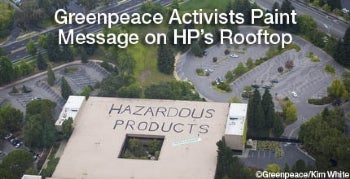
And, after writing my own blog entry on Greenpeace’s painting “Hazardous Products” on HP’s roof , the same PCWorld points out how successful Greenpeace has been in modifying Apple’s environmental position.

Greenpeace's aggressive tactics may turn off a lot of people, but they do get results. In 2006 the group launched an all-out PR war on Apple, which at the time was using PVC and BFRs in many of its products. Fast-forward to 2009, and Apple's new computer lines are virtually free of these toxic chemicals.

While Cupertino didn't exactly play nice with Greenpeace, there's little doubt the environmental group's constant badgering had an impact on Apple's green policy.

How can Greenpeace, not already have a plan in place to address Apple’s data center for its environmental impact?

Now, you could say Greenpeace why not go after Google or Microsoft?  Greenpeace could, but why haven’t they already.  It is not worth it for media coverage.  Going after Apple would get people’s attention.

If not Apple, who else makes sense to go after if you were Greenpeace?

Read more

A Different Environmental Roof, Greenpeace Paints “Hazardous” on HP’s Rooftop

We’re use to seeing solar panels put on rooftops for an environmental statement.  Greenpeace made their own environmental statement by painting “Hazardous Products” on  HP’s roof.

Greenpeace Paints 'Hazardous' on HP's Roof Over Toxics Use

Jeff Bertolucci, PC World

Jul 28, 2009 2:32 pm

Greenpeace Paints 'Hazardous' on HP Roof Over Toxics Use

Greenpeace, upset by what it calls Hewlett-Packard's "backtracking" on commitments to build greener tech gadgets, today sent a very large message to HP management.

Activists from the international environment group painted the message "Hazardous Products" on the rooftop of HP's global headquarters in Palo Alto, Calif. Greenpeace also sent automated phone calls from actor William Shatner (yes, Captain Kirk) to the company, urging it to phase out toxic chemicals in its products.

"Earlier this year, HP postponed its 2007 commitment to phase out dangerous substances such as brominated flame retardants (BFRs) and polyvinyl chloride (PVC) plastic from its computer products (excluding their server and printer lines) from 2009 to 2011," said Greenpeace in a statement.

A statement on HP's Website promises to phase out BFR and PVC in its personal computing products in 2011.

Read more

Searching for Renewable Energy Incentives

DataCenterKnowledge has a post on the DSIRE web site.

Database of Renewable Energy Incentives

July 23rd, 2009 : Rich Miller

dsire


Renewable energy is playing a larger role in data center site location, as companies seek to address energy efficiency goals and the prospect of federal carbon regulation. Sorting out the many incentive programs can be a lot of work, but is critical to assessing the economics of one state versus another.  

Where does this information come from?

The information on the DSIRE web site is based on the DSIRE staff’s analysis of statutes, enacted legislation, administrative rules, public utilities commission orders, executive orders, program guidelines, program web sites, and scores of newsletters and news digests. In addition, the DSIRE staff receives information from contacts at state energy offices, public utilities commissions and other government agencies; utilities; non-profit organizations; businesses; and the general public. The DSIRE staff proactively communicate with program administrators to verify or update incentives and policies currently included in DSIRE, and to obtain details and clarification of new incentives and policies.

Who is behind DSIRE?  Here is the about page.

Established in 1995, the Database of State Incentives for Renewables & Efficiency (DSIRE) is an ongoing project of the North Carolina Solar Center and the Interstate Renewable Energy Council (IREC). It is funded by the U.S. Department of Energy’s Office of Energy Efficiency and Renewable Energy (EERE), primarily through the Office of Planning, Budget and Analysis (PBA). The site is administered by the National Renewable Energy Laboratory (NREL), which is operated for DOE by the Alliance for Sustainable Energy, LLC.

NC Solar Center Logo
The N.C. Solar Center serves as a clearinghouse for solar and other renewable energy programs, information, research, technical assistance, and training for the citizens of North Carolina and beyond. Through its programs and services, the N.C. Solar Center seeks to stabilize energy costs for consumers, stimulate local economies, reduce dependence on foreign fuels, and mitigate the environmental impacts associated with fossil fuels. Established in 1988, the N.C. Solar Center is operated by N.C. State University’s College of Engineering at North Carolina State University.

IREC Logo
IREC’s mission is to accelerate the use of renewable energy sources and technologies in and through state and local government and community activities. Formed in 1980, IREC supports market-oriented services targeted at education, coordination, procurement, the adoption and implementation of uniform guidelines and standards, and consumer protection. IREC’s members include state and local government agencies, national laboratories, solar and renewable organizations and companies, and individuals.

EERE Logo
EERE’s mission is to strengthen America’s energy security, environmental quality and economic vitality in public-private partnerships that enhance energy efficiency and productivity; bring clean, reliable and affordable energy technologies to the marketplace; and make a difference in the everyday lives of Americans by enhancing their energy choices and their quality of life.

NREL Logo
NREL is DOE’s primary national laboratory for developing renewable energy and energy efficiency technologies and practices, advancing related science and engineering, and transferring knowledge and innovations to address the nation's energy and environmental goals.

The Search page allows you to look for specific areas.

image

Read more