IBM opens Green Innovation Data Center for tours

news.com has an article on IBM’s new Green Innovation Data Center.  Customers can now add this to a choice of HP’s Dynamic Smart Cooling solution.

IBM data center gets deep energy retrofit

by Martin LaMonica

SOUTHBURY, Conn.--IBM's "green" data center here is kind of like a techie version of the "This Old House" television show. But in this case, the project was to build a showcase for energy-efficiency computing, rather than construct a new addition for a suburban home.

IBM's main problem was data center sprawl. Five years ago, internal IT staff could barely keep up with growing demand for computing resources from employees, causing an expansion from one data center location to four--a situation that was costly and inefficient.

Now, those four data centers have been consolidated into a single spot with the latest in energy-efficient tech gear, including a network of 200 sensors and water-cooled servers. It also uses what are considered the best practices for physically laying out a data center, with close attention to everything from cabling to air flow.

The news.com article has a variety of pictures, most not really that interesting.  Here is a picture of the Automated Logic control panel which integrates with a beta IBM Tivoli energy management system.

DSC_0231_540x502.JPG (540×502)

IBM is a big believer in water cooling.

To lighten the overall cooling load, IBM is using its Cool Blue liquid-cooling systems, which fit onto the back of server racks. These heat exchangers cool the hot air coming from servers' fans by circulating cold water through coils, which absorb the server heat and then are cooled using the building's chiller.

I wonder how many IBM plumbers you get with a service engagement?

Side car prototype

A look at the under-floor controls for the water-cooling system, which is monitored for flow and temperature. The water is cooled by the building's chiller, but IBM set up a local loop of the water so that it can serve individual server racks, a way to improve the overall efficiency.

Water controls

It is interesting to see others who are trying to get rid of this complexity in the data center, and increase temperatures.

Read more

Data Center Construction Competition – DLR, MSFT, GOOG, AMZN – The Winner is?

Data center construction is a competitive business and we hear lots about the top companies – Digital Realty Trust (DLR), Microsoft (MSFT), Google (GOOG), and Amazon (AMZN). 

Who is winning?

Well if you want to judge based on stock price over the the last 5 years.  Check out this stock performance chart.  It looks like Digital Realty Trust (DLR)

image

It is interesting to wonder what would have happened if MSFT, GOOG, and AMZN were just in the data center business like DLR.

Also, keep in mind DLR is an REIT, and pays out its profits as dividends and has a 3.20% yield.

Read more

ARM pushes Performance per Watt, Announces 2Ghz Multicore Designs

news.com has a post on ARM’s new processor announcement.

ARM eyes Intel turf with 2GHz multicore designs

by Rupert Goodwins

Cambridge, England-based chip company ARM on Wednesday announced the development of dual-core, quad-core, and eight-core Cortex A9 processor designs, explicitly aimed at markets currently served by Intel's x86 chips and IBM's PowerPC.

"This is a huge departure from what we've done in the past", Eric Schorn, vice president of marketing for ARM's processor division, told ZDNet UK. "We really wanted to take off the handcuffs and see what could be done with performance, performance, performance."

The new designs, available in two variants optimized for low power consumption or high performance, are intended for use by companies building their own chips. ARM claims that the new processors, which can run at up to 2GHz, are up to eight times more efficient than Intel's low-power chips in terms of performance per watt, with the high-performance part running at five times the throughput of Intel's Atom chip for similar power levels.

The low-power part delivers twice the performance at a quarter the power, according to the company's published benchmarks.

A technical demonstration of an ARM server is running here.

This website runs on experimental ARM based servers based around the Marvell MV78100 SoC.

Each server blade has:

  • a single MV78100
  • 1 x 2.5inch 7400rpm SATA HDD
  • 1.5GBytes of DDR 2 RAM
7 of the these server blades are mounted into a custom built single rack with one 240VAC to 12VDC PSU to power all seven blades.

There is no forced cooling in the system.

The site runs an nginx web proxy / load balancer and apache, with mod_perl.

The OS is the ARM port of Debian Lenny.

The board is monitored by an ARM mbed prototype energy monitoring and control board. The counter in the footer of the site makes a crude estimate of the energy consumed while rendering each page.

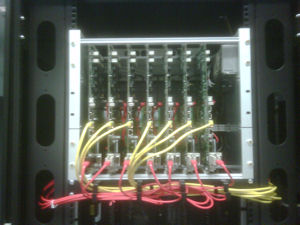
Rack of ARM based servers

If you wonder if any of the data center folks are paying attention, here is Amazon’s James Hamilton post.

The ARM is a clear win on work done per dollar and work done per joule for some workloads. If a 4-core, cache coherent version was available with a reasonable memory controller, we would have a very nice server processor with record breaking power consumption numbers.

I got a call from ARM soon after posting saying that I may get my wish sooner than I was guessing. Very cool. The Design that was announced earlier today includes a 2-core, performance optimized design that could form the building block of a very nice server. In the following block diagram, ARM shows a pair of 2-core macros implementing a 4-way SMP:

The ARM reported performance results:

Read more

French Ask More to Life than Money? Create a Well-being Index

WSJ has an article featuring France’s President Nicolas Sarkozy announcing a well-being index.

For France, a Joie de Vivre Index

Sarkozy to Add New Indicators, Such as Well-Being, to Measure Economic Health

By DAVID GAUTHIER-VILLARS

PARIS -- Nicolas Sarkozy was elected president two years ago on a pledge to boost France's economic prosperity. Now he is suggesting a different way to measure that prosperity -- one that includes factors such as vacation time, health care and family relationships.

From now on, to gauge the economy's health, France will consider well-being in addition to the classic measure of gross domestic product, Mr. Sarkozy said Monday in a speech at the Sorbonne, part of the University of Paris.

View Full Image

France's President Nicolas Sarkozy

Michel Euler/Reuters

France's President Nicolas Sarkozy delivered a speech at the Sorbonne University in Paris on Monday.

The specifics suggested are:

Healthy and Wealthy

Nicolas Sarkozy is suggesting gauges of economic health encompass well-being in addition to GDP. Measures could include:

  • Employment levels
  • Health care
  • Vacation
  • Household assets and income
  • Consumption
  • Education

The strategy is driven by top economists.

In the speech presenting the findings of a committee headed by Nobel Prize-winning economist Joseph Stiglitz, the president said new measures are needed in the wake of the financial crisis, which was triggered by an overreliance on free-market principles. "If the market was the solution to all problems and was never wrong, then why are we in such a situation?" asked Mr. Sarkozy. "We need to change criteria."

And, sustainability is referenced as a reason for the change.

In the longer term, the panel said, governments must pay more attention to sustainability to determine what level of well-being can be maintained for future generations.

The green theme is mentioned in SFGate’s reference to Nobel-winning economist Joseph Stiglitz.

The Nobel-winning economist Joseph Stiglitz has authored an important new study proposing new, and ultimately more accurate, ways of measuring a country's wealth. Wikipedia Commons The very formulas for...

Economists just want you to be happy

Economists just want you to be happy

The Nobel-winning economist Joseph Stiglitz has authored an important new study proposing new, and ultimately more accurate, ways of measuring a country's wealth.

Wikipedia Commons

The very formulas for measuring growth and prosperity turn out to be biased such that environmental protections will always look like short-term caps on growth, when, ultimately long-term growth and survival depend on preserving our natural resources.


Read more

Conversation Between Facilities and IT, Lost in Translation

After listening to Mike Manos’s chiller side chat and writing a short blog post.  It got me thinking about  the passionate conversations I’ve listened to between data center facilities and IT, and part of the problem is captured in understanding “Lost in Translation

If you haven’t seen the movie, here is an explanation of a reoccurring theme.

The concept of "lost in translation" occurs throughout the film with a number of meanings.[1] Bob (Bill Murray), a Japanese director (Yutaka Tadokoro), and an interpreter (Takeshita) are on a set, filming the whiskey commercial. In several exchanges, the director speaks several long sentences with passion, followed by a brief, inadequate translation from the interpreter. The scene (like all the film's Japanese dialogue) is played without subtitles.

Director [in Japanese, to the interpreter]: The translation is very important, O.K.? The translation.
Interpreter [in Japanese, to the director]: Yes, of course. I understand.
Director [in Japanese, to Bob]: Mr. Bob. You are sitting quietly in your study. And then there is a bottle of Suntory whiskey on top of the table. You understand, right? With wholehearted feeling, slowly, look at the camera, tenderly, and as if you are meeting old friends, say the words. As if you are Bogie in Casablanca, saying, "Here's looking at you, kid," -- Suntory time!
Interpreter [In English, to Bob]: He wants you to turn, look in camera. O.K.?
Bob: Is that all he said?[2]

Now imagine you had an IT guy as the Director, going on and on about the needs for hosting new applications and hardware in the data center.  A facilities team listening to the IT guy, and the outside data center design team translating the needs of IT to data center specification.

Do you think something is lost in translation?

This is all kind of funny as I am Japanese American, have taken twenty trips to Tokyo working on multiple products with many Japanese companies.  And, other friends who have gone through the pain recognize the patterns and mistakes that cause a lost in translation.

Watching IT folks and data center folks communicate is entertaining as they don’t understand each other even though they are both speaking English.

There is a way to solve the problem, but it requires people who can think about knowledge modeling to continuously assess cross system opportunities for improvement and optimization based on the changing requirements and system capabilities.

There are some people who can do this and they’ll laugh at the connection between “Lost in Translation” and data center conversations between facilities and IT.

Read more