Pacific National Northwest Lab’s Electricity Infrastructure Operations Center

I wrote a blog entry about PNNL winning $89 DOE Grant.  I’ve had chances to visit PNNL, but my trips got cancelled at the last minute.

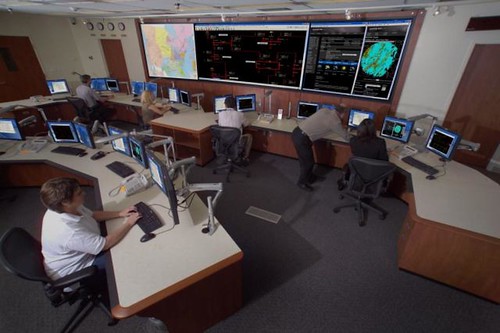
Curious I found the Electricity Infrastructure Operations Center.


What is the EIOC?

EIOC training room

The Electricity Infrastructure Operations Center (EIOC) at Pacific Northwest National Laboratory brings together industry-leading software, real-time grid data and advanced computation into a fully capable control room. Shaped with input from utilities, technology vendors and researchers across the Northwest, the EIOC serves as a unique platform for researching, developing and deploying technologies to better manage and control the grid. The new technologies developed here will be transferable across the industry and address the national need for a more reliable and effective electricity grid.

Addressing a Need

City skyline at night

Pacific Northwest National Laboratory researchers are exploring how changes in the way the nation's electrical grid is operated can improve its reliability, lower costs and lessen environmental impacts. The focus is on developing real-time tools and supporting their integration into operating systems. We recognize and understand the need for new tools that provide not only a better view of the current power grid, but also faster and more accurate predictions of what might be happening so operators can quickly respond.

Being geeky, I found the HPC efforts interesting.

Real-time simulations

Real-time operations platform graph
Figure 1. Integrated real-time operations platform for state estimation and grid simulation. Applying high-performance computing to power grid simulation enables real-time state estimation, faster-than-real-time dynamic simulation and dynamic contingency analysis. Click for a larger image.

At Pacific Northwest National Laboratory, we believe that traditional power grid algorithms can be reformulated and applied to high-performance computing platforms. Applying high-performance computing techniques and advanced computing hardware involves two major aspects: reformulation of power grid equations and parallelization of computational processes.

Power grid operations include many important functions. "State estimation" is central for driving other key functions, e.g., contingency analysis, optimal power flow and automatic generation control. State estimation typically receives telemetered data from the SCADA system every four seconds and extrapolates a full set of grid conditions for operators based on the grid's current configuration and a theoretically based engineering power flow solution.

Data Visualization

Visualization in Power

Visualization conveys complex information to system operators

Screenshot of Power Grid Visualization application
Force directed representation of the Western Power Grid. Click for a larger image.

Historically, the visualization of power system data has not kept pace with state-of-the-art visualization techniques. Work performed at Pacific Northwest National Laboratory's Electricity Infrastructure Operations Center (EIOC) leverages techniques and tools previously developed by the National Visualization and Analytics Center (NVAC), located at the Pacific Northwest National Laboratory, for applications not related to power systems. By collaborating with NVAC it has been possible to apply new technologies to power system applications with a significantly reduced lead time.

Read more

eBay Distinguished Architect understands impact data centers – location, monitoring, power

Was reading James Hamilton’s blog, and was curious to see if the enterprise architects are discussing data center issues, and I found one in eBay Distinguished Architect Randy Shoup’s presentation.

Lesson 7 – data center location

image

Lesson 9 – Monitor everything

image

And, the most surprising was in Lesson 10 – power (!)

image

Now few in audience probably caught these three impacts on data centers, but it is a good sign that enterprise architects think it is worthwhile to add these points to their presentations.

Read more

Pacific NW gets $89 mil of the $620 mil DOE Smart Grid grants

Pacific Northwest National Laboratory will manage the Pacific Northwest Smart Grid Demonstration project.

NW power grid project gets $89 million from DOE

A project to examine how high technology can improve the Pacific Northwest's electric power grid has received an $88.8 million grant from the U.S. Department of Energy.

By The Associated Press

RICHLAND — A project to examine how high technology can improve the Pacific Northwest's electric power grid has received an $88.8 million grant from the U.S. Department of Energy.

The money, to help pay for the $177.6 million Pacific Northwest Smart Grid Demonstration Project, was the largest among 32 grants DOE announced Tuesday as part of $620 million in stimulus aid.

The grant will go to Battelle Memorial Institute's Pacific Northwest National Laboratory in Richland, which will manage the project. The remainder of the project's cost will be borne by energy providers, utilities, technology companies and research organizations taking part.

Electricity Infrastructure Operations Center

Electricity Infrastructure Operations Center  by PNNL - Pacific Northwest National Laboratory.

The Electricity Infrastructure Operations Center at PNNL is a user-based facility dedicated to energy and hydropower research, operations training and back-up resources for energy utilities and industry groups.

Smart meters are part of the project.

Among those taking part in the project are the campuses of the University of Washington in Seattle and Washington State University in Pullman. At both schools, "smart meters" will be installed to provide real-time information on power consumption, along with software and other gear to automate and monitor the electricity distribution system.

I wonder if anyone has thought including the Pacific NW data centers in Washington and Oregon in the project?  Problem is almost all the big data center operators wouldn’t want the public to know the power consumption of their data centers.

I hope someone proves me wrong and signs up with PNNL.

Read more

Infiniband networking saves energy

If you are not familiar with the InfiniBand standard you should think about it as a way to save energy.

InfiniBand™ is an industry-standard specification that defines an input/output architecture used to interconnect servers, communications infrastructure equipment, storage and embedded systems. InfiniBand is a true fabric architecture that leverages switched, point-to-point channels with data transfers today at up to 120 gigabits per second, both in chassis backplane applications as well as through external copper and optical fiber connections.

InfiniBand™ has a robust roadmap defining increasing speeds through 2011 and 40 Gb/s InfiniBand™ products are shipping today.  The roadmap shows projected increased market demand for InfiniBand™ 1x EDR, 4x EDR, 8x EDR and 12x EDR beyond 2011, which translates to bandwidths nearing 1,000 Gb's in the next three years.

InfiniBand is a pervasive, low-latency, high-bandwidth interconnect which requires low processing overhead and is ideal to carry multiple traffic types (clustering, communications, storage, management) over a single connection. As a mature and field-proven technology, InfiniBand is used in thousands of data centers, high-performance compute clusters and embedded applications that scale from two nodes up to a single cluster that interconnect thousands of nodes.

How good is InfiniBand?  It is used in 18of the top 20 green super computers.

The TOP500 showed InfiniBand rising and connecting 182 systems (36 percent of the TOP500) and it clearly dominated the TOP10 through TOP300 systems. Half of the TOP10 systems are connected via InfiniBand and, although the new #1 system (JAGUAR from ORNL) is a Cray, it’s important to note that InfiniBand is being used as the storage interconnect to connect Jaguar to “Spider” storage systems.

But let’s talk efficiency for a moment… this edition of the TOP500 showed that 18 out of the 20 most efficient systems on the TOP500 used InfiniBand and that InfiniBand system efficiency levels reached up to 96 percent! That’s over 50 percent more efficiency than the best GigE cluster. Bottom line: WHEN PURCHASING NEW SYSTEMS, DON’T IGNORE THE NETWORK! You may be saving pennies on the network and spending dollars on the processors with an unbalanced architecture.

If you don’t have a supercomputer, then virtualized I/O is another area.

The StorageMojo take
Good to see Iband used as a big cheap pipe. Its low latency, cheap switch ports and high bandwidth make it the best choice for this application.

VMware and Hyper-V have serious I/O problems. Xsigo helps manage them.

Read more

Amazon.com data center Boardman, OR in local news

Leave it to the local news to publish a video of Amazon.com’s data center in Boardman, OR.

Amazon.com Builds Data Center in Boardman

Story Published: Nov 10, 2008 at 6:13 PM PST

By Molly Kelleher

Video

BOARDMAN - First an Amazon.com call center in came to Kennewick and now a data center is planned in Boardman.
Amazon is tapping into the Columbia Basin once again.
Back out in the corn fields, on a dirt road, a building is taking shape.
The Port of Morrow isn't allowed to say who's moving in to this 60 acre spot, but they can tell us a data center is being built out here in Boardman.
Oregon newspapers say, it's Amazon.com.

The news video is embedded below.

What I found interesting is how lean Amazon is in its data center construction and employment numbers.

The data center will bring in up to 200 construction jobs and once it's up and running, 20 people will work here full time.
And that's only phase one, there's also talks to adding two more centers just like this one.

WHIR says.

If all goes as planned, the $100-million site project will be completed in the third quarter of 2010, says Port of Morrow general manager Gary Neal.

The TV station recently shot footage of the Amazon site at the Port of Morrow, a 9,000-acre industrial park along the Columbia River that's about 160 miles east of Portland.

The 116,700-square-foot building is to be constructed over six phases, with two data centers to follow.

Here is a low res picture of the industrial park.

image

Read more