Avanade has a news release on a survey revealing the disconnect between IT and electricity use.
GLOBAL STUDY: MORE THAN HALF OF COMPANIES FAIL TO ACCOUNT FOR ENERGY COSTS IN IT BUDGETS Executives and IT decision-makers cite energy as a top cost in IT operations; Survey reveals disconnect in budgeting SEATTLE – March 31, 2010 – According to a recent survey commissioned by Avanade, a business technology services provider, there is a clear gap in energy policies within IT departments. Companies recognize energy as a top cost, but ultimately, more than half of respondents fail to account for energy costs when developing IT budgets.
Also, Avanade has a press release on customers interest in Microsoft Cloud Computing.
In 2009 Avanade engaged Kelton Research to conduct two global surveys on cloud computing – one in February 2009 and the other in September 2009. Between the first survey and the second, there was a 320 percent increase in executives and IT decision-makers reporting they are testing or planning to implement cloud computing technologies.
Makes me wonder how many enterprises are forgetting to account for the electricity bill as a cost savings for cloud computing.
There was recent news on system engineers being the best job in America.
1. Systems Engineer
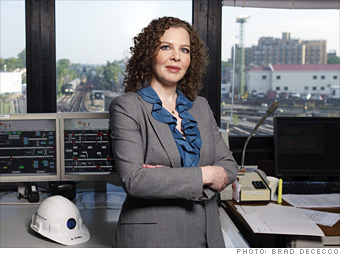
Anne O'Neil, a chief systems engineer at the N.Y.C. Transit Authority, is one of five female senior managers in a department of 1,500.
Top 50 rank: 1 Sector: Information Technology
What they do: They're the "big think" managers on large, complex projects, from major transportation networks to military defense programs. They figure out the technical specifications required and coordinate the efforts of lower-level engineers working on specific aspects of the project.
Why it's great: Demand is soaring for systems engineers, as what was once a niche job in the aerospace and defense industries becomes commonplace among a diverse and expanding universe of employers, from medical device makers to corporations like Xerox and BMW.
If you're a systems engineer who wonders whether you've chosen the right profession, I bring you good news.
But, what got me write a blog entry was Google's job post for Data Center system engineer.
The role: Data Center Control Systems Engineer
Data Center Control Systems Engineers possess demonstrated design, operation, and construction experience in the areas of complex and mission critical facilities. You will have extensive knowledge of large-scale facilities controls and monitoring systems for all infrastructural systems.
As the Data Center Control Systems Engineer, you have excellent communication skills and are able to work in teams and matrix organizations. You are expected to develop and maintain strong functional relationships across multidisciplinary teams to anticipate future controls and monitoring design requirements. You will be continuously involved in the improvement of plant performance based on historical data collected and collaborate on retrofit projects to improve plant efficiency based on business case justifications.
and on top of that there is a Data Center Strategic Negotiator job which fits as a business/technical person to work with the system engineer.
The role: Data Center Strategic Negotiator
As a Data Center Strategic Negotiator,you will lead a team to collect and analyze large sets of location data, execute extensive on-the-ground due diligence, and to ultimately lead negotiations in to develop comprehensive legal contracts for data centers, real estate, power, and networking services around the world, for both new and existing assets, of all sizes. You must have substantial knowledge of global markets, in-depth technical expertise, and strategic analytical skills, in addition to rock-solid negotiation and collaboration capabilities. All location strategy and site selection initiatives are team efforts spearheaded by the Global Infrastructure Group (“GIG”). You will need to be a flexible, proactive team player who understands and seeks to support the larger strategic initiatives of the company. You are a proven professional with a track record that matches our philosophy of leading by innovation, who has a detailed understanding of both the technological and the commercial sides of data centers, and who has the ability to deliver against aggressive deadlines with a driving passion for cost reduction and highly effective solutions.
The Data Center Strategic Negotiator will carry out the selection and negotiations process for new data centers from start to finish. You will have experience designing and executing large-scale international site selection initiatives; deep and broad transactional knowledge; strong technical negotiation skills in the areas of data centers; real estate leases, purchase agreements, and entitlements; energy and other utilities; telecommunications; and economic development incentives. Technical knowledge and experience negotiating collocation space, racks, power circuits, cross connects and remote hands in conventional data centers is preferred. You will be adept at strategizing, structuring, negotiating, and closing a range of mission critical transactions in diverse settings and with diverse parties.
I spent more time going through the Google job postings for Mtn View. Google is building teams I was used to working with at Apple developing hardware. But, Apple didn't have the system engineers above as data centers back when I worked there were just for enterprise applications.
It will be hard to discover what Google's data center system engineer and strategic negotiator do, but keep in mind, they are developing systems for the way Google operates as a business. Copying their actions could cause more problems than they solve unless you think of the whole system.
It is great to see that Google has reached a stage in maturity to identify system engineering and holistic system negotiation as keys to their continue growth and cost reduction. On the other hand the job for these people would have been much easier if they were hired 10 years ago as they now need to work with the momentum of dozens of groups who are entrenched.
The biggest challenge to doing the jobs above is whether you have the organizational skills to instill change in groups.
Why is it so hard to make lasting changes in our companies, in our communities, and in our own lives?
The primary obstacle is a conflict that’s built into our brains, say Chip and Dan Heath, authors of the critically acclaimed bestseller Made to Stick. Psychologists have discovered that our minds are ruled by two different systems—the rational mind and the emotional mind—that compete for control. The rational mind wants a great beach body; the emotional mind wants that Oreo cookie. The rational mind wants to change something at work; the emotional mind loves the comfort of the existing routine. This tension can doom a change effort—but if it is overcome, change can come quickly.
I blogged back in July 2009 asking what would be Greenpeace's target for environmental impact of data centers, speculating Apple, Google, Microsoft as a possible target. Well Greenpeace uses the Apple brand recognition and the iPad announcement to create awareness.
The announcement of Apple’s iPad has been much anticipated by a world with an ever-increasing appetite for mobile computing devices as a way to connect, interact, learn and work. As rumours circulated – first about its existence and then about its capabilities - the iPad received more media attention than any other gadget in recent memory. Apple Chief Executive Officer Steve Jobs finally showcased his company’s latest creation before a rapt audience in San Francisco. From their smart phones and netbooks, the crowd feverishly blogged and tweeted real time updates out to a curious world.
Whether you actually want an iPad or not, there is no doubt that it is a harbinger of things to come. The iPad relies upon cloud-based computing to stream video, download music and books, and fetch email. Already, millions access the ‘cloud’ to make use of online social networks, watch streaming video, check email and create documents, and store thousands of digital photos online on popular web-hosted sites like Flickr and Picasa.
The term cloud, or cloud computing, used as a metaphor for the internet, is based on an infrastructure and business model whereby - rather than being stored on your own device - data, entertainment, news and other products and services are delivered to your device, in real time, from the internet. The creation of the cloud has been a boon both to the companies hosting it and to consumers who now need nothing but a personal computer and internet access to fulfill most of their computing needs.
Greenpeace has been making noise about Facebook's data center, and now has started the public awareness in this pdf.
I know of some companies that have a sigh of relief they are not on the Greenpeace list.
Some of you have noticed I made a change last week to the blog title and now have Green (low carbon) data center.
Green is such an overloaded term it made sense to clarify a focus on discussing low carbon as a goal of a green data center. Note the following in the Greenpeace pdf.
More cloud-computing companies are pursuing design and siting strategies that can reduce the energy consumption of their data centres, primarily as a cost containment measure. For most companies, the environmental benefits of green data design are generally of secondary concern.
Facebook’s decision to build its own highly-efficient data centre in Oregon that will be substantially powered by coal-fired electricity clearly underscores the relative priority for many cloud companies. Increasing Key trends that will impact the environmental footprint of the cloud the energy efficiency of its servers and reducing the energy footprint of the infrastructure of data centres are clearly to be commended, but efficiency by itself is not green if you are simply working to maximise output from the cheapest and dirtiest energy source available. The US EPA will soon be expanding its EnergyStar rating system to apply to data centres, but similarly does not factor in the fuel source being used to power the data centre in its rating criteria. Unfortunately, as our collective demand for computing resources increases, even the most efficiently built data centres with the highest utilisation rates serve only to mitigate, rather than eliminate, harmful emissions.
Some people thought the hype about Facebook's coal power was a fad. No it is a trend and the start of evaluating the carbon impact of data centers.
By REUTERS SAN FRANCISCO (Reuters) - The 'cloud' of data which is becoming the heart of the Internet is creating an all too real cloud of pollution as ...
Data Center Knowledge - Rich Miller - 5 hours ago
The environmental group Greenpeace says data center builders must become part of the solution to the climate change challenge, rather than part of the ...
San Francisco, United States — As IT industry analysts label 2010 the “Year of the Cloud”, a new report by Greenpeace shows how the launch of quintessential ...
When I was visiting Mizzou last week, I was able to visit Clyde Bentley. Clyde writes a blog on Mobile Journalism and the conversation with Clyde was quite useful to build future discussions on mobile devices and its effect on information publishing.
Below is a video of Clyde discussing the change in journalism caused by Mobile Devices.
And, what got me thinking more was this post on AgileOperations.
Agile Operations is a concept which combines lean, low-cost service delivery with flexible, just-in-time response to business demands, helping you keep your department relevant and competitive with trendy low-cost solutions available outside the business. In a sort of technology judo, Agile Operations seeks to use the strengths of these alternatives against them, keeping the flexibility and the savings in house and under the control of the IT department without resorting to heavy-handed prohibitions and lock-down measures which simply serve to force users further and further from a state of trust and understanding with the CIO.
This post on AgileOperations and Mobile discusses the impact on IT departments.
The challenge to the IT department in this scenario is to provision and support users with these devices and solutions. This is a far different prospect than traditional IT provisioning and support, and many IT departments are having trouble keeping up. It's not the first time IT has had trouble staying on the same plane as users when new technologies emerge, but this time, the devices and the online solutions are sufficiently cheap that those users don't need the IT department to implement them. While IT has held the keys to the kingdom for many years, there is an increasing chance that the IT department will simply become irrelevant as users bypass it for easier, cheapers solutions. As this Wall Street Journal article outlines, that day is coming.
We have all been frustrated with IT departments who standardize the desktop and laptops we use to reduce IT costs. In Mobile, this is the strength of RIM's Blackberry server and the ability to manage the Blackberry device. But, the rest of the industry is moving so fast, and managed mobile devices are not a priority for many.
I had a blackberry curve last year and now have an iPhone 3GS. There is no way I would go back to a Blackberry device. If anything I would try a Google phone.
Maybe one of the most rapid innovations and growth for Mobile's is the fact they are not in control of many IT departments.
How many of you think you would have a better mobile experience if your IT department made your purchasing decision?
Feel sorry for all those blackberry users who have a choice of one. Unless you are an executive and you can get the more expensive Blackberry one with a touch screen. Ooohhh!!!!
Chef Dan Barber squares off with a dilemma facing many chefs today: how to keep fish on the menu. With impeccable research and deadpan humor, he chronicles his pursuit of a sustainable fish he could love, and the foodie's honeymoon he's enjoyed since discovering an outrageously delicious fish raised using a revolutionary farming method in Spain.
Here is a picture of the fish farm.
Which is different than a typical fish farm.
One of the best lines that gives you the method, the secret to success in the sustainable farm is the biologist isn't an expert in fish, but is an expert in relationships. If you go to time mark 8:10 you can listen to this.
Dan asks How did he become an expert on fish?
Fish?? I don't know anything about fish. I am an expert on relationships.
Why is this so important? Because the people who are doing the most innovative data center work understand the relationships of the site to the building to the IT equipment to the software and the services provided. This is what good system engineers know in mature industries. This is beyond the data center building with its power and cooling systems. The enlightened are looking at the energy supply chain with a focus on cost, carbon impact, and changes in the supply chain in the future. What is the future of services and applications that need to run on servers, storage, and networks. This is one damn hard problem to address as the silos in data center are powerful and entrenched in a companies organization and the rest of the industry.
I just came back from Missouri and got a chance to talk in more detail to the Civil Engineering company, Allstate Consulting who is working on site analysis of the Ewing Industrial Park. Over the past 9 months there are a variety of people who are being exposed to data centers who had no previous data center experience. Yet, there are many instances of where potential site users are surprised on the engineering analysis and drawings prepared.
Having a pizza at Shakespare's Pizza in Columbia, MO, with Chad Sayre, VP of Design Services at Allstate Consulting.
Chad W. Sayre, PE, Vice-President
Mr. Sayre obtained a Master of Science and a Bachelor of Science in Civil Engineering from University of Missouri-Columbia. Since 1994, Mr. Sayre has been a Project Engineer for Allstate Consultants. In 2000, he became Principal/Vice President and Chief of Design Services for the firm. He is responsible for municipal and land development engineering projects including forensic, water, wastewater, land planning, environmental compliance permitting, highway design, hydraulics, and stormwater projects. He is closely involved with construction administration, inspection, specification preparation of public and private projects and has a considerable amount of experience in expert testimony.
He was telling the story of how he attended DataCenterDynamics conference and was in the bar (which is common networking method at all DataCenterDynamics event), and was telling a big data center customer, "A year ago, I didn't know shit about data centers."
But, I'll tell you what Chad does know is the methane gas production issues from the adjacent land fill. How the topography of the site can be used to create isolation areas to protect the site and change building design. How easy it is to dig trenches to connect to additional fiber. How BioMass can be used to generate renewable energy. How construction techniques that have been applied to multiple other industries can be used in manner similar to what Microsoft has proposed.
These facilities will not be pretty and might actually resemble the barns I spent so much time around during my childhood in rural Illinois. That, combined with the fact that these facilities will be substantially lower cost per megawatt to build and substantially lower cost to run, makes it very easy to become excited about what we’re doing here.
William Gibson said it best: “The future is here, it’s just not widely distributed yet.”
When you look for who knows how to build sustainable, green, low carbon data centers, look for those who understand relationships. I am tired of hearing people tout their latest hardware as the answer to the problem, but they can't explain how this new equipment effects the rest of the system.
It would be pretty damn funny, but almost impossible to create a video like Dan Barber did for "How I fell in love with a Data Center"
Actually, I do know lots of people who fell in love with their data centers. But many times it is more like this image, high density, low PUE, with little discussed on the carbon impact or waste.
Wouldn't it be cool if data centers could help the environment?