Bill Gates has the data for connection between energy and climate, sees opportunities for Gates Foundation and his own money - Terrapower

Bill Gates recently presented at the TED conference.

image

His video is below and it is 30 minutes long so I know most of you will not watch the whole thing.

There are a few things I learned from his talk that most will miss.  I've been in a variety of BillG meetings while at Microsoft and have watched from the inside and outside how Bill operates.

One funny story I used to tell ( the story is over 10 years old) is a BillG keynote at Seybold Seminars.  This was back in late 1996-1998 when Bill wanted Windows to win the battle for desktop publishing.  He wanted the data on what Microsoft needed to do to win vs Apple.  Seybold Seminars no longer exist, but here is bit of background.

Jonathan Seybold sold the company, and various successors ran the conference into the ditch, with the seminar, once the biannual gathering of the print tribes, disappeared a year ago. Jonathan was the oracle of desktop publishing, whose late-80s mantra ("standard platforms, shrink-wrapped software") set the direction for desktop publishing, and, later, the open source movement for all content production.

I had researched the topic before the event and collected detailed notes on Apple and Adobe's presentations to prepare Bill for his keynote.  I also prepared discussion material for Jonathan Seybold visited Microsoft for a Bill Gates meeting and sat in the meeting.  Bill is a data driven guy and the night before his keynote the rehearsals was a data driven discussion on what to discuss.  There were at least eight Microsoft guys surrounding Bill as he practiced his presentation and asked for clarification or more data.

Where was I?  200 ft away in the audience sitting with the Seybold Seminar event staff, five women I was joking with watching the Microsoft guys jockey to get a word in.  I figured out a long time ago, there was not a huge upside to getting in front of Bill.  It's not like he says "great job Dave, here are more options."  But, he can say "that's f*** stupid." and you now need to fight your point to prove Bill is wrong or admit Bill was right and I am stupid.  How much fun is that? Vs. sitting with five women for 1 1/2 hrs having pleasant conversations.  Also, one of the five is now my wife.

I tell this story, because I look at Bill's speech from a different view.  So, back to what I saw in Bill's speech. 

  1. Bill has the data that shows the same people he is trying to help with health initiatives at the Gates Foundation are impacted to a greater degree by climate change and availability of energy. (seemed kind of obvious to me)  If there is a drought caused by global warming, then crops and water supplies are effected for the population.  This is explained in the first minute above video.
  2. The cost of energy has the most impact on the poor.  Here is a graph of the price of energy.image
  3. He has a simple formula. The sum of CO2 increases temperature has a negative effectimage
  4. Bill asks his scientist.  Can't we just reduce carbon to solve the problem.  His scientist say until CO2 from energy generation hits zero the temperature will continue to rise. image
  5. Bill next goes into what can be done to get to zero.  Asking the question can any of these go to zero.  Walks through each the conclusion is C02 per unit energyimage
  6. What Bill says is we need Energy Miracles that are cheap and no CO2.image
  7. Bill identifies the areas he think miracles can be done. image
  8. Bill makes this excellent point on energy storage.  All the batteries on the earth only store 10 minutes of energy.image 
  9. Then he gets to his answer for a miracle. Terrapower a travelling wave nuclear reactor.image
  10. And last, Bill appeals that there are many things that need to be done to reach the goal of 1/2 cost power with no carbon.image

One other big point that was made after Bill was presenting when discussing Terrapower.


Intellectual Ventures® investments in energy inventions have evolved to become TerraPower, an expert team that is investigating innovative ways to address energy needs. TerraPower’s most advanced work centers on radically improving ways to make electricity using nuclear reactors.

At minute 21:10 in the video, the question is asked where Terrapower and Bill's team is discussing who to work with.  The answer is China, Russia, and India.  Conversations with US Secretary of Energy are mentioned as well, but I can imagine the regulatory and political activists issues in the US have Terrapower seriously looking at countries outside the US to develop the technology.

On my next trip to Missouri I hope to get a tour of their nuclear reactor, and maybe I can ask them if they have had any discussions with Terrapower.

Here is a presentation by Terrapower's John Gilleland.

“The TerraPower Initiative”

presenter:

John Gilleland

Organization:

TerraPower LLC

Gilleland

video:

Click here to watch a recording of the talk

TerraPower, LLC is a privately funded initiative focused on the development of a new reactor and simplified nuclear infrastructure. Objectives include (1) reduction, and eventual elimination, of the need for enrichment facilities; (2) elimination of any future need for chemical separations-based reprocessing facilities; (3) utilization of natural or depleted uranium as fuel; and (4) achievement of a COE competitive with clean coal plants. Participants include 65 individuals from UC Berkeley, MIT, UNLV, ANL, Burns & Row, CBCG, and Intellectual Ventures.
The reactor is based on the travelling wave concept. The speaker will review the concept and discuss the development challenges.

Thanks to some friends at Intellectual Ventures, I have contacts at Terrapower, but Terrapower Nuclear power generation is decades off, and I can take my time until I have more data.  :-)
Read more

My Inspiration for Networking, my son

Going to data center events are great ways to network.  And, honestly I learn very little from the presentations, other than different ways to present the same material or how slow progress is being made in the data center industry.  I learn 10x times more as I talk to others before, during and after the events.  I am driven to network to learn.

When I was young, I was one of the smallest and quietest kids in class.  I was introverted, and it is easy to go back to an introverted mode as I think and research topics.  Thinking of things by myself is easy.  But, there is so much more you can do when you work with others.  I left Microsoft 4 years ago after 14 years mostly working on Windows.  Microsoft has an immense network inside and outside the company.  I needed to create a new network to work on some new ideas.  I didn't want to start a company with employees, but I like developing innovative solutions.

Some people join other companies right away, but I took a year off to think about what I wanted to do. and started the green data center blog as part of a way to research the topic and socialize ideas.

When I left Microsoft my son was 2, and will be 6 next month. He has a special gift of networking, a talented extrovert.  Socializing is natural for him, allowing him to build a large strong network.  He can play sports with 3rd graders, the 5th grade girls think he is cool, and he makes high school kids laugh.

How good is he?  He is in kindergarten, and he is one of the most popular cool kids at school.  Yes, we have had many parents warn us we are going to have interesting challenges given his social skills and popularity.

On his own he wanted to be in the school's talent show.  He is in kindergarten and wants to solo perform in front of the school.  He has his own idea of what he wants to do, makes up his own dance, and won't listen to any help from his mom who is a talented dancer.  He's got his own vision.

How popular is he?  He gets applause and people call out his name when he walks on stage, receiving more attention than most get after they perform.

image

He's been practicing his moves.

image

His smile is natural and effective.

image 

He knows how to create intensity.

image

And finishes with a bow, then another, and another as the crowd claps.

image

I can't even come close to what my 5 year old can do, but I keep on trying to learn from his natural talent to network.  :-)

Read more

Flaw in Data Center Site Selection, one number vs. range of performance approach

I was just talking to some folks about data center site selection and the method to create a long list of criteria, create weightings, multiple the numbers, add the scores, then select the highest score as criteria site selection is flawed.

The flaw? Thinking that the weightings are the right numbers and the criteria can be counted as independent factors.

First one, weightings help prioritize those factors that are more important to the business.  This creates a single number.  Problem is business changes, and not all businesses can be represented by a single number.

Right approach, data center sites should be characterized by a range of performance that support the range of business now and in the future.  The sites that should be scored highest are the ones that best suit the range of performance for the business, not the highest score.

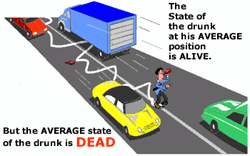
The error of a single number view vs. the range can be illustrated by the "Flaw of Averages."

The Flaw of Averages
A common cause of bad planning is an error Dr. Savage calls the Flaw of Averages which may be stated as follows: plans based on average assumptions are wrong on average.

As a sobering example, consider the state of a drunk, wandering around on a busy highway. His average position is the centerline, so...

Second one.  The criteria listed are assumed to be independent factors, but most criteria have relationships to other things, and the interaction of criteria creates good and bad conditions that experienced people know, but the site selection so-called gurus think they can solve the problem with enough criteria and weightings.

For the amount of money spent on data centers over the lifecycles, data center models should be built.  The trouble is few companies know how to do this as it requires a holistic view,bridging site, data center building, IT hardware, and software. This is problem worth solving.

Read more

Finding Fiber in Columbia, MO, providing data access for 400 megawatt of power, Mike Manos kicks the dirt again

I've blogged about the 400 megawatt of power in Columbia, Missouri, and an obvious next question is what is the fiber like.  Last year's information was "there isn't enough fiber."

Research the site and the common knowledge is three providers - AT&T, Level3, and CenturyLink/Lightcore.  That's not enough.  But look at where the data comes from, the salesperson who is ready to take the order.

Mike Manos wrote an entertaining post on kicking the dirt.

Mike Manos discusses data center site selection, you need to “kick the dirt” to find what is real

At Gartner’s Data Center Conference, Mike Manos made an excellent point that “75% of the data center costs are effected by site selection.” Great architecture is designed to a site characteristics.  But, the status quo is to design data centers that are built based on past experiences.  Green data centers need to be designed to fit with site characteristics.

Mike wrote a post on site selection.

Kickin’ Dirt

December 21, 2009 by mmanos

mikeatquincy

Mike Manos was out at the Columbia, MO data center site to kick the dirt, and he recalls there not being enough fiber being in Columbia from his past data center research. The team luckily had Mike for a day without his cell phone as he forgot it at home, so they had his undivided attention.

Chicago and Kansas City are midwest centers for cattle which was connected by railway.

image

And Interstate 70 connects Kansas City and St. Louis.

image

There must be more fiber available.  With a little "kickin the dirt" and willingness to spend a bit of more and time, there are 4 more providers few discuss.

Global Crossing

Sprint

XO Communications

MNA - Missouri Network Alliance

Kicking the dirt further, turns out Level 3 has two fiber paths in Columbia - the typical interstate 70, and a little known WillTel's pipeline fiber.

Also the North South path on Highway 63 is available for future growth.

In general, Columbia is a place to take take a piss and fast food break between Kansas City and St. Louis.  There are three fiber trenches running this same path that can be tapped within 30 miles of Columbia.  Note the 30 mile separation helps meet the fiber requirement for geographic diversity.

image

Now that the team has kicked the dirt, it is easy to tell the fiber access story in Columbia, MO.  400 megawatts of power and plenty of available fiber. 

Read more

Green the Data Center with Open and Transparent thinking

This past week I slowed my blog posting.  I wrote 5 posts for the week, and many times I'll write 5 posts in a day as I run across interesting information that is publicly available.  I was down in the bay area and had great conversations with technical friends who I have known for 10 - 20 years.  And, with the announcement of non profit organization partnership with University of Missouri, I have been thinking more about the approach we will use in the partnership.

I leave in a few hours to get on a plane to Missouri, and one of the people we will meet with is the President of the University of Missouri system, Gary Forsee.

Gary Forsee

Gary Forsee

Gary D. Forsee became the 22nd president of the four-campus University of Missouri System Feb.18, 2008. He is the chief executive officer of the university with four campuses in Columbia, Kansas City, Rolla and St. Louis. The system’s annual operating budget is approximately $959 million, with total revenues of $2.5 billion and an endowment of $1 billion.

In his first year as president, Forsee established a comprehensive set of performance objectives, surveyed Missourians on their attitudes of public higher education and focused on conveying the university’s distinctive value to the state.

Prior to his appointment as university president, Forsee spent more than 36 years in the telecommunications industry. Most recently, he served as chairman and CEO of Sprint Nextel in Kansas City, Mo. He also served as CEO of Global One, a joint venture of Sprint, Deutsche Telekom and France Telecom; and in various leadership positions at AT&T and Southwestern Bell.

And, this is forcing me think hard to what does it mean to be a green data center.  Is it a low PUE?  Is it a 100% renewable energy supply? Is it cloud computing?

What is consistently missing from almost all green data center claims is an open and transparent approach to share the knowledge beyond the PR message.

What do I mean by Open and Transparent?  Here is an article that does a very good job of explaining.

Openness

If you are open-minded, not closed, you are open to new ideas, to new thoughts, to new people and to new ways of working. When you come across new things you are curious and eager to explore them. You are non-judgmental and you look to engage other people in conversation – not so much in debate, but more in dialogue.

You deliberately go out of your way to discover new things. You are an explorer!

You ask for criticism from people – not praise. You are not afraid when people challenge your ideas – in fact you welcome it. This is how you learn. You are willing to ‘let things in’. People can ‘come in’. Hence the word ‘open’.

Transparency

If you are transparent, you work in a way which naturally enables people to see what you are doing. You publish your activity and your ‘work in progress’ as a by-product of the way that you work. You deliberately go out of your way to try to be honest and open about who you are. There is no façade, no pretense – with you, people get what they see.

You speak in your own voice. You are authentic. Others can see clearly who you are, what you are doing and why you are doing it.

You do not try to hide things out of fear of being seen to make a mistake. You actually want your mistakes to be seen. And you want others to point them out to you – that way you get to learn and to get even better at what you do. You make it easy for people to find you and to connect with you. You ‘let things out’. People can ‘see in’. Hence the word ‘transparent’.

The article finishes with the signs of if you are open and transparent.

Behaviours

Being open and transparent is a state of mind and more about general behaviour than the use of any specific tools. But if you are open, and transparent the more likely you are to blog; to ‘Twitter’; use wikis and other social-networking tools; give talks; publish papers, articles or newsletters; keep your calendar online; have an online presence indicator; and, write regular status reports on your activity and much more besides.

Being open and transparent are not the only traits of an effective knowledge worker, but I do believe they are two of the core behaviours. So do you think openness and transparency are important? If so, just how open and transparent are you and what might you do to improve?

I have now shared the approach I will take in the discussion with President Forsee and others at the University of Missouri.

If green data centers used an open and transparent approach, the adoption of technologies and methods would be faster. 

Think about what is holding back people and organizations from using this approach.  I am.

Read more