ASHRAE Standard 90.1 Data Center Documents

After writing on Google's post regarding ASHRAE's standard 90.1 and requirement for economizer and talking to Google's Chris Malone, I decided to find the documents.

Here is the proposed Addendum bu.

6.5.1 Economizers. Each cooling system that has a fan shall include either an air orwater economizer meeting the requirements of Sections 6.5.1.1 through 6.5.1.4.

There are a through k in just section 6.5.1

j. Systems primarily serving computer rooms where
1) the total design cooling load of all computer rooms in the building is less than 3,000,000 Btu/h (880,000 kW) and the building in which they are located is not served by a centralized chilled water plant, or

And Addendum cy

What is hard to figure out is why ASHRAE is making economizers a requirement for cooling systems instead of a performance based solution, but if you meet an efficiency improvement in table 6.3.2 you are allowed you to eliminate economizers.

image 

Does addendum cy supersede addendum bu?  addendum cy doesn't have the above section j.

DataCenterKnowledge references addendum bu.

ASHRAE, for its part, says it welcomes the feedback on the proposed changes. “ASHRAE is committed to excellence in the consensus standard development process and encourages anyone with comments regarding the proposed addendum regarding data centers (addendum bu) to participate in the public review process,” it said.

Are you confused?  I am.

Read more

Can Data Centers benefit from Supply Chain Management concepts?

Currently, I am studying data center site selection, and have been asking the question what is wrong with data centers having 1% of the cost being in the land when other commercial real estate will typically have land 20-25% of the cost.  One big thing most miss is land is not a cost, it is a non-depreciable asset. 

Capital assets that are inexhaustible or where the useful life does not diminish or expire over time, such as land and land improvements. Infrastructure assets reported using the modified approach to depreciation are also not depreciated.

Land is not an expense, it is an investment.  So, land should be looked evaluated on its ROI, not it's overall cost, including land improvements. 

Which then led me to think why is it data centers don't use more supply chain management concepts which would address issues like land cost in the overall solution and most likely save you much more than the cost of the land?

Supply Chain Management is defined as.

Supply chain management (SCM) is the management of a network of interconnected businesses involved in the ultimate provision of product and service packages required by end customers (Harland, 1996).[1] Supply Chain Management spans all movement and storage of raw materials, work-in-process inventory, and finished goods from point of origin to point of consumption (supply chain).

Another definition is provided by the APICS Dictionary when it defines SCM as the "design, planning, execution, control, and monitoring of supply chain activities with the objective of creating net value, building a competitive infrastructure, leveraging worldwide logistics, synchronizing supply with demand, and measuring performance globally."

Can't you think of all the different groups and vendors involved in providing data center and IT services as a supply chain management problem?  Is the CIO in charge of the supply chain? Maybe.

Here is a piece of irony from a CIO.com article on supply chain management.  Supply chain management SW is a mess.

Supply chain management software is possibly the most fractured group of software applications on the planet. Each of the five major supply chain steps previously outlined is comprised of dozens of specific tasks, many of which have their own specific software. Some vendors have assembled many of these different chunks of software together under a single roof, but no one has a complete package that is right for every company. For example, most companies need to track demand, supply, manufacturing status, logistics (i.e. where things are in the supply chain), and distribution. They also need to share data with supply chain partners at an ever increasing rate. While products from large ERP vendors like SAP's Advanced Planner and Optimizer (APO) can perform many or all of these tasks, because each industry's supply chain has a unique set of challenges, many companies decide to go with targeted best of breed products instead, even if some integration is an inevitable consequence.

So, if a bunch of people who focus only on supply chain management can't get the software right, how can the data center industry get the right software to run data centers like a supply chain?

I think I have an answer on how to approach supply chain management for data centers.  The first step is to identify the problem, then test what approaches solve the problem best. The fragmentation and silos is the opportunity to address.  How do you pull all the pieces together?  My ideas are based on using social networking and memetics.

More to come.

Read more

Google, Microsoft, Amazon, Nokia, Digital Realty Trust, Dupont Fabros vs. ASHRAE standard 90.1 requirement for economizers limits innovation - comment to be heard

Google's Public Policy blog has a post with some of the most innovative data center operators.

Chris Crosby, Senior Vice President, Digital Realty Trust
Hossein Fateh, President and Chief Executive Officer, Dupont Fabros Technology
James Hamilton, Vice President and Distinguished Engineer, Amazon
Urs Hoelzle, Senior Vice President, Operations and Google Fellow, Google
Mike Manos, Vice President, Service Operations, Nokia
Kevin Timmons, General Manager, Datacenter Services, Microsoft

This collection and probably many others are appealing to ASHRAE to change the requirement for economizers.

Unfortunately, the proposed ASHRAE standard is far too prescriptive. Instead of setting a required level of efficiency for the cooling system as a whole, the standard dictates which types of cooling methods must be used. For example, the standard requires data centers to use economizers — systems that use ambient air for cooling. In many cases, economizers are a great way to cool a data center (in fact, many of our companies' data centers use them extensively), but simply requiring their use doesn’t guarantee an efficient system, and they may not be the best choice. Future cooling methods may achieve the same or better results without the use of economizers altogether. An efficiency standard should not prohibit such innovation.

I know many of these above people and thanks to a friend they forwarded me this link to Google's blog post, I speculated on what drove the economizer requirement:

  1. Without talking to anyone, one assumption is this group who are active in ASHRAE brought up the energy efficiency issue early on, and ASHRAE stakeholders, most likely vendors who make economizers saw an opportunity to make specific equipment a requirement of energy efficiency data centers.  I could be wrong, but it would explain why an organization who sets standards would choose to specify equipment instead of performance.
  2. In many established data center organizations like financials, economizers are/were unacceptable in data centers a few years back.  So, is the move to establish economizers a reaction to those who refused to use economizers for energy efficient cooling.
  3. The ASHRAE consulting community sees a need for their services to meet ASHRAE's economizer requirement.  For example, if in a given area there are X number of hours a year that are available for running economizers, does the economizer need to be run for a specific %.  Hire an ASHRAE consultant to interpret the standard.  I sure can't.

The data center group above proposes the following as a better update to the ASHRAE standard.

Thus, we believe that an overall data center-level cooling system efficiency standard needs to replace the proposed prescriptive approach to allow data center innovation to continue. The standard should set an aggressive target for the maximum amount of energy used by a data center for overhead functions like cooling. In fact, a similar approach is already being adopted in the industry. In a recent statement, data center industry leaders agreed that Power Usage Effectiveness (PUE) is the preferred metric for measuring data center efficiency. And the EPA Energy Star program already uses this method for data centers. As leaders in the data center industry, we are committed to aggressive energy efficiency improvements, but we need standards that let us continue to innovate while meeting (and, hopefully, exceeding) a baseline efficiency requirement set by the ASHRAE standard.

It doesn't make any sense that all data centers built to ASHRAE's standards have to use economizers. If you choose to have a waterfront data center and could use the body of water as a heat sink for your cooling, ASHRAE wouldn't allow it or would they?

The public comment period is open until April 19.  If you disagree with ASHRAE's economizer requirement comment on this blog or Google's blog post.

I was able to talk to Google's Chris Malone on this topic after I wrote the above.  The main concern Google has is if you are trying to be innovative in energy efficiency the last thing you want is a barrier saying you have to use a particular technology.

In other words, the standard should set the required efficiency without prescribing the specific technologies to accomplish that goal. That’s how many efficiency standards work; for example, fuel efficiency standards for cars specify how much gas a car can consume per mile of driving but not what engine to use.

Imagine if MPG numbers were mandated by use of hybrid, diesel, or turbocharger.  It is obvious that the most innovative MPG is going to come from those who have the freedom to use any technology.

You should soon see other data center bloggers write on this issue.  If you think this is wrong comment on the Google Blog post or one of the others.

Read more

Open Data Map movement demonstrates innovation opportunity for Open Sourced Data Center Initiative

Tim Berners- Lee has a 6 minute TED presentation on the year open data went worldwide.

Map and location services are top scenarios for mobile devices.  Google and Microsoft have their maps.  Nokia bought Navteq and MetaCarta.  Apple bought PlaceBase.  With all the companies creating services, volunteers using an open approach to collaborate can beat the proprietary services.

The MercuryNews reports on Open Street Maps.

Volunteers create new digital maps

By Mike Swift

mswift@mercurynews.com

Posted: 04/09/2010 09:08:55 PM PDT

Updated: 04/10/2010 01:36:26 PM PDT

Ron Perez hikes by a waterfall while a portable GPS device records his tracks as... (Jim Gensheimer)

When Brian "Beej" Hall first heard about an audacious volunteer effort to create an Internet map of every street and path in every city and village on the planet, he was hooked. At the time, the nascent effort had only a few American members, and the U.S. map was essentially a digital terra incognita.

Just a few years later, the Berkeley software engineer is editing digital maps so precise they include drinking fountains and benches in the Bay Area parks where he hikes, and the mapping community has swelled to more than 240,000 global members. The effort, OpenStreetMap, is a kind of grass-roots Wikipedia for maps that is transforming how map data is collected, shared and used — from the desktop to smartphones to car navigation.

The reporter makes the observation of how a nonprofit community can change the map business.

But increasingly, the nonprofit community collaboration model behind OpenStreetMap, which shares all the cartographic data in its maps for free, is also changing the business of mapping, just as Wikipedia changed the business of reference. More and more, the accuracy of searches on Google Maps or directions issued by your car's navigational device are based on data collected by volunteers like Hall and other members of OpenStreetMap's do-it-yourself army.

Part of the reason why OpenStreetMap is popular is the fact that the end users are creating the maps.

OpenStreetMap users say that because their data is collected by people who actually live in a place, it is more likely to be accurate.

"It's the people's map," said Paul Jarrett, director of mapping for CloudMade.

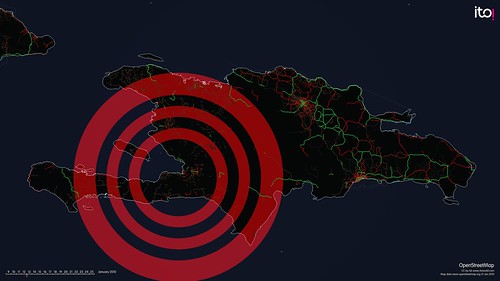
If you are interested in the use of OpenStreetMap in Haiti go here.

We chose to tell the story of 'OpenStreetMap - Project Haiti'.
We all followed the crisis that unfolded following the Haiti earthquake, many of us chose to donate money, a few were flown out and deployed as part of the relief effort. But what practical impact can many have without being there in Haiti itself? Well, during this crisis a remarkable story unfolded; of how people around the world could virtually collaborate and contribute to the on-the-ground operations.

OpenStreetMap - Project Haiti 1

With the little existing physical, political and social infrastructure  now destroyed or damaged, the situation was especially challenging for aid agencies arriving on the ground. Where are the areas most in need of assistance, how do we get there, where are people trapped under buildings, which roads are blocked? This information is important to the rescue agencies immediately after the event, and to the longer rebuilding process. In many developing countries, there is a lack of good mapping data and particularly after a crisis, when up-to-date information is critical to managing events as they evolve.
Enter OpenStreetMap, the wiki map of the world, CrisisMappers and an impromptu community of volunteers who collaborated to produce the most authoritative map of Haiti in existence. Within hours of the event people were adding detail to the map, but on January 14th high resolution sattelite imagery of Haiti was made freely available and the Crisis Mapping community were able to trace roads, damaged buildings, and enter camps of displaced people into OpenStreetMap. This is the story of OpenStreetMap - Project Haiti:

There are many who think the Open Source Data Center Initiative will not work.  There are a lot of people who thought OpenStreetMaps wouldn't work too.

Read more

Nokia acquires MetaCarta, continues investment in geolocation services beyond Navteq

GigaOm's Om Malik has a post with Nokia's CEO on the future of the Mobile industry.

Nokia’s CEO on the Challenges & Promise of the New Mobile Industry

By Om Malik Apr. 8, 2010, 10:50am PDT 11 Comments

IMPORTANT POINTS
Expand

Nokia Chairman, CEO and President Olli-Pekka Kallasvuo has the second-toughest job in the mobile industry — that of turning the decades-old, set-in-its-ways, $58-billion-a-year mobile handset maker into a services-driven, Internet-oriented monster that not only catches up to but surpasses new upstart rivals Apple and Google. The good news is that unlike Palm CEO Jon Rubenstein (who has the toughest mobile gig), he doesn’t have to worry about running out of money anytime soon.

Part of the interview is the hot top of location services.

Location Gives the Internet Relevance

One of the things that gets Kallasvuo excited is location — or more specifically, location-based services. “Location is not an app, instead it adds a whole new dimension (and value) to the Internet,” he said, explaining why his company has made huge investments in location, including its $8 billion purchase of mapping company Navteq. Nokia earlier this year released a new Ovi Maps application that allows it to compete in markets such as India, Brazil and Russia, places where Google and Apple haven’t made inroads just yet.

“Putting location elements into different type of services is a big opportunity which makes the Internet more exciting,” Kallasvuo said. (I’ve written about Nokia’s location-oriented strategy in the past.) Location, along with different types of sensors and augmented reality, will open the mobile world up to different possibilities, he said.

For 2 weeks thanks to a friend who works on geolocation solutions,  I've known Nokia was acquiring MetaCarta.

MetaCarta Inc. is the leading provider of geographic intelligence solutions. MetaCarta’s unique technology combines geographic search and geographic tagging capabilities so users can find content about a place by viewing results on a map. MetaCarta’s products make data and unstructured content "location-aware" and geographically relevant. These innovative solutions make it possible for customers to discover, visualize, and act on important location-based information and news.

And, yesterday the press release went out on MetaCarta's website. And Nokia's. So, now I can reference public sources on the acquisition.

Nokia acquires MetaCarta Inc.

Espoo, Finland – Nokia announced today that it has acquired MetaCarta Inc. MetaCarta, based in Cambridge, Massachusetts, is a privately owned company which employs over 30 people and has expertise in geographic intelligence solutions. MetaCarta’s technology will be used in the area of local search in Location and other service.

Who is MetaCarta?  Here are what IT analysts say.

Dave Sonnen, Consultant, Spatial Information Management Research
Sue Feldman, Research Vice President, Content Technologies

Relevant Research


Whit Andrews, Vice President Research / Analyst
Jeff Vining, Vice President Research / Analyst
Allen Weiner, Managing VP

Relevant Research

Mike Boland, Senior Analyst

Relevant Research

Here are some of the companies who worked with MetaCarta and awards they have won.

  • Technology Partners: ArdentMC, Clickability, EMC/Documentum, Enterprise Search Solutions (ESS), ESRI, Google, Microsoft, MITRE, Northrop Grumman, OpenText, Raytheon, and SAIC
  • Awards: IndustryWeek Technologies of the Year, KMWorld 100 Companies That Matter in Knowledge Management, and 2-time KMWorld Trend-Setting Products, Red Herring Top 100 Private Companies, Red Herring Top Innovator

If you believe the media, Nokia is irrelevant in the battle between Apple, Google, and RIM.

Apple's iPhone OS 4 may have more than 100 new features, but it established three big targets for Apple: Microsoft, Google and RIM. To some extent, it also showed that Apple considers Palm and Nokia to be irrelevant.

But, I would guess this view exists because media users are mostly iPhone users, then RIM and Android.  With Nokia almost no market share with the US media reporters.  Note: I have a Nokia E71 I can use when I want a high quality phone, and thanks to OVI Maps April 6 release I can get free OVI maps for the phone.

After listening to your overwhelmingly positive feedback and feeling your love for your favourite mobile phone, we have now created a custom version that works on Nokia E71 and Nokia E66.

However, because of technical constraints, it isn’t possible to offer premium content such as Michelin and Lonely Planet guides on these devices.

I wouldn't count out Nokia the way most media does.  Om Malik doesn't.

If there was one point Nokia’s big boss wanted to make before we ended our conversation, it was that the Nokia in 2010 is going to be a lot different from the Nokia of the past. The company has its work cut out for it. The good news, if you can call it that, is that its CEO knows what to do. Acceptance is the first step toward recovery. And for me that’s a good start. I look forward to falling in love with Nokia all over again.

It will be interesting to see Nokia's new phones in 2010.

I am sure we'll here about big data center plans from Nokia to support its growth in services.

Read more