What is missing from prediction of Top 5 Green Data Center Trends in 2011? Words of wisdom from a conversation with Olivier Sanche

TriplePundit has a post on the Top 5 trends in Green Data Center in 2011.

Top Five Trends for Green Data Centers in 2011

By Kathryn Siranosian | January 18th, 2011 3 Comments

Last year, Triple Pundit took an in-depth look at how companies are greening their data centers.

Now, it’s time for us to revisit that issue and ask, “What’s new?”

What’s the list of top 5?

1. Continued emphasis on efficiency –with a twist.

2. Improving business flow through virtualization and cloud computing.

3. Modularity.

4. Innovative design and design integration.

5. Continued evolution of certification and regulation.

But does this list really help you green the data center?  Something is missing.  Something more important.  Then, it came to me as I am researching stories for a eulogy I’ll give for Olivier Sanche’s memorial service.  A method that Olivier practiced – a passion to drive for a complete system that works and is better than the rest.  Which now that I am writing this makes sense why Olivier fit in Apple’s culture and admired Steve Jobs when he read about the company 20 years ago.  Olivier had the same passion for data centers that Steve Jobs has for consumer products.

Read this story shared by Nic Bustamente.  You’ll get the idea.

I was lucky enough to meet with Olivier a few weeks before his passing. We conversed about many issues. I was always amazed how he ably wore so many hats. Many folks in the industry wear one or a few hats, but Olivier wore them all so well. We fondly discussed typical data center guy stuff – outages, uptime, maintenance, design, construction – it went on for hours. Throughout the discussion he never seemed to tire. Olivier was ten years my senior, and I was starting to wear out. It was both embarrassing and humbling. I was battling bronchitis, (which later developed in to pneumonia) but we kept talking!  He continued asking me pointed and highly in depth questions. I was honestly starting to get pretty physically tired, but he was so mentally engaging I didn’t want it to end, and he kept me on my toes. It always amazed me how enthused and lively he could be with his energy – his questions and the discussion kept me going. We started discussing our various company’s positions and learned that later on that month we were due to meet up again at an industry event. We talked about how many in the industry present the same thing every year, how things don’t change too often, or as much as we would like. There are very few folks in this world who drive real change, and even fewer who embrace it. Of those among us who are agents of both, Olivier was one who you could always count on to do so intelligently and thoroughly, but most importantly, without ego. His was always a passionately genuine and humanistic approach. I am glad we had the opportunity to talk one last time, and I will always cherish the final experience.

I have a hard time thinking about it, cause every time I do I start to honestly cry. I didn’t think in a million years we would have to say goodbye like this.

Read more

Google, Amazon, and Netflix comment on uptime 99.999%

NYTimes has a post on uptime.

99.999% Reliable? Don’t Hold Your Breath

By RANDALL STROSS


AT&T’s dial tone set the all-time standard for reliability. It was engineered so that 99.999 percent of the time, you could successfully make a phone call. Five 9s. That works out to being available all but 5.26 minutes a year.

The author was able to get Google.

As for moving to 99.999, well, that may never come. “We don’t believe Five 9s is attainable in a commercial service, if measured correctly,” says Urs Hölzle, senior vice president for operations at Google. The company’s goal for its major services is Four 9s.

Google’s search service almost reaches Five 9s every year, Mr. Hölzle says. By its very nature, it is relatively easy to provide uninterrupted availability for search. There are many redundant copies of Google’s indexes of the Web, and they are spread across many data centers. A Web search does not require constant updating of a user’s personal information in one place and then instantly creating identical copies at other data centers.

Amazon

One of those services, the Simple Storage Service, or S3, allows companies to store data on Amazon’s servers. “We talk of ‘durability’ of data — it’s designed for Eleven-9s durability,” says James Hamilton, a vice president for Amazon Web Services. That works out to a 0.000000001 percent chance of data being lost, at least theoretically.

And threw in a Netflix blog post.

One thing that Google and other companies offering Web services have learned to do is to keep software problems at their end out of the user’s view. John Ciancutti, vice president for personalization technology at Netflix, wrote on the company’s blog in December about lessons learned in moving its systems from its own infrastructure to that of Amazon Web Services. He said Netflix had adopted a “Rambo architecture”: each part of its system is designed to fight its way through on its own, tolerating failure from other systems upon which it normally depends.

“If our recommendations system is down, we degrade the quality of our responses to our customers, but we still respond,” Mr. Ciancutti said. “We’ll show popular titles instead of personalized picks. If our search system is intolerably slow, streaming should still work perfectly fine.”

Watch for availability to be marketed more.

Read more

Three Data Center Rating Systems: Uptime, LEED, CEEDA

ZDNET has a post summarizing the three data center rating systems out there  - Uptime, LEED, and CEEDA.  The author summarizes the current rating system hype.

How does your datacenter rate?

By David Chernicoff | January 20, 2011, 11:39am PST

Many businesses looking at building new datacenters announce that they are planning on achieving certification for their new datacenter by an external authority that will evaluate their datacenter and grant a specific status or award to the facility. When the new datacenter gets such a status or award, the company will send out press releases, tell stockholders, and use it in their promotional material, if applicable. But the standard for the current crop of rating entities are consistent only across their own ratings, and there are more groups doing this than you might realize. Here’s the current crop of high-end standards and awards applied to datacenters.

One of the most popular out in the public is LEED, and the author pops that illusion .

Leadership in Energy and Environmental Design (LEED)

This standard, run by the US Green Building Council, you might be surprised to learn, is not a datacenter standard per se, despite all the press over the last year on datacenters achieving high LEED awards. The USGBC defines the standard as “a nationally accepted benchmark for the design, construction, and operation of high-performance green buildings.”  And while a datacenter needs to work hard to achieve LEED awards, the basic metric is not designed to rate a fully optimized datacenter.

Does your marketing group tell you to get a LEED rating?

Read more

Problem with choosing a path of cost reduction for greening a data center, the end leads to bankruptcy

I am reading a book on FedEx.

Changing How the World Does Business: Fedex's Incredible Journey to Success - The Inside Story

The author is a distribution logistics expert.

About the Author

Roger Frock has conducted numerous projects and workshops dealing with the subjects of transportation networks, logistics operating systems, and responsible and ethical management during his years with A.T. Kearney, as a part of the decade with Federal Express. He has been a guest speaker at the National Council of Physical Distribution Management amoung others on a variety of subjects.

One of my first passions after college was in distribution logistics when I worked at HP and at that time UPS was the dominant shipper and FedEx was a minor player being used for only those few shipments that had to get there the next day.  Focusing on distribution logistics is what got me hired at Apple, and has helped to think about the abstraction of products to delivery of services.

Part of the book tells the story how the board of directors thought it was a time for change in management and was ready to reduce Fred Smith’s authority.  One of my favorite paragraphs is the following.

image

Watch out for those in the data center/IT space who make cost reduction the #1 goal.  Cost reduction is a temporary move, at some point you need to grow, and growing with cost reduction is not sustainable.

There was actually an executive sponsored study to reduce the # of cities during FedEx’s growth days because those cities were too expensive compared to others.

image

For those who have been around for a while, we have all heard or seen various projects that feel like this.  The problem is cost reduction is not sustainable for a growing business.  Cost efficacy is a sustainable.

Could you imagine a data center designs were done by someone who focuses on cost reduction?  In fact, that may be a good horror story talking to some designers.  The top two ways typically designed for are resiliency and efficiency.  Who designs for cost reduction?  Willing to compromise resiliency and efficiency.  Not many, but I wouldn’t be surprised there are some designs out there as there are people out there who don’t know data centers/IT who love to hear the words “cost reduction” coming from the data center group.  Until their data center services go out of business with downtime.

Read more

After Google Reorg, Data Centers are important to all three top execs

Google announced Larry Page is CEO, replacing Eric Schmidt.

But as Google has grown, managing the business has become more complicated. So Larry, Sergey and I have been talking for a long time about how best to simplify our management structure and speed up decision making—and over the holidays we decided now was the right moment to make some changes to the way we are structured.


For the last 10 years, we have all been equally involved in making decisions. This triumvirate approach has real benefits in terms of shared wisdom, and we will continue to discuss the big decisions among the three of us. But we have also agreed to clarify our individual roles so there’s clear responsibility and accountability at the top of the company.

When you read what Larry's role is leading product development and technology strategy it makes sense that Google's data center group would report to Larry.

Larry will now lead product development and technology strategy, his greatest strengths, and starting from April 4 he will take charge of our day-to-day operations as Google’s Chief Executive Officer. In this new role I know he will merge Google’s technology and business vision brilliantly. I am enormously proud of my last decade as CEO, and I am certain that the next 10 years under Larry will be even better! Larry, in my clear opinion, is ready to lead.

Sergey is working on strategic projects.  But, how can Google develop new products without data center resources.

Sergey has decided to devote his time and energy to strategic projects, in particular working on new products. His title will be Co-Founder. He’s an innovator and entrepreneur to the core, and this role suits him perfectly.

And Eric is working on external projects - deals, partnerships, ... technology thought leadership that are increasingly important.  You need Google's data centers for these deals.


As Executive Chairman, I will focus wherever I can add the greatest value: externally, on the deals, partnerships, customers and broader business relationships, government outreach and technology thought leadership that are increasingly important given Google’s global reach; and internally as an advisor to Larry and Sergey.

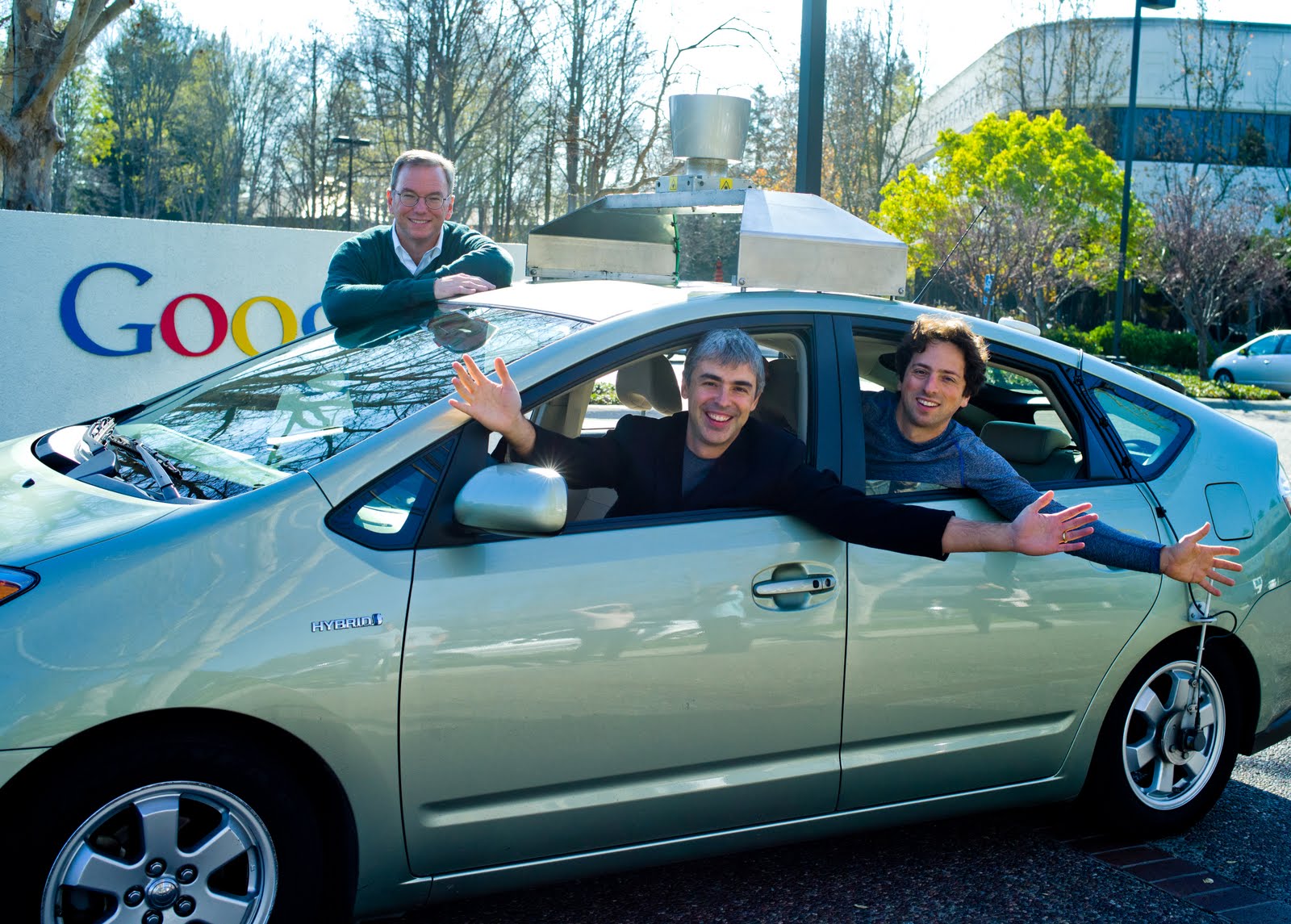
From left to right - Eric, Larry and Sergey in a self-driving car in a photo taken earlier today

So, even though Eric, Larry, and Sergey all have new roles.  They all need Google's data centers.

How many companies do you know need data centers for the three top billionaire executives to do their job?

Read more