The Secret is out IT Development Labs need energy efficiency solutions

I have had conversations with Cisco's Chris Noland who presented at Teladata's Technology Convergence Conference and made this comment.

‘People Have Woken Up’

But labs are now being sharing space in data center expansion projects. Noland says Cisco is building a “showcase” engineering lab featuring rack-top chimney containment systems. Last year Brocade consolidated its labs in a brand-new state-of-the-art data center at the company’s new campus in San Jose.

I admit I didn't got to the session as I have been talking with people/companies to implement energy efficiency in lab environments for over 4 years. Why?  Because, even though the data center is the big target there are great opportunities in IT labs.  Here are a few of the reasons I have told people.

  1. Selling in the data center is hard.  Selling into a lab is 10 times easier.
  2. The Lab is willing to experiment more than a data center. (The lab has people who are not as risk adverse as a typical IT data center.)
  3. Many times you only need to sell one person on your solution in a lab.  In a data center you'll be lucky if you only need to sell three people.
  4. The sales cycle is dramatically less in the lab vs. data center.
  5. Start in the lab, then use the lab installation as a demonstration for others in the enterprise. (You need your product installed to sell more long term)
  6. Use the lab as awareness to develop lower energy solutions. (Like Cisco's lab)
  7. The Labs actually use a lot more energy than people think.  (Look at HP, Intel, Sun, IBM, and Microsoft's energy efficiency implementations and they have all addressed the lab.)

Here is the Teladata Technology Convergence Conference session on energy efficiency in R&D labs.


Mark Thiele
11:00 a.m. - 11:40 a.m.
Panel Discussion Topic: Data Center Challenges and Solutions in the R&D Lab

Moderator: Mark Thiele, VP of Data Center Strategy at ServiceMesh
Panelist: Chris Noland, Lab Manager at Cisco Systems Inc.
Panelist: Duffie Cooley, Lab Manager for Juniper Networks
Panelist: Val Sokolov, Senior Manager for Engineering lab services at Brocade

Unlike enterprise and production data centers, today's R&D electronics lab is a dynamic and constantly changing work environment with variable demands for power, space and cooling.  IT engineers expect as much autonomy and flexibility as possible in the way that they access their IT resources and then develop and test their IT solutions.  So, how realistic is it to believe that our new data center standards and "best practices" can be implemented in the IT lab as well?  Hear leading laboratory operators describe their challenges and barriers to success and explain how they have modified well established data center solutions to fit the needs of their unique R&D environments.

And, Rich Miller reported on the presentation.

Engineering Labs: An Efficiency Opportunity

February 28th, 2011 : Rich Miller

A panel on engineering labs at the Technology Convergence Conference featured Mike Honer from Juniper Networks, Chris Doland from Cisco Systems and Val Sokolov from Brocade.

As America’s largest companies begin to get a handle on their data center energy usage, they’re widening their gaze to scrutinize the efficiency of their engineering labs. Managers of some of the leading lab operations in Silicon Valley say the attention is long overdue, and will lead to significant energy savings.

The secret is out that IT labs need energy efficient solutions.  There is still huge opportunities to sell energy efficient solutions, and more people are discussing the idea.  I just can't tell people it's a little known area of opportunity to go after.  But, it does feel good I was talking about the idea 4 years before it gets up on a panel discussion.  And, I've moved on to a bunch of different ideas I am playing with that nobody is discussing.

FYI, part of the reason I research and blog on topics is to watch what the industry is doing so I can figure out the opportunities.

Prineville local news on Facebook promoting Green Data Center features

Here is a local news spot on KTVZ about Facebook's data center and its green features.

Facebook Prineville: Lot of Data, Lot of Green

'Simplicity Is the Key Here,' says Manager of Huge Data Center

By Adam Aaro, KTVZ.COM

POSTED: 7:17 pm PST February 28, 2011

PrintEmail

PRINEVILLE, Ore. -- To realize just how big Facebook has become, think about this: One out of every 14 people in the world use it.

Now sit back and imagine what it would take to capture and communicate the billions upon billions of status updates, photo albums and friend requests.

Soon, all of that will happen every second of the day inside the company's data center in Prineville, and Facebook says it will do it using some of the most cutting-edge and energy efficient practices in the world.

"It's simplistic. Simplicity is the key here. Complexity creates waste and we have built specifically a simplistic, easy to use, low energy design," Site Manager Ken Patchett said during my recent visit.

Here is a video.  Not a lot new, but interesting to see the story Facebook is building for its April 2011 opening.

Servers and Data Centers, Intel's formula for Profit Margins

Barron's has a post on Intel' presentation at a Morgan Stanley Technology event.

  • FEBRUARY 28, 2011, 2:42 PM ET

Intel Talks Up Data Center, Networking Prospects

By Tiernan Ray

Most interesting presentation today by Intel’s (INTC) chief of its data center unit,Kirk Skaugen, speaking at the Morgan Stanley Tech, Media and Telecomconference.

One of the more interesting facts was Intel's server processor margins.

Since 2005, Intel’s increased its share of the server market for processors from 80% to 92%, he notes and increased its average selling prices by 60%. Intel’s total unit volume of server chips is about the same as in 2005 as a percentage of total company shipment volume, at 5.5%, but those chips now make up 22% of revenue, double what they were five years ago, and a third of Intel’s profit.

One other part the author discussed as interesting is Intel's comment on Networking.

But another interesting one was Skaugen’s insistence the networking market is going the way of PC microprocessors:

So if you look at an old Cisco [Systems (CSCO) switch or router, it used to be internally developed ASIC from Cisco. If you open up a Nexus 5000 today it’s a Xeon microprocessor next to an ASIC. And I bet you in the future you’re going to just see two Xeon microprocessors there because we’ll put new instructions into the chip that will accelerate things that used to be proprietary.

With an Eye on China, India’s spending most likely includes defense data centers

Reuters has an article on India’s increase is defense department. spending.

With an eye on China, India steps up defence spending

NEW DELHI | Mon Feb 28, 2011 5:19am EST

Feb 28 (Reuters) - India increased annual defence spending by about 11.6 percent on Monday, aiming to overhaul the military to counter the rapidly growing capabilities of giant neighbour China.

The hefty increase suggests the government plans to move ahead with some of a slew of planned defence acquisitions, analysts said, including a $10.5 billion fighter jet contract, one of the world's largest on offer.

With all that defense spending you would think there is a bunch of data centers being built to support defense operations and cyber security.  But, I am sure we will not hear anything about those data centers.

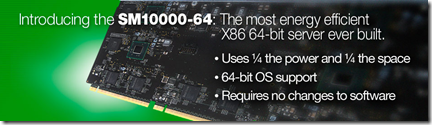
SeaMicro ships 64-bit Atom Server, 1/4 power of Xeon

SeaMicro has a press release on its latest 64-bit Intel Atom Server.

image

SeaMicro Now Shipping the World’s Most Energy Efficient x86 Server with New 64-bit Intel Atom N570 Processor

The New SM10000-64™ Integrates 256 Intel® Atom™ Dual-core 1.66GHz Processors – 512 64-bit Cores and 850GHz, into a 10 Rack Unit System

A Hadoop benchmark was run that beat the performance of Xeon based servers with 1/4 the power.

For example, in the Hadoop MinuteSort benchmark test (http://sortbenchmark.org), 29 SeaMicro SM10000-64s were able to beat the performance of 1,406 dual socket quad core servers, but used just one-quarter of the power and took one-fifth the space.

Here is a Mozilla case study on using the SeaMicro box.

Mozilla compared performance on the SeaMicro
SM10000 with their incumbent system - an HP C7000
Dual Socket Quad Core L5530 Xeon Blade and found
SeaMicro to be dramatically superior on all of the
competitive dimensions: Capital expense per unit
compute, HTTP requests serviced per/Watt, and HTTP
requests serviced per Rack Unit. These advantages
combined to produce dramatic savings in both capital
expense and operating expense. On the operating
expense side, the SeaMicro SM10000 used less than
1/5 the power per request, and took less than 1/4 the
space of the HP C7000 for small transaction, high
volume workloads.

VentureBeat also covers the press announcement.

“The response has been extraordinary,” said Andrew Feldman (pictured at top), chief executive of SeaMicro. “The sucking sound in the market is unbelievable. Everybody wants low-power computing.”