AWS arrives in Tokyo with 1-10ms latency in local area

Amazon Web Services blog announced the arrival of AWS to Tokyo.

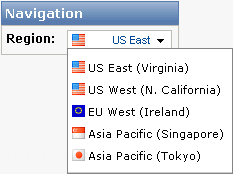
Now Open: AWS Region in Tokyo

I have made many visits to Japan over the last several years to speak at conferences and to meet with developers. I really enjoy the people, the strong sense of community, and the cuisine.

Over the years I have learned that there's really no substitute for sitting down, face to face, with customers and potential customers. You can learn things in a single meeting that might not be obvious after a dozen emails. You can also get a sense for the environment in which they (and their users or customers) have to operate. For example, developers in Japan have told me that latency and in-country data storage are of great importance to them.
Here is a cool logo for the Japan AWS users group.

Put it all together and developers in Japan can now build applications that respond very quickly and that store data within the country.

The JAWS-UG (Japan AWS User Group) is another important resource. The group is headquartered in Tokyo, with regional branches in Osaka and other cities. I have spoken at JAWS meetings in Tokyo and Osaka and they are always a lot of fun. I start the meeting with an AWS update. The rest of the meeting is devoted to short "lightning" talks related to AWS or to a product built with AWS. For example, the developer of the Cacoo drawing application spoke at the initial JAWS event in Osaka in late February. Cacoo runs on AWS and features real-time collaborative drawing.

Amazon's Jeff Barr says he can't share the exact location.

Although I can't share the exact location of the Region with you, I can tell you that private beta testers have been putting it to the test and have reported single digit latency (e.g. 1-10 ms) from locations in and around Tokyo. They were very pleased with the observed latency and performance.

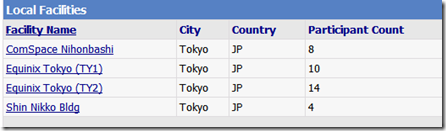
But Amazon's peering point is in Equnix Tokyo.

image

With Equinix listed facilities as
image


I think GreenM3 escaped being labeled a Content Farm

After blogging about the web site getting labeled by Google as a content farm I was wondering how the Green Data Center Blog (GreenM3) would be affected.

I was a bit concerned because I reference a lot of other people's content and take a few parts then comment. Always referencing the original source and to not take too much from the other site.

Why do I think I escaped?

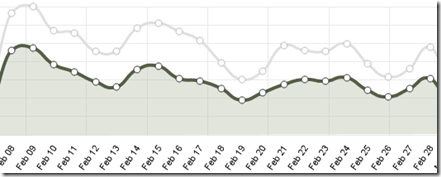
Here is my traffic for last 3 weeks.

image

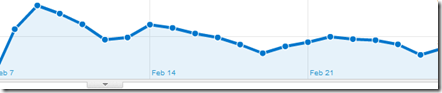
Here is traffic from search engines.

image

Compare this to what happened to the guy who got labeled as a content farm.

google search traffic

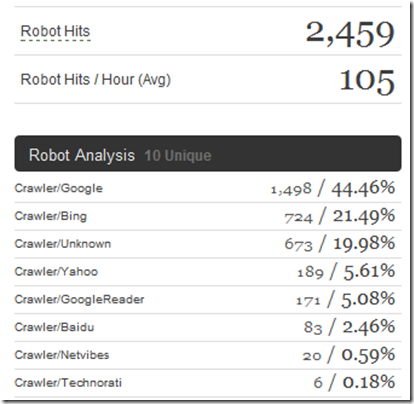
And, in the last 24 hours here are robot hits to my site.

image

One thing that SquareSpace has helped me a lot vs. TypePad is I am getting way more robot hits.

Knock on wood, I think the Green Data Center blog escaped being labeled as a content farm.  Also, what may have saved me is the others sites that do copy my work and don't credit me.  One site stopped copying me a month ago when I sent a cease and desist letter for copyright infringement.

Do you think of what you put in your e-mail before you send? You should

Here is a lesson for many.  One benefit I have of spending so many years working at Microsoft is be very careful what you put in e-mail.  (note I left Mircosoft in 2006)  Assume anything you put in writing could be read by the DOJ.  If you want to have a private conversations don't use e-mail.  Read the following to understand the risks of thinking e-mail is private.

Wikileaks is making news disclosing for the public what people assumed were private conversations.

WikiLeaks

From Wikipedia, the free encyclopedia

WikiLeaks is not affiliated with Wikipedia or the Wikimedia Foundation.

Julian Assange, the main spokesperson and editor-in-chief for WikiLeaks

WikiLeaks is an international non-profit organisation that publishes submissions of private, secret, and classified media from anonymousnews sources and news leaks.

Wikileaks is so popular it now has imitators.  Red Tape discusses an example.

Do WikiLeaks imitators put your e-mail at risk?

Posted: Tuesday, March 1 2011 at 06:00 am CT by Bob Sullivan

Imagine having every e-mail you've written published by hackers for the entire world to see. You don't have to stretch your imagination very far -- it's already happening to some folks.

Here an example of what has caused a huge embarrassment for security company.

Hackers who call themselves Anonymous -- the group that has gained notoriety for attacking Visa and MasterCard in defense of WikiLeaks -- broke into computers operated by a government contractor named HBGary Federal in early February.  Once inside, Anonymous members wreaked all kinds of electronic havoc, including the theft of thousands of employee e-mails. These were then published in searchable form on a Web site similar to WikLeaks, leading to a host of embarrassing disclosures for HBGary employees.  The incident drew so much attention that it was featured in a recent segment on “The Colbert Report.”

Which was so embarrassing the CEO just resigned.

Aaaron Barr, HBGary Federal CEO, resigns

The CEO of HBGary Federal, Aaron Barr, has stated that he is resigning his position. In a telephone interview with Threatpost, Barr said that “I need to focus on taking care of my family and rebuilding my reputation ... It's been a challenge to do that and run a company. And, given that I've been the focus of much of bad press, I hope that, by leaving, HBGary and HBGary Federal can get away from some of that. I'm confident they'll be able to weather this storm."

Here is a detailed post on Anonymous's method to break into HBGary.

Anonymous speaks: the inside story of the HBGary hack

By Peter Bright | Last updated 13 days ago

It has been an embarrassing week for security firm HBGary and its HBGary Federal offshoot. HBGary Federal CEO Aaron Barr thought he had unmasked the hacker hordes of Anonymous and was preparing to name and shame those responsible for co-ordinating the group's actions, including the denial-of-service attacks that hit MasterCard, Visa, and other perceived enemies of WikiLeaks late last year.

When Barr told one of those he believed to be an Anonymous ringleader about his forthcoming exposé, the Anonymous response was swift and humiliating. HBGary's servers were broken into, its e-mails pillaged and published to the world, its data destroyed, and its website defaced. As an added bonus, a second site owned and operated by Greg Hoglund, owner of HBGary, was taken offline and the user registration database published.

Over the last week, I've talked to some of those who participated in the HBGary hack to learn in detail how they penetrated HBGary's defenses and gave the company such a stunning black eye—and what the HBGary example means for the rest of us mere mortals who use the Internet.

Hope you think about your e-mail conversations in a different way.  All my business friends know anything really private we don't put in e-mail.

The Secret is out IT Development Labs need energy efficiency solutions

I have had conversations with Cisco's Chris Noland who presented at Teladata's Technology Convergence Conference and made this comment.

‘People Have Woken Up’

But labs are now being sharing space in data center expansion projects. Noland says Cisco is building a “showcase” engineering lab featuring rack-top chimney containment systems. Last year Brocade consolidated its labs in a brand-new state-of-the-art data center at the company’s new campus in San Jose.

I admit I didn't got to the session as I have been talking with people/companies to implement energy efficiency in lab environments for over 4 years. Why?  Because, even though the data center is the big target there are great opportunities in IT labs.  Here are a few of the reasons I have told people.

  1. Selling in the data center is hard.  Selling into a lab is 10 times easier.
  2. The Lab is willing to experiment more than a data center. (The lab has people who are not as risk adverse as a typical IT data center.)
  3. Many times you only need to sell one person on your solution in a lab.  In a data center you'll be lucky if you only need to sell three people.
  4. The sales cycle is dramatically less in the lab vs. data center.
  5. Start in the lab, then use the lab installation as a demonstration for others in the enterprise. (You need your product installed to sell more long term)
  6. Use the lab as awareness to develop lower energy solutions. (Like Cisco's lab)
  7. The Labs actually use a lot more energy than people think.  (Look at HP, Intel, Sun, IBM, and Microsoft's energy efficiency implementations and they have all addressed the lab.)

Here is the Teladata Technology Convergence Conference session on energy efficiency in R&D labs.


Mark Thiele
11:00 a.m. - 11:40 a.m.
Panel Discussion Topic: Data Center Challenges and Solutions in the R&D Lab

Moderator: Mark Thiele, VP of Data Center Strategy at ServiceMesh
Panelist: Chris Noland, Lab Manager at Cisco Systems Inc.
Panelist: Duffie Cooley, Lab Manager for Juniper Networks
Panelist: Val Sokolov, Senior Manager for Engineering lab services at Brocade

Unlike enterprise and production data centers, today's R&D electronics lab is a dynamic and constantly changing work environment with variable demands for power, space and cooling.  IT engineers expect as much autonomy and flexibility as possible in the way that they access their IT resources and then develop and test their IT solutions.  So, how realistic is it to believe that our new data center standards and "best practices" can be implemented in the IT lab as well?  Hear leading laboratory operators describe their challenges and barriers to success and explain how they have modified well established data center solutions to fit the needs of their unique R&D environments.

And, Rich Miller reported on the presentation.

Engineering Labs: An Efficiency Opportunity

February 28th, 2011 : Rich Miller

A panel on engineering labs at the Technology Convergence Conference featured Mike Honer from Juniper Networks, Chris Doland from Cisco Systems and Val Sokolov from Brocade.

As America’s largest companies begin to get a handle on their data center energy usage, they’re widening their gaze to scrutinize the efficiency of their engineering labs. Managers of some of the leading lab operations in Silicon Valley say the attention is long overdue, and will lead to significant energy savings.

The secret is out that IT labs need energy efficient solutions.  There is still huge opportunities to sell energy efficient solutions, and more people are discussing the idea.  I just can't tell people it's a little known area of opportunity to go after.  But, it does feel good I was talking about the idea 4 years before it gets up on a panel discussion.  And, I've moved on to a bunch of different ideas I am playing with that nobody is discussing.

FYI, part of the reason I research and blog on topics is to watch what the industry is doing so I can figure out the opportunities.

Prineville local news on Facebook promoting Green Data Center features

Here is a local news spot on KTVZ about Facebook's data center and its green features.

Facebook Prineville: Lot of Data, Lot of Green

'Simplicity Is the Key Here,' says Manager of Huge Data Center

By Adam Aaro, KTVZ.COM

POSTED: 7:17 pm PST February 28, 2011

PrintEmail

PRINEVILLE, Ore. -- To realize just how big Facebook has become, think about this: One out of every 14 people in the world use it.

Now sit back and imagine what it would take to capture and communicate the billions upon billions of status updates, photo albums and friend requests.

Soon, all of that will happen every second of the day inside the company's data center in Prineville, and Facebook says it will do it using some of the most cutting-edge and energy efficient practices in the world.

"It's simplistic. Simplicity is the key here. Complexity creates waste and we have built specifically a simplistic, easy to use, low energy design," Site Manager Ken Patchett said during my recent visit.

Here is a video.  Not a lot new, but interesting to see the story Facebook is building for its April 2011 opening.