Are Tablets a longer term threat to Smart Phones than Laptops?

My AT&T bill just finished a billing cycle, I used 650 minutes total on my cell phone plan and 500 MB of data.  Most of my data access is on wifi.  Do I really need a smartphone?  Or will my future Motorola Xoom make the smartphone obsolete?  Some people are addicted to be connected all the time, but is it better to have a dumb cell phone and be connected with a Tablet when you want to?

Businessweek has an article exactly on this idea.

Size Matters: Tablets vs. Smartphones

When consumers weigh buying a tablet, a smartphone, and a basic, no-frills phone for calling, the smartphone looks expendable, contends analyst Eric Chan

By Eric Chan

STORY TOOLS

Smartphones are the products most at risk of cannibalization in the rising tide of tablet sales—not laptops, as some industry analysts are predicting.

Current forecasts for the 'tablet effect' are shortsighted and fail to consider the long-term implications that this phenomenon will have on the mobile electronics industry. While tablets are likely to crimp laptop and netbook sales for the first year or so—until consumers fully understand what a tablet is—the long-term trend is different. Laptop sales will bounce back. Smartphone sales will drop. This long-term trend should be clear just by looking at user surveys, product evolution, the redundancy factor, and basic economics.

Eric Chan sees the change in the younger audience.

I specifically see smartphone sales falling among consumers in the 13-17 and 18-24 year old markets. Young consumers will start buying down on their phones, opting to buy a tablet plus a feature phone, rather than the expensive redundancy of a smartphone and a tablet, or the limited features of just a smartphone. These age groups are particularly vulnerable because they are already adopting tablets and e-readers as book replacements. Changing readership habits provides a strong incentive for moving to a tablet device; these demographics' smaller budgets will necessitate a buy-down on the phone. In the 25-34 market, consumers will still use smartphones when employers provide them. Left to their own devices, a significant proportion will opt instead for a tablet, plus a basic phone.

Businessweek says Cloud Tech Titans are Amazon, Google, & Microsoft

Businessweek has a cover story on the cloud titans.

The Cloud: Battle of the Tech Titans

Amazon, Google, and Microsoft are going up against traditional infrastructure makers like IBM and HP as businesses move their most important work to cloud computing, profoundly changing how companies buy computer technologyhttp://images.businessweek.com/mz/11/11/600/1111_mz_cloud.jpg


Fredrik Broden

By Ashlee Vance

THIS ISSUE

magazine cover

March 7, 2011

The Power of the Cloud

Amazon.com's (AMZN) squat Seattle headquarters looks nothing like the country club affairs found in Silicon Valley. There are no free soft drinks or volleyball courts. The light fixtures hanging from the ceiling in the reception area aren't fixtures at all but rather collections of extension cords fitted with bulbs. The receptionists lack computerized systems for registering guests. They simply write down visitors' names on a piece of paper. Such is low-margin life in online retail, where Wal-Mart (WMT) stands at the ready, waiting to take away your extension cords.

But is this really a cloud fight or the new battle in Information Technology?

"Things are downright Darwinian right now," says Mike Olson, the chief executive officer of Cloudera, a startup that specializes in data analytics software. "There hasn't been this type of Cambrian explosion in corporate technology in 20 years."

Is this the future?

Scott Raney, a partner at venture capital firm Redpoint Ventures, which has invested in numerous cloud-powered startups, views the recent acquisitions and outpouring of rhetoric as a signal that the big boys fully appreciate what's at stake. Still, he can foresee their numbers dwindling as great volumes of data are sucked up into the cloud. The disaster scenario for the traditional heavyweights is that Amazon, Google, and Microsoft end up as the corporate information kingpins.

"There is one school of thought that the world is heading toward three really big data centers owned by those three companies," says Raney. "They will be the world's computers, more or less, and all the software will be running there. It's a pretty extreme view, but that's spooking the hell out of all the other companies."

Why I ordered a Motorola Xoom vs. an iPad 2, the Google Cloud

My family has an iPad original which is great for watching movies and surfing the web.  The iPad 2 just shipped on Mar 11, and it was tempting to get an iPad 2 to share with the family.  One of my friends got an iPad 2 on Mar 11 and shared his experience vs. his iPad 2.

I have been enjoying it as much as my original iPad.  Impressions:
- I still find them too slippery!  the smooth aluminum back slides around in my lap.
- it feels a lot thinner.  it feels more like Dave's Kindle 3 in thickness
- it feels a lot lighter, again, closer to Dave's Kindle 3.
- the screen feels brighter
- the operation is snappier.  I find that web pages are rendering faster.  I am getting less of the checkerboard placeholder while web pages render.  I also sense that the lag between starting a touch operation and the system detecting that is shorter, resulting in snappier response in games, etc.
- I read that the white bezel could be distracting and that the black was superior.  I deliberately bought the white to try that out, and to distinguish it from my original iPad (now my son’s).  I am not as used to it yet, but once I am reading, I can't say that I really notice it.  The content, especially that about Japan's earthquake and tsunami are so compelling that the bezel isn't really a factor.
- I haven't seen the fancy new covers yet, but I hear that they are great.  One site is predicting that Apple will sell nearly $1BN of the covers alone!!  what a business!!

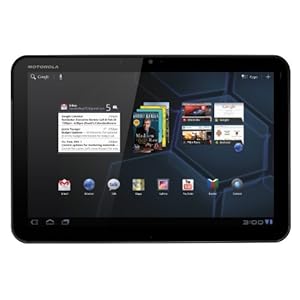
Amazon.com and others are taking orders starting Mar 16, 2011 for the $599 Motorola Xoom 32GB wifi tablet.
by Motorola

new

Price:
$599.00 & eligible for free shipping with Amazon Prime

This item has not yet been released.
You may pre-order it now and we will deliver it to you when it arrives.
Ships from and sold by Amazon.com.

I decided to place an order for a Motorola Xoom as many of my technical friends prefer Google Android vs. Apple iOS operating system.

Forbes has a blog entry on the iPad 2 vs. the Xoom which has a high 22,781 views

Apple iPad 2 vs. Motorola Xoom: Which Wins As A Business Tool?

Mar. 14 2011 - 1:31 pm | 22,781 views | 2 recommendations | 9 comments

The iPad 2 (left) is thinner than the Xoom (right) but has a slightly smaller screen than its rival.

If you are a Travelgeek you either have or are considering one of the latest tablet computers. A lot has been written on this topic, so my focus is on the utility and value of these devices for the pro business traveler. Is it worth the investment?

After reading the Forbes post, it became clearer what I am looking for in the Xoom vs. the iPad.

Why do I believe that Android will prevail? It is because almost all of our lives are now wrapped around Google and its incredible data search and access capabilities. Apple, in my view, cannot compete with what Google can offer to Smartphone and tablet users: an amazing array of instant information from anywhere in the world which has been integrated into the functionality of a tablet or Smartphone through its Android operating system.

I use Gmail and Google Search more than any other app.  For the same reason Microsoft shipped apps for the Mac, but eventually developed more for Windows given they owned the OS, they could do more.  Google can do more on Android than Apple’s iOS.

There are many out there who are happy being an Apple device family.  But, in my work Google is the dominant player with almost no need for Apple software.  I may need to apps running on my iPhone, but I don’t actually need the iPhone.

Google is a company who lives in the cloud.  If you want to leverage the cloud why wouldn’t you get their device.  The Motorola Xoom is the better device for working with the Google cloud than the iPad.  The iPad may be better for entertainment and media, but that is not my work. 

Part 2 of the Forbes blog on iPad 2vs. Xoom closes with.

As the Xoom takes its place as the serious business tablet, then I guarantee you will appreciate its attributes over the iPad, especially if you are computer-savvy and can appreciate the design differences between it and the iPad 2.

As to the utility of tablets in general, I found more and more uses for my iPad during the past year and have come to realize its value and versatility as a computing device. Having said that, it has only taken me two weeks to all but discarded it in favor of what I consider as the “Grown Up” new tablet for business: the Xoom.

Intel endorses Micro Server Market Segment, offers low power Atom and Xeon

Even since the Intel Atom was introduced I have been asking when there would be little green servers for those cases where low power is a higher priority.

ZDNet covers the Intel Announcement.

Intel builds its microserver, ARM hedges

By Larry Dignan | March 15, 2011, 3:48pm PDT

Summary

Intel doesn’t do wimpy chips and made its name pushing performance. But just in case this crazy microserver thing takes off Intel wants you to know it has a master plan.

Intel doesn’t do wimpy chips and made its name pushing performance. But just in case this crazy ARM-based microserver thing takes off Intel wants you to know it has a master plan.

In a briefing Tuesday, Intel executives rolled out its plan for microservers, small low-power units that are used in large-scale environments deployed by the likes of Facebook. The plan: Release new Xeons that are built for microservers.

Here’s a look at Intel’s money slide from its microserver talk:

The Intel news room has a press release.

Chip Shot: Intel Outlines Low-Power Micro Server Strategy

Posted by Patrick Darling on Mar 15, 2011 9:52:52 AM

Intel disclosed its roadmap for low-power processors for the emerging micro server category today, including a new server processor based on the Intel® Atom™ processor microarchitecture targeted for 2012. Micro servers share infrastructure resources and are ideal for workloads where many low-power, dense servers may be more efficient than fewer, more robust servers. Intel will deliver four new processors for the category that span 45 watt high performance to sub-10 watt, all with server features including 64-bit, Intel® Virtualization Technology and Error-Correcting Code (ECC). Customers are already planning designs based on these processors, including Intel® Xeon® processors E3-1260L and E3-1220L in production now.

With a pdf fact sheet on the emerging micro server category.


Are the 4 biggest management vendors the dinosaurs with the arrival of clouds? IBM, HP, CA, BMC

SearchDataCenter has an article on system management tools in the virtual age.

Systems management in the virtual age: Out with the old

By Alex Barrett, Executive Editor

15 Mar 2011 | SearchDataCenter.com

Consider how Facebook has changed the fabric of society by providing new ways for people to connect. With its large, relatively new data center, the social media company and other organizations like it provide fresh ideas for IT pros working on an old problem: systems management.

Many of these large companies use open source tools and tweak them as they see fit. Stuart Radnidge, an infrastructure architect at a large, multinational financial services firm, viewed a video demonstration of Facebook engineers and their back-end management. “You never see guys like them buying from the Big Four,” Radnidge said. “They use open source tools and modify them for their massive scale.”

Indeed, in era of the Internet and virtualization, IT managers seek inspiration on how to manage their environments from everywhere except the Big Four-- otherwise known as IBM, Hewlett-Packard, BMC Software and CA. And for the up-and-coming generation of systems administrators, traditional systems management tools are almost anathema.

The tools of choice are open source.

While most open source software is associated with Linux, these tools can monitor an impressive breadth of systems, said FSW’s Foran. In Hyperic’s case, “I think the only operating system they can’t see is BeOS,” he quipped, surely a corner case in any modern data center.

Further, having access to the source code and a community of developers translates into new features much faster than in a monolithic, closed-source environment, said the senior product manager at a large Canadian telecommunications firm, which last year replaced traditional Big Four monitoring tools with the commercial open source Zenoss.

The article does point to some who are making the change.

In their defense, traditional systems management players have awakened to the new world and responded by acquiring new forward-looking management players. In the past year, for example, CA purchased 3Tera, a cloud and grid management platform, and Software as a Service-based monitoring provider Nimsoft Technologies.

As ZDNET's  Dan Kunetsky has had conversations with CA's Jay Fry, so have I.

CA's Jay Fry touches on the Golden Rules of IT

By Dan Kusnetzky | February 4, 2011, 2:54am PST

Summary

When good enough is no longer good enough, and management is screaming about costs, cloud computing just could be the answer.

From time to time, I have the chance to speak with Jay Fry, of CA. We’ve had many similar experiences over the years and have come to present similar viewpoints. A blog post he published a while back, Making ‘good enough’ the new normal focused on a couple of the Golden Rules of IT

I wrote something on these rules a long time ago (see Reprise of the Golden Rules of IT if you’d like to torture yourself by reviewing the rules) and believe that Jay has a point. Golden Rule number 4 is “Good enough is good enough” and Golden Rule number 5 is “Don’t make major changes unless people are screaming!” Let’s look at the definition of those rules

4. Good enough is good enough. Although it would be nice to have the luxury of unlimited amounts of time, resources and funding and be able to develop every conceivable feature, most IT executives know that they are only going to be allowed the time, the resources and the funding to satisfy roughly 80% of requests for new capabilities.

5. Don’t make major changes unless people are screaming! If they’re not screaming, see Rule #4, good enough is good enough. If they are merely asking for changes, see Rule 2, don’t touch it, you’ll break it, and Rule 3, if you touched it and broke it, it will take longer to fix than you think. If they begin screaming, you’ll have to do something to respond, just touch things as lightly as possible.