Ex-Goldman Sachs programmer gets 8 years for stealing high-frequency trading code

Reuters has the news on an Ex-Goldman Sachs programmer sentenced to 8 years in prison.

Ex-Goldman programmer gets 8 years for code theft

Sergey Aleynikov and his lawyer, Sabrina Shroff, depart from federal court in New York February 17, 2010. REUTERS/Chip East

By Grant McCool

NEW YORK | Fri Mar 18, 2011 10:55pm EDT

(Reuters) - A former Goldman Sachs Group Inc (GS.N) computer programer was sentenced to eight years in prison on Friday for stealing secret code used in the Wall Street bank's valuable high-frequency trading system.

Sergey Aleynikov, was arrested by the FBI and charged in July 2009 with copying and removing trading code from Goldman before taking a new job at Teza Technologies LLC, a high-frequency trading startup firm in Chicago.

But, who would believe his statement?

"I very much regret the foolish thing of downloading information," theRussian-born father of three said at his sentencing on Friday. "Part of this information was proprietary to Goldman. I never meant to cause Goldman any harm or harm anyone at the bank."

He goes to Teza Technologies where his actions were traced.

But the strange thing is that even though Aleynikov was a software expert, (his credentials are impressive - Read Linkedin profile), the mistake he made was downloading so much source code to his home computer since his programming commands were recorded by Goldman's back-up systems, as reported by The New York Times (see below). The bank also noticed the surge in data moving from its servers.

This is what happened according to New York Times DealBook: "...just before he left (Goldman Sachs), according to the complaint, Mr. Aleynikov used his desktop computer at Goldman's New York offices to upload a stream of code to a Web site hosted by a server based in Germany. Later, he downloaded the files again to his home computer, his laptop computer and to a memory device."

The case sheds light on the secret world of high frequency trading, but also attests to the security precautions taken by investment banks. Meanwhile, ZeroHedge points out that Aleynikov was arrested the day after he joined Teza Technologies, co-founded by Misha Malyshev, a former head of high-frequency trading at hedge fund Citadel Investment Group LLC. (Teza was reportedly paying hin $1.4 million.) Aleynikov was suspended without pay and Teza is cooperating with the investigation, according to a Teza spokesman's statement, which also said the firm was not aware of alleged misconduct.The case sheds light on the secret world of high frequency trading, but also attests to the security precautions taken by investment banks.
News Source for US Military Activities in Libya, AFRICOM

I have some friends who do some work for three letter acronyms entities and they pointed me to AFRICOM as some innovative thinking.  One of things that is useful going to the AFRICOM Military website is you can get access to the public documents and images shared on things like the US Military activities in Libya that media outlets reuse.

Here are a few pictures that are open for the public to view.

image

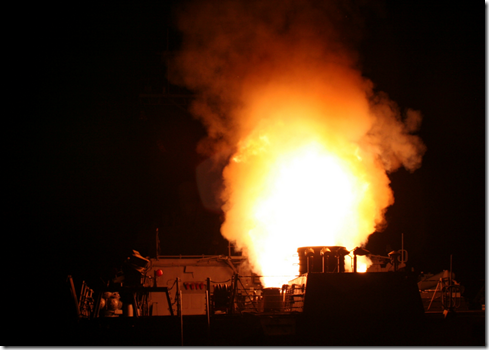
MEDITERRANEAN SEA - Arleigh Burke-class guided-missile destroyer USS Stout (DDG 55) launches a Tomahawk missile in support of Operation Odyssey Dawn on March 19, 2011. This was one of approximately 110 cruise missiles fired from U.S. and British ships and submarines that targeted about 20 radar and anti-aircraft sites along Libyaaâ€s Mediterranean coast. Joint Task Force Odyssey Dawn is the U.S. Africa Command task force established to provide operational and tactical command and control of U.S. military forces supporting the international response to the unrest in Libya and enforcement of United Nations Security Council Resolution (UNSCR) 1973. UNSCR 1973 authorizes "all necessary measures" to protect civilians in Libya under threat of attack by Qadhafi regime forces. JTF Odyssey Dawn is commanded by U.S. Navy Admiral Samuel J. Locklear, III. (U.S. Navy photo by Petty Officer 2nd Class Nathan Pappas) [20110320132841 ]

MEDITERRANEAN SEA - The Arleigh Burke-class guided-missile destroyer USS Stout launches a Tomahawk missile in support of Operation Odyssey Dawn, March 19, 2011. This was one of approximately 110 cruise missiles fired from U.S. and British ships and submarines that targeted about 20 radar and anti-aircraft sites along Libya's Mediterranean coast. Joint Task Force Odyssey Dawn is the U.S. Africa Command task force established to provide operational and tactical command and control of U.S. military forces supporting the international response to the unrest in Libya and enforcement of United Nations Security Council Resolution 1973. (U.S. Navy photo by Petty Officer 3rd Class Jeramy Spivey) [20110320124046 ]

image

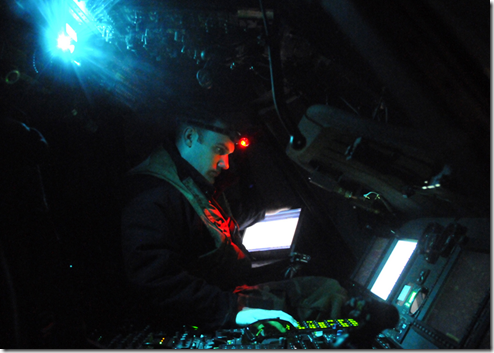
MEDITERRANEAN SEA - Petty Officer 2nd Class Joseph Fremen, with Helicopter Sea Combat Squadron (HSC) 22, calibrates the forward looking infrared (FLIR) system of a MH-60S Knight Hawk helicopter on the flight deck of amphibious assault ship USS Kearsarge (LHD 3) in support of Operation Odyssey Dawn, March 19, 2011. The FLIR system allows pilots a 360-degree view of the area surrounding the helicopter. Joint Task Force Odyssey Dawn is the U.S. Africa Command task force established to provide operational and tactical command and control of U.S. military forces supporting the international response to the unrest in Libya and enforcement of United Nations Security Council Resolution (UNSCR) 1973. UNSCR 1973 authorizes all necessary measures to protect civilians in Libya under threat of attack by Qadhafi regime forces. JTF Odyssey Dawn is commanded by U.S. Navy Admiral Samuel J. Locklear, III. (U.S. Navy photo by Petty Officer 3rd Class Scott Pittman) [20110320131427 ]

This AFRICOM press release was more informative than most media articles out there if you are looking for facts.

Beginning late on March 19, 2011, the U.S. military launched strikes against selected military targets in Libya, launching more than 120 Tomahawk cruise missiles from U.S. ships and U.S. and British submarines.
U.S military assets that participated in the strikes include: two U.S. Navy ships and three submarines; 15 U.S. Air Force aircraft, including the B-2 Spirit Bomber and four U.S. Marine Corps AV-8B Harriers all of which launched strikes against targets in Libya. These targets include SA-5, SA-3 and SA-2 air defense systems around Libyan airfields and various munitions sites. U.S. Navy EA-18G Growlers provided electronic warfare support.

...

In a statement late March 19, U.S. AFRICOM commander General Carter Ham discussed U.S. and international objectives. Ham stated, "Our goals are simple: We want to protect innocent civilians, prevent attacks against civilian communities, and deter mass atrocities."
U.S. leaders and their international counterparts have defined clear objectives for military actions, Ham noted. These include:

  • A cease-fire must be implemented and all attacks against civilians must stop
  • Troops must stop advancing against Benghazi and must be pulled back from Ajdabiya, Misrata, and Zawiya.
  • Water, electricity, and gas supplies must be turned on to all areas.
  • Humanitarian assistance must be allowed to reach the people of Libya.

Twitter's Data Center Migration Story on its 5th Birthday

There is lots of news out there on Twitter's 5th Bday. Twitter launched a new website and video.

Twitter Launches New Website & Video To Celebrate Its 5th Birthday [VIDEO]

In celebration of its fifth birthday, Twitter has launched a new website and a new video featuring some of its most prominent users.

Twitter employees have started tweeting links to discover.twitter.com, a website that features 16 different users from a variety of backgrounds, including entertainment, political, business and even astronautics. The list includes tennis star Serena Williams, Virgin Group founder Richard Branson, rapper Snoop Dogg, U.S. Speaker of the House John Boehner and astronaut Paolo Nespoli, among other recognizable celebrities and institutions.

What will be missed by most is the data center story by the Twitter engineering team.

Twitter Engineering

MONDAY, MARCH 21, 2011

The Great Migration, the Winter of 2011

If you look back at the history of Twitter, our rate of growth has largely outpaced the capacity of our hardware, software, and the company itself. Indeed, in our first five years, Twitter's biggest challenge was coping with our unprecedented growth and sightings of the infamous Fail Whale.
These issues came to a head last June when Twitter experienced more than ten hours of downtime. However, unlike past instances of significant failure, we said at the time that that we had a long-term plan.

Here are a few nuggets that jump out.

Once all the data was in place we began serving live traffic from the second data center for end-to-end testing and to continue to shed load from our primary data center. Confident that our strategy for replicating Twitter was solid, we moved on to the final leg of the migration, building out and moving all of Twitter from the first and second data centers to the final nesting grounds. This essentially required us to move Twitter a second time. Yes, that’s right, we moved all of Twitter twice!

Twitter discusses three data centers.

First, our engineers extended many of Twitter’s core systems to replicate Tweets to multiple data centers. Simultaneously, our operations engineers divided into new teams and built new processes and software to allow us to qualify, burn-in, deploy, tear-down and monitor the thousands of servers, routers, and switches that are required to build out and operate Twitter. With hardware at a second data center in place, we moved some of our non-runtime systems there – giving us headroom to stay ahead of tweet growth. This second data center also served as a staging laboratory for our replication and migration strategies. Simultaneously, we prepped a third larger data center as our final nesting ground.

Another released pieced of information is Twitter's expected employee growth from 350 to 3,000 in 2 years.

Now headquartered in the South of Market, Twitter is eyeing a move to Brisbane. Twitter CFO Ali Rowghani informed city officials last week that if the proposed tax exemption were approved, the company would move into the vacant Furniture Mart on Market Street just east of Ninth Street. It projects growing its current workforce of 350 to 3,000 by 2013.

Web 2.0 vs. Enterprise, know your users and their religious orientation

It is interesting how fiefdoms develop in IT.  One of the latest divisions that occur is the enterprise IT group vs. the Web 2.0 online services group.  I've laughed many times watching data center executives walk into Web 2.0 companies and pitch their wares. 

One mistake made most often is using the same presentation they use for a corporate enterprise IT department as the Web 2.0  department.  See this for a web 2.0 department definition.  Think Twitter, Facebook, Zynga

The term Web 2.0 is associated with web applications that facilitate participatory information sharing, interoperability, user-centered design,[1] and collaboration on the World Wide Web. A Web 2.0 site allows users to interact and collaborate with each other in a social media dialogue as creators (prosumers) of user-generated content in a virtual community, in contrast to websites where users (consumers) are limited to the passive viewing of content that was created for them. Examples of Web 2.0 include social networking sites, blogs, wikis, video sharing sites, hosted services, web applications, mashups and folksonomies.

For enterprise software, think of something you would sell to a government IT department on a department that has mainframes.

Why is this important because Web 2.0 people look down at the enterprise IT as people who are in the past, and they are better.  Telling a Web 2.0 department of your enterprise sales doesn't impress them, it can handicap you as a product not appropriate for Web 2.0.

Don't expect this to logical, it is kind of religious.

Evidence shows AWS is not perfect, Reddit reports outage due to AWS

Amazon Web Services (AWS) is on fire being a leader in the industry and with companies like Netflix committing to AWS, they look like the perfect cloud computing environment to many.  For over a year I’ve heard of many though who are looking to move out of  AWS as they run into performance problems.

DataCenterKnowledge reports on the problems Reddit has had using AWS.

  • Reddit Ties Outage to Amazon Performance

    March 18th, 2011 : Rich Miller

    UPDATE: Reddit has now updated its post from saying that it “been working to completely move Cassandra off EBS and onto local storage” to say that it is moving Cassandra “off of EBS and onto the local storage which is directly attached to the EC2 instances.” We have updated out post to reflect that Reddit has not reduced its use of AWS, but only the way it deploys resources on it.

    The social news siteReddit is revising how it uses Amazon’s cloud computing service following performance problems that contributed to six hours of downtime for the Reddit site this week. The Reddit operations team attributed the outages to problems with Postgres and Cassandra servers deployed on Elastic Block Storage (EBS), a service offered by Amazon Web Services. Reddit said EBS servers in a single U.S. availability zone for AWS experienced performance problems.

It will be interesting to watch as more stories become public of those who are moving out of AWS.  Where are companies moving to?  Many big players are going straight to wholesale space.  Some are going to Softlayer where they can get get dedicated hardware.  Keep in mind the hot start-ups like Reddit most of time have their code written to scale on multi-processor servers and utilize the hardware capabilities without virtualization.

If you don’t need virtualization why go to the cloud?

There is a good reason why Amazon doesn’t rent out dedicated hardware.  Do you know why?