A 10X increase in GreenM3 traffic increases latency, what was hitting my site?

Last night I wrote about Amazon.com’s Cloud Drive, and noticed a 10X increase in traffic.

image

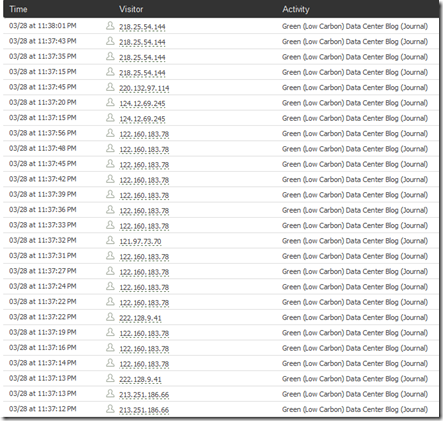
Which was actually unrelated to the post as a dump of the traffic shows a bunch of repeated URLs hitting only the home page.

image

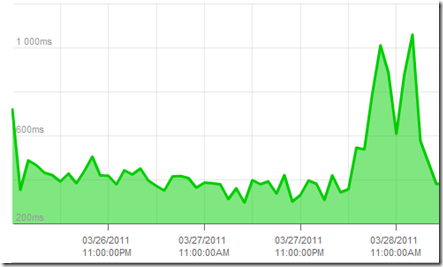
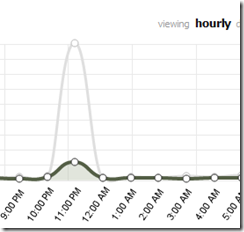
Latency spiked, but the site stayed up.  The following is from Pingdom monitoring www.greenm3.com.

image

Curious I am going to contact SquareSpace support to see if they were showing any other activity like this to their site.

The quick response from SquareSpace gave me the answer in 3 minutes.  Very cool.

This is a form of spam. Robots attempt to add comments on pages with forms in hopes that your website posts comments without moderation. They're not actually trying to hack into your account -- they're seeing the form and trying to leave a reciprocal link for the site they're promoting.
We've been trying to block these, but occasionally they slip through. No need to block the IP -- the fact that they hit the site so many times will alert our spam filters.
Sorry for the troubles.

Amazon Announces Cloud Drive, that explains Amazon’s data center build out in Oregon

Amazon.com, Inc. (NASDAQ:AMZN) just announced Cloud Drive along with Cloud Player.

image

Introducing Amazon Cloud Drive, Amazon Cloud Player for Web, and Amazon Cloud Player for Android

Buy anywhere, play anywhere and keep all your music in one place
Start with 5 GB of free Cloud Drive storage - upgrade to 20 GB free with purchase of any MP3 album

SEATTLE, Mar 29, 2011 (BUSINESS WIRE) --

Amazon.com, Inc. (NASDAQ:AMZN) today announced the launch of Amazon Cloud Drive (www.amazon.com/clouddrive), Amazon Cloud Player for Web (www.amazon.com/cloudplayer) and Amazon Cloud Player for Android (www.amazon.com/cloudplayerandroid). Together, these services enable customers to securely store music in the cloudand play it on any Android phone, Android tablet, Mac or PC, wherever they are. Customers can easily upload their music library to Amazon Cloud Drive and can save any new Amazon MP3 purchases directly to their Amazon Cloud Drive for free.

"We're excited to take this leap forward in the digital experience," said Bill Carr, vice president of Movies and Music at Amazon. "The launch of Cloud Drive, Cloud Player for Web and Cloud Player for Android eliminates the need for constant software updates as well as the use of thumb drives and cables to move and manage music."

Here is the site for Cloud Drive.
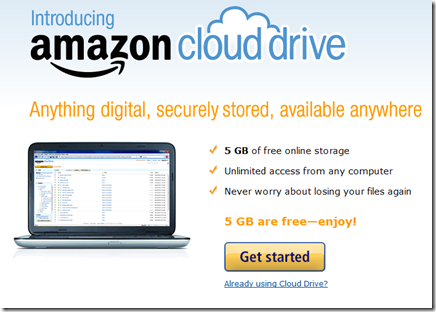
image

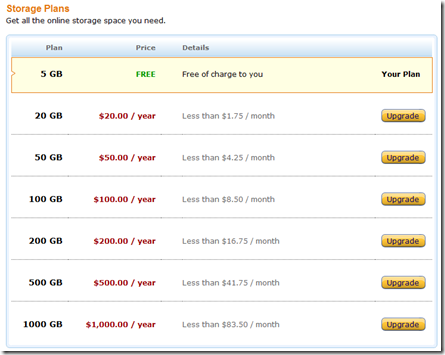
After 5 GB here is the pricing.

image

The music battle between Apple iTunes and Amazon MP3 Store are turned up a notch.
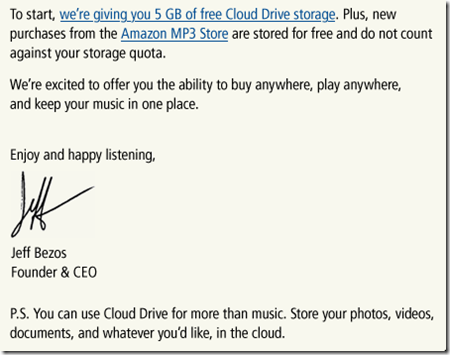
image

Here are some technical details on what is behind cloud drive.

A Drive in the Cloud

To build Amazon Cloud Drive the team made use of a number of cloud computing services offered by Amazon Web Services. The scalability, reliability and durability requirements for Cloud Drive are very high which is why they decided to make use of the Amazon Simple Storage Service (S3) as the core component of their service. Amazon S3 is used by enterprises of all sizes and is designed to handle scaling extremely well; it stores hundreds of billions of objects and easily performs several hundreds of thousands of storage transaction a second.

Amazon S3 uses advanced techniques to provide very high durability and reliability; for example it is designed to provide 99.999999999% durability of objects over a given year. Such a high durability level means that if you store 10,000 objects with Amazon S3, you can on average expect to incur a loss of a single object once every 10,000,000 years. Amazon S3 redundantly stores your objects on multiple devices across multiple facilities in an Amazon S3 Region. The service is designed to sustain concurrent device failures by quickly detecting and repairing any lost redundancy, for example there may be a concurrent loss of data in two facilities without the customer ever noticing.

Cloud Drive also makes extensive use of AWS Identity and Access Management (IAM) to help ensure that objects owned by a customer can only be accessed by that customer. IAM is designed to meet the strict security requirements of enterprises and government agencies using cloud services and allows Amazon Cloud Drive to manage access to objects at a very fine grained level.

A key part of the Cloud Drive architecture is a Metadata Service that allows customers to quickly search and organize their digital collections within Cloud Drive. The Cloud Player Web Applications and Cloud Player for Android make extensive use of this Metadata service to ensure a fast and smooth customer experience.

DataCenterKnowledge just posted on expanded data center growth by Amazon in Oregon, speculating on AWS growth, but the big growth is Amazon Cloud Drive & Player which is specifically in Amazon S3.

Amazon’s Cloud Goes Modular in Oregon

March 28th, 2011 : Rich Miller

The data center arm of Amazon.com is building data centers at three sites in Oregon, according to local media, who report that two of the sites are using a modular design. A third site, which has been the focus of on-and-off construction activity for several years, appears to be employing a more traditional design.

With the new projects, Amazon.com joins major cloud builders Google, Microsoft and Yahoo in embracing factory-built components as a strategy to reduce the cost and deployment time for data center capacity. The Oregon construction is part of a larger effort by Amazon to prepare for a significant expansion of its data center capacity to accommodate the growth of its cloud computing business, Amazon Web Services (AWS). Amazon has also been acquiring property near Dublin, Ireland to expand the European data center hub for AWS.
Starbuck’s CEO Howard Schultz story, an 8 year break as CEO. Would Bill Gates follow the example?

Starbuck’s Howard Schultz releases his story on returning to Starbucks as CEO.

From Publishers Weekly

Starred Review. In 2000, Starbuck's founder and CEO Schultz (Pour Your Heart into It) stepped down from daily oversight of the company and assumed the role of chairman. Eight years later, in the midst of the recession and a period of decline unprecedented in the company's recent history, Schultz-feeling that the soul of his brand was at risk-returned to the CEO post. In this personal, suspenseful, and surprisingly open account, Schultz traces his own journey to help Starbucks reclaim its original customer-centric values and mission while aggressively innovating and embracing the changing landscape of technology. From the famous leaked memo that exposed his criticisms of Starbucks to new product strategies and rollouts, Schultz bares all about the painful yet often exhilarating steps he had to take to turn the company around. Peppered with stories from his childhood in tough Canarsie, N.Y., neighborhoods, his sequel to the founding of Starbucks is grittier, more gripping, and dramatic, and his voice is winning and authentic. This is a must-read for anyone interested in leadership, management, or the quest to connect a brand with the consumer. (Mar.)
(c) Copyright PWxyz, LLC. All rights reserved.

When I see this story and I start reading it (I have pre-ordered the Kindle edition, so it should show up on my Kindle in 2 hours at Midnight PT.), I wonder if Bill Gates would follow Howard Schultz’s example and return to Microsoft.  Many say Bill would never go back, but I am sure many said the same of Howard Schultz.

Howard felt so good about his accomplishments he wrote a book to tell the story.  Can you imagine the story Bill would tell after 8 years returning to Microsoft?  I bet there would be many people who left Microsoft who would return if Bill came back.

High Voltage Power Line Construction Video

Data Center discussions always lead to a power discussion.  But, usually the power lines are in place so rarely do people discuss high voltage power line construction.

Here are two time lapse construction videos that compress a lot of hard work putting high voltage power lines in place.

Mission Critical Patterns - Hospitals and Data Centers have resistant to change and collaboration

WSJ has an article on The Secret to Fighting Infections.  What got my attention is the following statement.

PETER PRONOVOST: The main barriers are the lack of collaboration and a culture that is resistant to change. There is also a lack of systems integration.

Hospitals and Data Centers have much in common from a building perspective.  Location is critical.  Power back-up is a given.  The buildings are very expensive, but what is in them is just as expensive.  They are a bunch of really smart people using the building, and with the smart people come egos that are not necessarily very collaborative.  Then you add on the risk avoidance.  In hospitals, malpractice/legal types of issues.  In Data Centers, those who make mistakes are many times the first to be fired as fingers of blame point.  Administrators who are looking to cut costs.

Here is the example of the hospital problems.

Nurses and pharmacists work for the hospital, which typically has clear lines of authority and procedures for dealing with failure to follow accepted practices. But physicians are often self-employed, have little training in teamwork and, perhaps like all of us, are often overconfident about the quality of care they provide, believing things will go right rather than wrong. Nurses are often reluctant to question them, and hospitals don't pressure physicians about teamwork for fear of jeopardizing the business they bring to the hospital.

Facility Ops and Sys admins are like the nurses and pharmacists with clear lines of authority and processes.  Developers and business unit are owners are like the Physicians.

The WSJ article focuses on safety and fighting infections in the hospital.