GigaOm points to 10 ways to achieve a Greener Data Center

Next week on Apr 21, 2011 is Green:Net 2011 and the folks at GigaOm have been helping to spread the news for green data centers.  Here is a post on 10 ways to green the data center.

10 Ways Data Centers Are Becoming Greener

By Katie Fehrenbacher Apr. 13, 2011, 12:00am PT

Energy efficient data centers have solidly moved into the (low power) spotlight in recent weeks thanks to the Open Compute Project from Facebook. Last week the social network giant shared an unprecedented amount of data about its low power servers and data center designs that have enabled its new data center in Oregon to be remarkably energy efficient. To me, the move shows just how important these energy efficient characteristics have become for the leading Internet companies as a way to stay competitive and keep their energy costs as low as possible.

4 years when I started blogging on green data centers people thought I was silly.  Now it is common and expected for data center operators to discuss their environmental impact.

I have my next idea brewing on what I think I should blog as a whole topic in data centers no one discusses now.  But, for now Green Data Centers has me plenty busy.

Fed CIO targets a key area to improve Fed IT, World Class Program Managers

I was reading ZDNET's post on the Fed targeting to close 800 data centers by 2015.

Fed CIO Kundra: We need to shut 800 data centers down by 2015

By Larry Dignan | April 12, 2011, 1:49pm PDT

Summary

Vivek Kundra, the chief information officer of the Federal government, said Tuesday that the company is actively shutting down 800 data centers by 2015.

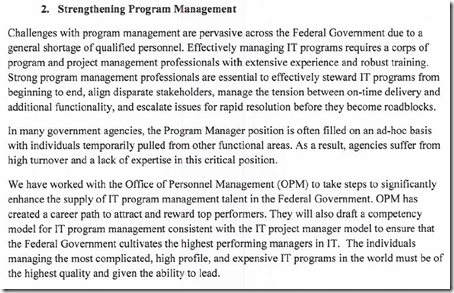
Then I read the PDF testimony by Vivek Kundra to understand more, and found the section on strengthening program managers.

image

I spent much of my career at Apple and Microsoft as a program manager working on operating system releases.  Three of some of the best I worked with are:

Sheila Brady - Project Leader for System 7

Dennis Adler - Group Program Manager for Windows 95


While a director for MSR, Mr. Adler led a team from Research to the Windows Server Division and oversaw the initial development of a new server deployment and management technology that shipped with Windows Server 2003; formed the University Relations Group in
MSR and oversaw its rapid growth and initial expansion into Europe and Asia; was instrumental in MSR’s initial external public relations endeavors; and was a liaison between MSR and Microsoft’s product teams, as well as a Group Program Manager in the Personal
Systems Division.  Mr. Adler led the team responsible for designing and overseeing the development of the core components for Windows 95

John Medica - Project Leader for Macintosh II

John K. Medica retired as Senior Vice President and Co-Leader, Product Group from Dell Inc. in April 2007. In 1993, Mr. Medica joined Dell as Vice President, Portable Systems. During 1996, he served as President and Chief Operating Officer of Dell?s Japan division. He returned to the U.S. in August 1997 as Vice President, Procurement, and later served as Vice President, Web Products Group, and Vice President and General Manager, Transactional Product Group. Prior to joining Dell, he served as Project Leader for the Macintosh II, Director of the Macintosh CPU Projects Group and Senior Director of PowerBook Engineering with Apple Computer. Mr. Medica received his bachelor?s degree in Electrical Engineering from Manhattan College, and his master?s degree in Business Administration from Wake Forest University. Mr. Medica is currently a director of Compal Electronics, Inc., a publicly traded company.

These are some of top program managers I learned a lot from and the unique talent to manage complex projects with 100s if not 1000s of people on projects that were market successes.  And, I have been lucky to be able to connect with these great program managers even the products shipped.

Facebook Prineville Data Center Design and Site Selection Video

Jay Park, Facebook's Director of Data Center Design presents at the Open Computer Project.

Jay explains three reasons why Prineville was chosen.

    1. Available power
    2. Network
    3. Climate for running with chillers

Highlights the 480V/277V power system and chiller-less cooling system.

In the above video is a 3D rendering of the data center showing airflow.  Note: these 3D renderings are not part of the Open Compute Project web site.

Three examples of what Facebook doesn't include in Open Compute, like the use of Fusion IO integration

There are many out there who believe Facebook's Open Compute Project published all the details on Facebook's new data center.  When I see the Open Compute website  I see what is missing more than what is there.  So, let's try and list a couple of areas where Facebook doesn't share its data center information.

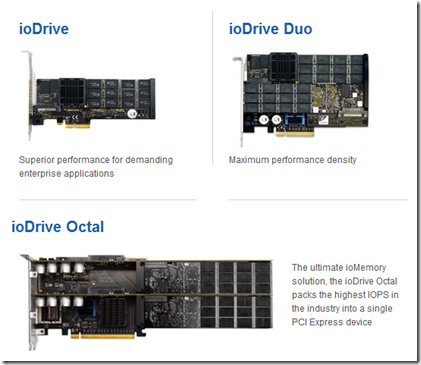
1)  ZDNET's Between the Lines reports on Fusion-IO plans for IPO and Facebook is its largest customer.  The Fusion IO products look like the following.

image

When you look at the Open Compute PCB, you don't see any Fusion IO products or mention of solid state memory or PCIe slots.  There is an external PCI Express connector, but no explanation of what connects to it.

Image of AMD motherboard

image

How are the Fusion IO product being used by Facebook?  I can't find any details on Open Compute regarding the use of Fusion IO, can you?

Why wouldn't this be share, because knowing how Facebook uses solid state memory in its servers is a competitive advantage.

2)  What is the % mix of server skus and from what vendors.  Dell DCS is part of the launch event and is a supplier of Facebook. HP is mentioned as well.  Supermicro and many others have sold servers to Facebook.  What % of the 150,000+ servers Facebook has are Open Compute Project versions? 

image

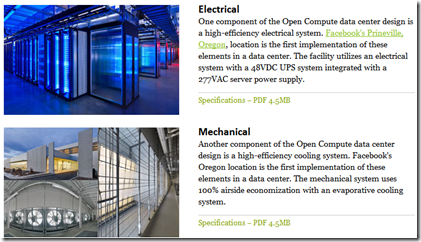
3) Where are the drawings for the Electrical and Mechanical systems?

image

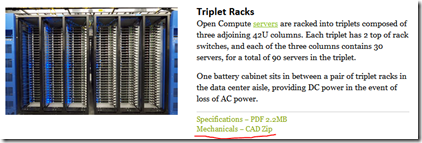
The Triplet Racks do have mechanical drawings.

image

Why wouldn't Facebook publish their mechanical drawings for the electrical and mechanical systems?  Either they are too valuable and give away too many secrets and/or they don't own the distribution rights from the data center engineering design companies.  We'll see if Facebook ever publishes its mechanical and power drawings.