Data Center shortage is not Power, Cooling, or Network, but executives - Apple hires Microsoft's Data Center GM

Much of what you hear about data centers is from the vendors who have marketing budgets to sell solutions for power, cooling, and networking issues in data centers.  But, you know what is one of the scarcest resources around? Data center executives.  If vendors had a way to package up executives, we'd hear more.  Wait maybe that is a way to think about the new wave of Data Center Infrastructure Management (DCIM) tools.  Data center executive in a box.  Interesting idea, but that is a later post.  Back to data center executives.

Whenever I sit down with a data center insider to catch up, we almost always discuss executive movement to other companies.  In some ways it is a short hand way to discuss what is going on in the industry as it can mean many different things why an executive moves from one company to another.

News that a bunch of us have been discussing is Apple hiring Kevin Timmons (GM of Microsoft's data center services group).  Don't expect any press releases from Apple or Microsoft on this one.  Here is probably one of the last articles we'll see featuring an interview with Kevin Timmons talking about green data centers and knowledge sharing posted by DataCenterDynamics. 

Datacenter Leaders Q&A Kevin Timmons, Microsoft

Kevin Timmons, General Manager, Data Center Operations, Microsoft believes in sustainability, knowledge sharing, security and modularity

Published 13th April, 2011 by Ambrose McNevin

DC_Leaders_Dozen_KevinTimmonds_ver2

DCD Q: What can the data center industry do to increase its influence over government policy?

KT, A: At Microsoft, we think there is an opportunity for everyone in the industry to help share our collective knowledge to help the entire industry evolve and influence policies that benefit all our customers and increase greater efficiencies. We are committed to driving software and technology innovations that help people and organizations improve the environment.

The position Kevin is going to fill is not known and is not the position vacated by the departed Olivier Sanche.  Olivier's position has been filled by another data center operations executive. 

It is such a small world in data centers and especially smaller for the executive rank, information flows as recruiters call and others want opinions on various candidates and companies to work for.  Besides the executives, senior data center design engineers are heavily recruited like Facebook recently hired a senior mechanical engineer from Equinix and Google's Daniel Costello who also came from Microsoft.  Mike Manos is proud of his renegade action to recruit Daniel from Intel to Microsoft while he had the job that Kevin Timmons had filled and now departed.

I called him [Daniel Costello] and told him I needed him for my program.  No HR.  No Recruiters.  I wanted the best talent possible and he was it.   I offered him the job on the spot over the phone.   We were building something incredible.

One of the interesting problems is at many companies working in the data center group is not respected and as well paid as other technical positions.  In fact, some technology companies probably don't even think of their data center staff as technical.  Which then leaves the opening for the neglected to find greener pastures.  At Google the data center group is respected.  At Facebook, the data center group is respected.  At Apple, most learn about data centers from the media as there is little news on Apple's data centers discussed.

In one of the data center insider conversations a friend jokingly mentioned The Manchurian Candidate where sleeper agents are placed in strategic positions, and later are activated for covert activities.  With so many executives moving from competing companies will there be psychological analysis looking for latent devious action?  Nah. But, it was good for a laugh.  Which by the way is part of chatting about who is moving where.  We eventually start laughing about some move somewhere which could make this appear like gossip.  But, we know the data center executive shortage is real, and where the scarce resources go influences the system. 

Data Center Gossip can be useful.

Have You Heard? Gossip Turns Out to Serve a Purpose

By BENEDICT CAREY

Published: August 16, 2005

...

People find it irresistible for good reason: Gossip not only helps clarify and enforce the rules that keep people working well together, studies suggest, but it circulates crucial information about the behavior of others that cannot be published in an office manual. As often as it sullies reputations, psychologists say, gossip offers a foothold for newcomers in a group and a safety net for group members who feel in danger of falling out.

"There has been a tendency to denigrate gossip as sloppy and unreliable" and unworthy of serious study, said David Sloan Wilson, a professor of biology and anthropology at the State University of New York at Binghamton and the author of "Darwin's Cathedral," a book on evolution and group behavior. "But gossip appears to be a very sophisticated, multifunctional interaction which is important in policing behaviors in a group and defining group membership."

Google Infrastructure is more than Data Centers and Servers, it's software

In the data center world if you hear the word infrastructure you naturally think of the data centers and servers.  Why not Infrastructure is defined as:

Infrastructure is the basic physical and organizational structures needed for the operation of a society or enterprise,[1] or the services and facilities necessary for an economy to function.[2] The term typically refers to the technical structures that support a society, such as roads,water supply, sewers, electrical grids, telecommunications, and so forth.

A couple of years ago at a conference I was talking to a Google architect and I eventually asked what he did.  He said I work on the infrastructure.  When he said infrastructure I named a few people in the data center group I had ran into at data center  conferences, but he didn't know any of those people.  Then, he repeated I work on THE infrastructure.  What we build our applications on - search, storage, compute.  OHHH, you guys get it that your infrastructure is more than physical devices.  Software is infrastructure few think about to build services.  Most typically think physical infrastructure.

GigaOm has a post with Google's Infrastructure czar, Urs Hölzle.  Om Malik says it has been 5 years since he has touched base with Urs.  I would never go that long.

Hölzle was company’s first VP of engineering, and he has led the development of Google’s technical infrastructure.

Hölzle’s current responsibilities include the design and operation of the servers, networks and data centers that power Google. It would be an understatement to say that he is amongst the folks who have shaped the modern web-infrastructure and cloud-related standards.

When you read the GigaOm post don't just think physical infrastructure, think about the software Google has in place to support cloud services.

Others might disagree, but Hölzle believes Google’s common infrastructure gives it a technological and financial edge over on-premise solutions. “We’re able to avoid some of that fragmentation and build on a common infrastructure,” says Hölzle. “That’s actually one of the big advantages of the cloud.”

GigaOm points to 10 ways to achieve a Greener Data Center

Next week on Apr 21, 2011 is Green:Net 2011 and the folks at GigaOm have been helping to spread the news for green data centers.  Here is a post on 10 ways to green the data center.

10 Ways Data Centers Are Becoming Greener

By Katie Fehrenbacher Apr. 13, 2011, 12:00am PT

Energy efficient data centers have solidly moved into the (low power) spotlight in recent weeks thanks to the Open Compute Project from Facebook. Last week the social network giant shared an unprecedented amount of data about its low power servers and data center designs that have enabled its new data center in Oregon to be remarkably energy efficient. To me, the move shows just how important these energy efficient characteristics have become for the leading Internet companies as a way to stay competitive and keep their energy costs as low as possible.

4 years when I started blogging on green data centers people thought I was silly.  Now it is common and expected for data center operators to discuss their environmental impact.

I have my next idea brewing on what I think I should blog as a whole topic in data centers no one discusses now.  But, for now Green Data Centers has me plenty busy.

Fed CIO targets a key area to improve Fed IT, World Class Program Managers

I was reading ZDNET's post on the Fed targeting to close 800 data centers by 2015.

Fed CIO Kundra: We need to shut 800 data centers down by 2015

By Larry Dignan | April 12, 2011, 1:49pm PDT

Summary

Vivek Kundra, the chief information officer of the Federal government, said Tuesday that the company is actively shutting down 800 data centers by 2015.

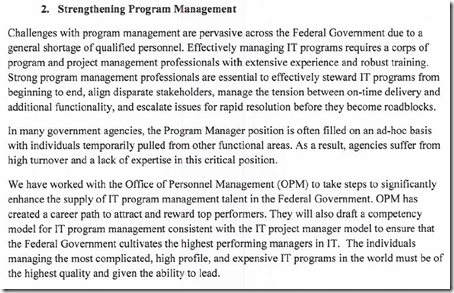
Then I read the PDF testimony by Vivek Kundra to understand more, and found the section on strengthening program managers.

image

I spent much of my career at Apple and Microsoft as a program manager working on operating system releases.  Three of some of the best I worked with are:

Sheila Brady - Project Leader for System 7

Dennis Adler - Group Program Manager for Windows 95


While a director for MSR, Mr. Adler led a team from Research to the Windows Server Division and oversaw the initial development of a new server deployment and management technology that shipped with Windows Server 2003; formed the University Relations Group in
MSR and oversaw its rapid growth and initial expansion into Europe and Asia; was instrumental in MSR’s initial external public relations endeavors; and was a liaison between MSR and Microsoft’s product teams, as well as a Group Program Manager in the Personal
Systems Division.  Mr. Adler led the team responsible for designing and overseeing the development of the core components for Windows 95

John Medica - Project Leader for Macintosh II

John K. Medica retired as Senior Vice President and Co-Leader, Product Group from Dell Inc. in April 2007. In 1993, Mr. Medica joined Dell as Vice President, Portable Systems. During 1996, he served as President and Chief Operating Officer of Dell?s Japan division. He returned to the U.S. in August 1997 as Vice President, Procurement, and later served as Vice President, Web Products Group, and Vice President and General Manager, Transactional Product Group. Prior to joining Dell, he served as Project Leader for the Macintosh II, Director of the Macintosh CPU Projects Group and Senior Director of PowerBook Engineering with Apple Computer. Mr. Medica received his bachelor?s degree in Electrical Engineering from Manhattan College, and his master?s degree in Business Administration from Wake Forest University. Mr. Medica is currently a director of Compal Electronics, Inc., a publicly traded company.

These are some of top program managers I learned a lot from and the unique talent to manage complex projects with 100s if not 1000s of people on projects that were market successes.  And, I have been lucky to be able to connect with these great program managers even the products shipped.