Facebook invites Goldman Sachs, Rackspace, AMD, and Microsoft to speak at Open Compute Summit, announces Open Compute Foundation non-profit

In Facebook's summary of the Open Compute Summit, they mention a community of presenters - Rackspace, Goldman Sachs, AMD, and Microsoft.

As a part of growing the community, the following people shared their perspectives:

  • Joel Wineland and Bret Piatt from Rackspace shared their thoughts on how Open Compute Project servers could fit into their data center business. What was really awesome is that Rackspace benchmarked our Open Compute Project AMD 1.0 servers  against their own off-the-shelf hardware, and our servers did very well. For the first time, independent, external feedback on our designs was shared with the community! Rackspace also expressed what they would like to see this community do: to be ambitious and, most of all, to innovate.
  • Grant Richard and Matthew Liste from Goldman Sachs presented their vision of OCP hardware filling a big role in their large scale compute clusters and, more importantly, how hardware from multiple Open Compute Project vendors could dramatically improve their ability to manage their systems, which are much more heterogeneous than ours.
  • Bob Ogrey from AMD presented interest in Open Compute technology from China and other countries in East Asia, and discussed how AMD intends to open up their motherboard design files to ODMs in the near future.
  • Dileep Bhandarkar from Microsoft shared his experiences building modular data centers, comparing and contrasting with the data center and server designs from the Open Compute Project. Most importantly, Dileep presented a number of technological areas Microsoft is potentially interested in engaging with the Open Compute Project going forward.

To continue the community effort Frank announced they will launch the Open Compute Foundation.

To help facilitate collaboration, Frank also announced our intention to create a non-profit foundation with roles ranging from using this hardware to building it to actually contributing to the specifications and leading entire projects. While all of the details aren't yet worked out, each project will be separate, allowing you to choose exactly the areas where you want to contribute and want to avoid. These projects must embody the four tenets of efficiency, economy, environmental friendliness, and openness that have driven the Open Compute project from the start. Projects and hardware sold based on these designs must be aligned with these core tenets before they can call themselves "Open Compute."
Facebook's Open Compute Project shares 2x Server v2.0 future and Storage Server v1.0

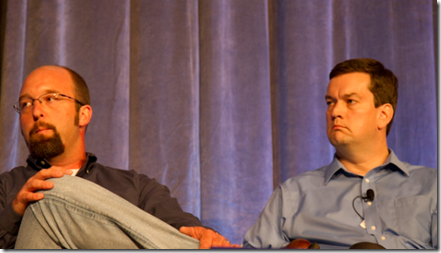
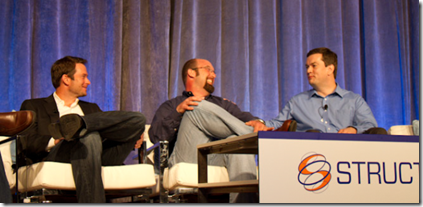
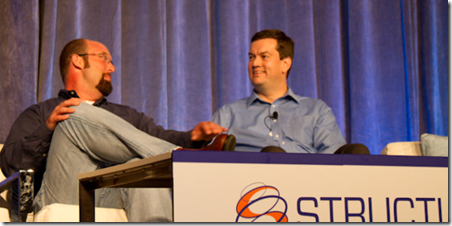
Facebook's Frank Frankovsky was on a panel at Structure 2011 and was as Dell's Forrest Norrod the baloney in the sandwich between the vendors VMware and Dell.  Frank looks like a pretty happy piece of Baloney here.

image

THE ECONOMICS OF OPEN EVERYTHING

The power of open-source software can’t be denied. At its best, it has democratized innovation and is a stub for other subsequent innovations. Think Apache and the web. But where is the money in it? Does there have to be a profit motive? We talk to two exponents of recent projects -- Open Stack and Cloud Foundry -- both of which are open and have the promise to shake up the cloud industry.

Moderated by:Lew Moorman - Chief Strategy Officer and President of the Rackspace Cloud, Rackspace
Speakers:Derek Collison - CTO, Chief Archictect, Cloud Division, VMware

Frank Frankovsky - Director, Hardware Design and Supply Chain, Facebook

Forrest Norrod - VP and GM, Server Platforms, Dell

The session was dynamic and Forrest Nod was able to crack a few smiles as well.

image

I didn't get a picture of Frank and Forrest smiling at the same time, but they are both looking quite serious here.

image

I caught Frank later at the conference and he said they shared their Open Compute summit information that they had on June 17, 2011.  I am going to break the information into a few posts - this one is server and storage hardware.

Facebook's Amir Michael announced v2.0 of the Open Computer Server that doubles the motherboard densities in the 1 1/2 U design.

Doubling the Compute Density

Amir Michael, Facebook’s hardware design manager, introduced our new initiatives in server hardware, presenting new AMD and Intel motherboard designs that double the compute density relative to our original designs.

Instead of placing a single motherboard in each chassis, we’re now building servers with two narrow motherboards sitting next to each other. These motherboards support the next generation of Intel processors and AMD’s Interlagos. To enable these new designs, we’ve also modified the server chassis, power supply (700W output from 450W), server cabinet, and battery backup cabinet.

What was not clear is what Facebook does for big storage for all the pictures on Facebook pages.  And.... the answer is Storage Server 1.0 which can support from one to four server connections with a variety of connection technologies to provide low cost and high performance.

Storage Server v1.0

One question that has been asked a number of times since releasing version 1.0 of the Open Compute designs is if Facebook plans to build a storage server. Amir announced a project designed for our storage intensive applications. It’s actually a platform approach in that you can vary the ratio of compute to storage using the same physical building blocks. If you fully load the server, each storage node can support 50 hard drives split across two controllers.

Tough, Mean, Chaos Monkey Logo

Mike Manos presented on the Chaos Monkey and Donkey idea at Uptime.

Chaos Monkeys, Donkeys and the Innovation of Action

May 19, 2011 by mmanos

Last week I once again had the pleasure of speaking at the Uptime Institute’s Symposium.  As one of the premiere events in the Data Center industry it is definitely one of those conferences that is a must attend to get a view into what’s new, what’s changing, and where we are going as an industry.  Having attended the event numerous times in the past, this year I set out on my adventure with a slightly different agenda.

When I caught up with Mike he told me a lot of people said they were guilty of being data center donkeys.

Interestingly after my talk I literally have dozens of people come up and admit they had been donkeys and offered to reconnect next year to demonstrate what they had done to evolve their operations.

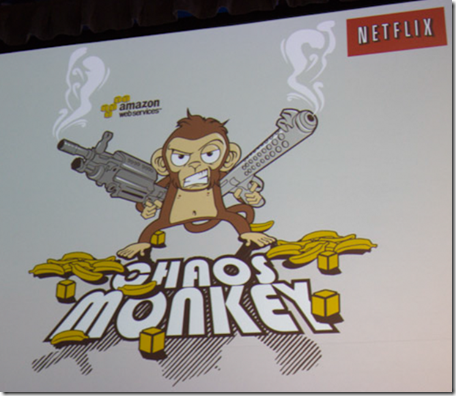
Werner Vogel at GigaOm Structure discussed the Chaos Monkey idea used at Netflix and had a slide.  Check out this logo.

image

The funny thing is the data center executive I was sitting with in Mike's presentation said He is a Chaos Monkey.  I am guilty of being a Chaos Monkey.

Now that you see a graphic.  Are you a donkey or a Chaos Monkey?

Future of Cloud Computing presentation at #structureconf

There is panel discussion at GigaOm Structure.

THE FUTURE OF THE CLOUD PANEL

Recently, GigaOM Pro, The 451 Group, and Northbridge Venture Partners conducted an industry survey to map the future of enterprise cloud computing. The results of the survey will be revealed for the first time in this panel, and we will hold a lively discussion among the stakeholders in key industry sectors about the implications of these results.

Moderated by:Michael Skok - General Partner, North Bridge Venture Partners
Speakers:Dries Buytaert - Co-Founder and CTO, Acquia

John Dillon - CEO, Engine Yard

Marten Mickos - CEO, Eucalyptus Systems

Lew Moorman - Chief Strategy Officer and President of the Rackspace Cloud, Rackspace

What is cool is you can see the slides here.  Here are a few from the presentation.