An Example of why I blog, gaining insight to how important topics are

I come up with all kinds of ideas and many times I wonder whether others think the ideas are any good.  In the old days, I would test an idea by sharing them with others and see what they had to say.  Now, I can write a blog entry and see the traffic numbers.  Some may say the comment are what people read, but  I don't spend time on the comments as moderating comments takes up just as much time as writing blog entries if not more and is much more frustrating.

Here is an example.  Before going to 7x24 Exchange I saw Domenic Alcaro from Schneider was to present on the idea of Human Error in the Data Center.  I had talked to Domenic on the phone and met him in person for the first time at Uptime Symposium in May.  I asked Domenic if I could get a copy of his presentation before hand to see what he had to say.  This gave me time to think about what he was presenting and how his ideas could be applied.  I posted Domenic's talk here.

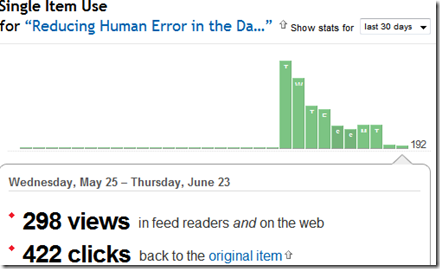
Curious I wanted to see what traffic was.  On Feedburner I got these numbers.  The 192 is the peak read on the first day.  Domenic presented to 100 people at 7x24 and I double the reach with one blog entry in one day. Smile

image

In addition I had another 200 hits, so metrics were about 900 view/clicks.  The raw number isn't as important as how this compares to my other entries.  This one is in top group of interest.

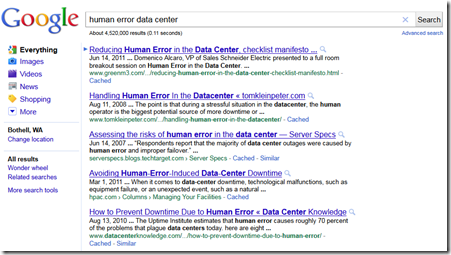
Google search "human error data center" and my entry is #1.

image

So why blog all this.

  1. I want to share these results with Domenic, and it takes me just as much time to write a blog entry as writing an e-mail.
  2. It is good once in a while to see what my readers think is important.
  3. It explains part of the reason why I am a pervasive blogger, and what I learn from sharing ideas.

An Example of what I am thinking of what I'll be working on next

At Structure I ran into some of my readers and they asked what I was planning on doing next as I posted on my plan to change what I work on.

Time to make some changes, my present to myself for my 51st B'day, "it is time"

FRIDAY, JUNE 17, 2011 AT 6:13AM

5 Years ago, I quit Microsoft after 14 years with no idea what I was going to do next.  What I did know is after 5 years I would be working on things that were much bigger and more fun than than what I was doing at Microsoft when I left.  Working on Win3.1, Win95, Windows 2000, and Windows XP were the most fun I had at Microsoft and I have the best memories.  Working at Apple, re-architecting the physical distribution system, being part of the hardware team on the Macintosh II, and working on software components for System 7 was when I had the most fun at Apple.  HP fresh out of school, I had all kinds of ideas on what I wanted to try.  Ideas in quality/reliability engineering, process engineering, and distribution logistics were fun.  Yeh, I am engineering nerd.  Why can’t the same ideas I worked on 30 years ago be applied to data centers?

I was lucky to catch up with one of my old friends who was visiting from Japan yesterday and review some of my plans.  Another of our SW friends who has been working on cloud solutions for the three years said our friend stationed in Japan was in town.  Both of these guys are extremely smart SW operating system, application development, and even data center operations experience.  I quickly sent e-mail seeing if he was available for dinner and cleared my schedule.  As background, we all used to work together at Apple 20 years ago.  One engineer worked for the other at Apple and Adobe.  The senior engineer worked for me for a while at Microsoft and we have always had great discussions on technology, but haven't formed a business together.  Now is the time to try.

In the hour dinner conversation we reviewed the solution and he agreed on the innovative approach that works well in data centers, but applies to many other areas besides data centers.  He complimented me that I had figured out some great insights being immersed in data centers that no one thinks about, and the ideas scale like a platform.  Platform ideass like we did at Apple and Microsoft with operating systems.

We discussed patent strategies, and he came up with better intellectual property protection mechanisms.  We discussed user interface design and real time information vs. post analysis processing of information.  We agreed on a strategy to create a new language that solves many issues we discussed. 

The two engineers will meet in person on Saturday for lunch and hopefully come up with more ideas. We'll have a conference call on Monday to review things as a group.

This reminds of the fun we had at Apple where I was project leader and supported great engineers who knew the right thing to do.  We all left Apple in the dark ages of 1992-3 after System 7.  Neither of us went back to Apple, but we look fondly back to the old days when we were much younger.  One of great lessons we all learned early on at Apple was the confidence and method to create solutions with no data to support the product.  There is no data that supports the solution we are thinking about will work and what the market size is.  The typical business plan approach would be to conduct a market analysis study.  Nahh.  We are going to build it.

My next data center conference is 7x24 Exchange Phoenix in Nov, 2011 and I'll see if some of the SW engineers will join me there.

Quincy Diesel Generator footprint, 69 existing + 28 Dell + 44 Sabey

Wenatchee World writes on the state of Diesel generator permits for data centers in Quincy, WA.

Ecology seeks comments on data center generators

By K.C. Mehaffey
World staff writer

Thursday, June 23, 2011

QUINCY — The state Department of Ecology wants public comment of its review of the impact of 28 diesel-powered generators that would provide electricity during power failures for the new Dell Data Center under construction in Quincy.

The 28 engines proposed for Dell’s 350,000-square-foot building would be added to 69 diesel generators already permitted at three other Quincy data centers — 37 at Microsoft, 23 at Yahoo and 9 at Intuit, said Greg Flibbert, Ecology’s project manager for the data center permits.

He said Sabey Corp. is also proposing to install 44 diesel generators for its 520,000-square-foot data center, but Ecology has not yet issued a draft permit for Sabey’s proposal, which will have its own public review period.

What’ll win for the hardware of the future? Lowest TCO, not efficiency or performance

GigaOm has a post on the Structure session with Calxeda, SeaMicro, and Tilera.

Efficiency vs. performance: What’ll win for the hardware of the future?

By Ryan Lawler Jun. 23, 2011, 6:09pm PT 2 Comments

Stacey Higginbotham (GigaOM), Barry Evans (Calxeda), Andrew Feldman (SeaMicro),Don Newell (AMD), Omid Tahernia (Tilera) - Structure 2011At GigaOM’s Structure conference, hardware executives from Calxeda, SeaMicro, AMD and Tilera battled it out over how the hardware infrastructure of the future will take shape. For the most part, the debate came down to the need for highly efficient hardware that used up a fraction of the space and a fraction of the power of legacy hardware solutions, versus the desire for more powerful options from existing hardware makers.

I started blogging on the idea of the little green server with an Intel Atom 3 years ago.

Little Green Server Ideas Starting

TUESDAY, JULY 29, 2008 AT 12:48AM

ExtremeTech has an article building an Intel Atom based PC.

Intel's Atom has generated a lot of attention. Some of that attention has been positive: Intel building an x86 CPU whose primary design goal is very low power usage while maintaining good performance. On the other hand, Atom has been criticized for given up some key performance features, such as speculative, out-of-order execution.

What the author misses in making this an efficiency vs. performance battle is with many software services at large scale the cost of providing the service is the issue.  People want performance and efficiency, but want defines success is the cost of the service.

The next year will be when we see these servers hitting the market in mass.  Whoever is providing the lowest cost for performance per watt is most likely going to be winning the most amount of business.

I would watch the guys at Calxeda with ARM processors.

Facebook invites Goldman Sachs, Rackspace, AMD, and Microsoft to speak at Open Compute Summit, announces Open Compute Foundation non-profit

In Facebook's summary of the Open Compute Summit, they mention a community of presenters - Rackspace, Goldman Sachs, AMD, and Microsoft.

As a part of growing the community, the following people shared their perspectives:

  • Joel Wineland and Bret Piatt from Rackspace shared their thoughts on how Open Compute Project servers could fit into their data center business. What was really awesome is that Rackspace benchmarked our Open Compute Project AMD 1.0 servers  against their own off-the-shelf hardware, and our servers did very well. For the first time, independent, external feedback on our designs was shared with the community! Rackspace also expressed what they would like to see this community do: to be ambitious and, most of all, to innovate.
  • Grant Richard and Matthew Liste from Goldman Sachs presented their vision of OCP hardware filling a big role in their large scale compute clusters and, more importantly, how hardware from multiple Open Compute Project vendors could dramatically improve their ability to manage their systems, which are much more heterogeneous than ours.
  • Bob Ogrey from AMD presented interest in Open Compute technology from China and other countries in East Asia, and discussed how AMD intends to open up their motherboard design files to ODMs in the near future.
  • Dileep Bhandarkar from Microsoft shared his experiences building modular data centers, comparing and contrasting with the data center and server designs from the Open Compute Project. Most importantly, Dileep presented a number of technological areas Microsoft is potentially interested in engaging with the Open Compute Project going forward.

To continue the community effort Frank announced they will launch the Open Compute Foundation.

To help facilitate collaboration, Frank also announced our intention to create a non-profit foundation with roles ranging from using this hardware to building it to actually contributing to the specifications and leading entire projects. While all of the details aren't yet worked out, each project will be separate, allowing you to choose exactly the areas where you want to contribute and want to avoid. These projects must embody the four tenets of efficiency, economy, environmental friendliness, and openness that have driven the Open Compute project from the start. Projects and hardware sold based on these designs must be aligned with these core tenets before they can call themselves "Open Compute."