2x Storage and Performance for less cost, a greener storage solution?

StorageMojo has a post on Backblaze’s most recent open source storage solution.

2 years ago Backblaze, an online backup provider, open-sourced their storage pod design: 45 drives in a box (see Build a RAID 6 array for $100/TB). Now they’re back with v2: 45 3TB drives in a box with higher performance.

Backblaze uses this device for their storage service, and compare their costs vs. AWS S3.

And the savings over renting cloud storage can be substantial as this Backblaze chart suggests:
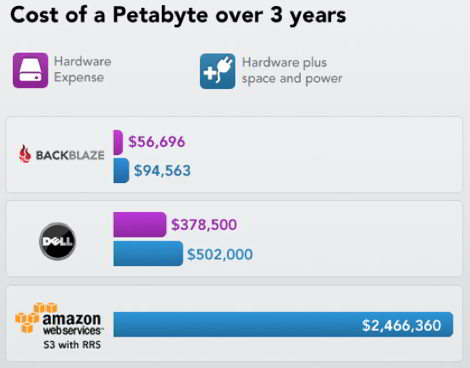
True, Amazon provides many more services, but if you need petabytes for mini-bucks, this is hard to beat.

Backblaze blog discusses its own savings.

Density Matters – Double the Storage in the Same Enclosure

We upgraded the hard drives inside the 4U sheet metal pod enclosure to store twice as much data in the same space. After the cost of filling a rack with pods, one datacenter rack containing 10 pods costs Backblaze about $2,100 per month to operate, roughly divided equally into thirds for physical space rental, bandwidth, and electricity. Doubling the density saves us half of the money spent on both physical space and electricity. The picture below is from our datacenter, showing 15 petabytes racked in a single row of cabinets. The newest cabinets squeeze one petabyte into three-quarters of a single cabinet for $56,696.

Backblaze Storage Servers in Datacenter

Our online backup cloud storage is our largest cost, and we are obsessed with providing a service that remains secure, reliable and, above all, inexpensive. We’ve seen competitors unable to react to these demands who were forced to exit the market, like Iron Mountain, or raise prices, like Mozy and Carbonite. Controlling the hardware design has allowed us to keep prices low

Is Seamicro SM1000 series the mainframe of the Web2.0 data centers?

There has been a bunch of press on Seamicro's latest SM1000 product.  The press release is here.

SeaMicro Introduces the SM10000-64HD, Setting Industry Record for Energy Efficiency and Compute Density

July 17, 2011

With 384 Intel® Atom™ Dual-core 1.66 GHz Processors; 768 64-bit Cores and 1,275 GHz in a 10 Rack Unit System

SUNNYVALE, Calif., July 18, 2011 – SeaMicro™, the Silicon Valley pioneer of low power server technology, today announced the immediate availability of the world’s most energy efficient 64-bit x86 server: the SM10000-64HD™. SeaMicro has once again defined best in class by improving its own compute density record by 150 percent and increasing its own industry leading compute per-watt metric by 20 percent. The new SM10000-64HD replaces 60 traditional servers, four top of rack switches, four terminal servers and a load balancer while using one-fourth the power and taking one-sixth space—all without requiring any changes to software.

I have been talking to a couple of people who have hands on experience with the Seamicro boxes.  One way to think about the Seamicro box is as if it is different type of mainframe.

Mainframes are designed to handle very high volume input and output (I/O) and emphasize throughput computing. Since the mid-1960s, mainframe designs have included several subsidiary computers (called channels or peripheral processors) which manage the I/O devices, leaving the CPU free to deal only with high-speed memory. It is common in mainframe shops to deal with massive databases and files. Gigabyte to terabyte-size record files are not unusual.[5] Compared to a typical PC, mainframes commonly have hundreds to thousands of times as much data storage online, and can access it much faster.[citation needed] Other server families also offload I/O processing and emphasize throughput computing.

Thanks the processor and high volume server wars, the data center in dominated by Intel Xeon based servers typically running in 2 processor configuration.  Few 4, 8, 16 processor configurations are sold.  For Big Iron for Amazon.com and eBay type of loads there are the Sun Servers for big Oracle databases, but Sun no longer has the presence in data centers it used to.

SPARC Enterprise M9000 Server

Oracle's most scalable mission-critical server for the largest, most demanding workloads

Designed for mission-critical environments, Oracle's SPARC Enterprise M9000 server delivers massive scalability, with up to 64 processors and 256 cores for the most demanding virtualization, consolidation, and multi-hosting deployments.

SPARC Enterprise M9000

Now the problem with a mainframe metaphor is mainframes are considered dying, but look how IBM has extended the life of the mainframe.

The safe thing to do for a Web 2.0 company is to continue down the path of low cost dual processor servers, networked with top of rack gigabit switches.

Even though some look at Seamicro in terms of the Intel Atom processor, I pay more attention to how Seamicro is solving the IO and networking issues that are typical bottlenecks for throughput.  Consider this job posting at Seamicro.

SeaMicro is looking for an experienced Senior Hardware Design Engineer to architect and implement a flexible and scalable networking solution for its next generation data center products. This is an excellent opportunity for high-energy candidates who can take a complex networking solution from conception, through execution, to first customer shipment.

Qualifications:

  • 10+ years of experience in high-performance/high-bandwidth micro-architecture
  • 10+ years of experience in Verilog RTL development, with some experience in design/development of networking chips
  • Experience with designs based on network processors, 10G interfaces, and DDR memory controllers desirable
  • Solid understanding of L2 Ethernet switching protocols including VLAN, Broadcast/Multicast, and LACP is a plus
  • Working knowledge of IPv4, IPv6, ACLs, and QOS

Environmental Impact of Washing Machine, more time for reading, sometimes it is better to use more carbon

Hans Rosling has a TED video on the Magic of the Washing Machine.

If you go to the TED stream you can click on the transcript to jump to sections I refer to below. http://www.ted.com/talks/lang/eng/hans_rosling_and_the_magic_washing_machine.html

Let's start with the end point.  Hans is an environmentalist who discusses the benefit of the washing machine. In the end the environmental impact in his case gave his mother time to read.

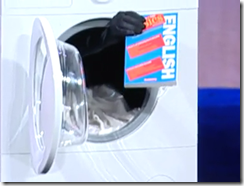
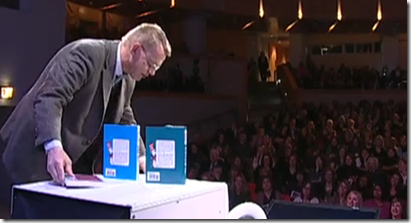
And what's the magic with them? My mother explained the magic with this machine the very, very first day. She said, "Now Hans, we have loaded the laundry; the machine will make the work. And now we can go to the library." Because this is the magic: you load the laundry, and what do you get out of the machine? You get books out of the machines, children's books. And mother got time to read for me. She loved this. I got the "ABC."This is where I started my career as a professor,when my mother had time to read for me. And she also got books for herself. She managed to study English and learn that as a foreign language. And she read so many novels, so many different novels here. And we really, we really loved this machine.

image

image

And what we said, my mother and me, "Thank you industrialization. Thank you steel mill. Thank you power station. And thank you chemical processing industry that gave us time to read books."

Thank you very much.

Hans discuss the environmentalist extremist view who says not everyone in the world should have washing machines.

But when I lecture to environmentally-concerned students, they tell me, "No, everybody in the world cannot have cars and washing machines." How can we tell this woman that she ain't going to have a washing machine? And then I ask my students,I've asked them -- over the last two years I've asked, "How many of you doesn't use a car?" And some of them proudly raise their hand and say, "I don't use a car." And then I put the really tough question: "How many of you hand wash your jeans and your bed sheets?" And no one raised their hand. Even the hardcore in the green movementuse washing machines.

(Laughter)

Hans makes the point that energy use is growing in Emerging Markets, and part of the factor are a woman like below voting for an official who brought electricity to her home.

image

This is what we hope may happen. It's a real challenge in the future. But I can assure you that this woman in the favela in Rio, she wants a washing machine. She's very happy about her minister of energy that provided electricity to everyone -- so happy that she even voted for her.And she became Dilma Rousseff, the president elect of one of the biggest democracies in the world -- moving from minister of energy to president. If you have democracy, people will vote for washing machines. They love them.

You could say Data Centers and cloud services are like washing machine and changes people's lives, but just like the washing machine the features that people purchase are energy and water efficiency.  The old days of simply getting things to work have moved to using the least resources to accomplish the task.

Will Midwest Heat wave shift Republican views on Climate Change?

There is record heat wave in the Midwest.

CHICAGO — An oppressive and potentially deadly summertime mix of sizzling temperatures and high humidity baked a large swath of the country again on Sunday, pushing afternoon heat indexes in dozens of cities to dangerous levels.

Forecasters warned the heatwave would persist through much of the coming week and cautioned residents in more than three dozen states to take extra precautions.

The National Weather Service posted excessive heat warnings for much of the country's midsection, including Illinois, Wisconsin, Minnesota, Iowa, Missouri, Kansas, Nebraska, Oklahoma, as well as South and North Dakota, where forecasters predicted heat indexes could hit 115 degrees.

"This will likely be the most significant heat wave the region has experienced in at least the last five years," the weather service said.

The Midwest tends to be Republican political views.

As you pick through various polls, what's interesting is how little America's political landscape has actually changed. Take this map from the USA Today polltracker. The orange is "too close" and the gray is "not enough" data. Red is Republican and blue is Democrat, of course.

usa_today_map.jpg

And, here is a difference in belief in global warming.

Figure 1

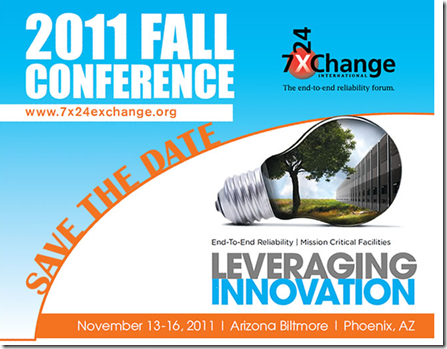
Getting ready for 7x24 Exchange 2011 Fall Conference, Nov 13-16

I received the save the date e-mail for 7x24 Exchange, and plan on attending my 2nd conference, and have much bigger plans.

image

#1 I have been working with David Schirmacher, VP of 7x24 on a panel discussion with some big names to discuss an interesting topic for the attendees.  One of the things that feels good is the people we hope to have on the panel are two executives who knew of each other, but never really chatted until I got them together at Data Center Social 1..0 at Uptime Symposium.  If all goes well, the specifics of who and what will be discussed will be firmed up in the next month.

One of the things that is refreshing is the session slot is assigned at 7x24 based on the audience interest, not on sponsorship package purchased by the speaker.

#2 We'll have another version of Data Center Social with thought leaders in the data center industry.  At past events we had tried to have the rule no vendors at the data center social, but with any rule there was an exception.  So modifying the rule, thought leaders who work at companies that are considered vendors can attend, but that brings up one of the other rules.  If the ego is too big, we in general don't want to invite them why?  Consider this post for some reasons why a big ego is bad karma.

While people with big egos seem confident and even intimidating on the outside, they're most often driven by low self-esteem and a lack of confidence inside.
...

Note the fact that it's their way or the highway. They equate compromise with loss. Egotistical people also feel that they have to be the center of attention to validate themselves. They often neglect the needs of those around them and think only in terms of what will suit them.

Just because everyone knows you doesn't mean you are a thought leader.  Thought leaders are not necessarily well known.

For Data Center Social 3.0 at 7x24 Exchange Fall Conference, we'll continue with what we know has worked in the past, but also try some different ideas to bring in new people.  Keep in mind this is not necessary an exclusive club, but a group of people who enjoy meeting others who are not satisfied with the past.  A group who are thought leaders.

Thought leader is business jargon for an entity that is recognized for having innovative ideas.

The term was coined in 1994, by Joel Kurtzman, editor-in-chief of the Booz, Allen & Hamilton magazine, Strategy & Business. "Thought leader" was used to designate interview subjects for that magazine who had business ideas that merited attention.[1] Among the first designated "thought leaders," were British management thinker, Charles Handy, who advanced the idea of a "portfolio worker" and the "Shamrock Organization", Stanford economist Paul Romer, Mitsubishi president, Minoru Makihara, and University of Michigan strategist, C.K. Prahalad, author of a number of well known works in corporate strategy including "The Core Competence of the Corporation" (Harvard Business Review, May-June, 1990); and his co-author, Gary Hamel, a professor at the London Business School. And at the turn of the millennium Chris Harris in his trend leading insight book Hyperinnovation, the first treatise to begin to address a rapidly interconnecting, growing, technologically innovative world.