1/4 watt per user to use Gmail, how much energy does your corporate e-mail use? 3x-10x more?

I just posted on Gmail's green data center impact with 1.2kg CO2 per year.  And, the nice folks at Google sent me a link to a PDF that provides much more details for my technical audience.

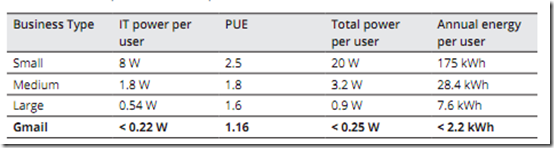
What kind of details?  How about 0.25 watt is the power consumption accounting for a 1.16 PUE.
image

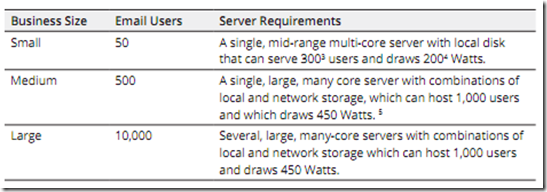
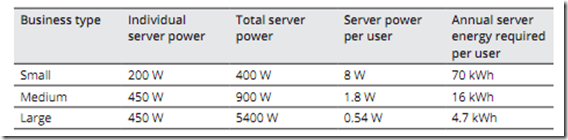
Small, Medium, and Large business sizes were used in the calculation.
image

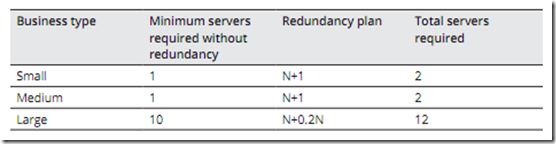
Redundancy calculations are made for each business size.
image

Add all this up accounting for the size of the servers.
image

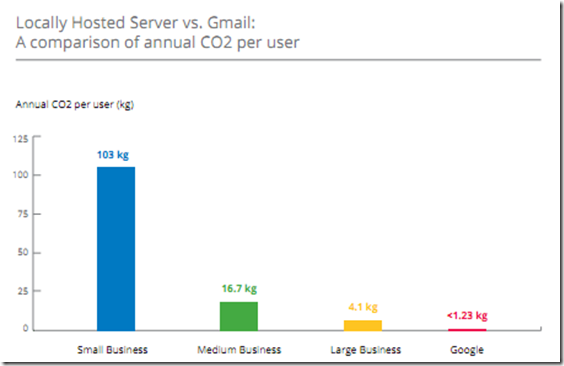
And you get the first graphic on the amount of power per user.  The biggest gain in energy efficiency is for the small business being 10X more energy efficiency, using 10% of the energy if they chose a gmail solution.
image

I use Gmail for my e-mail accounts and map domains for my own e-mail dave(at)greenm(dot)com.  It is nice to know I am consuming a 1/4 watt per account.
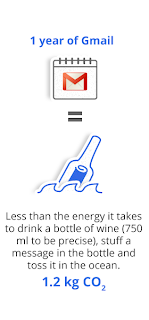
Gmail's Green Data Center footprint in the Cloud, 1 year = 1.2kg CO2

The Official Google Blog has a post on the carbon footprint in a Google's data center to support a Gmail account.

The data Google uses is:

We compared Gmail to the traditional enterprise email solutions it’s replaced for more than 4 million businesses. The results were clear: switching to Gmail can be almost 80 times more energy efficient than running in-house email. This is because cloud-based services are typically housed in highly efficient data centers that operate at higher server utilization rates and use hardware and software that’s built specifically for the services they provide—conditions that small businesses are rarely able to create on their own.

An illustration of inefficient server utilization by smaller companies compared to efficient utilization in the cloud.

Your carbon footprint is most likely larger for the device you use than what is in the cloud.

In calculating these numbers, we included the energy used by all the Google infrastructure supporting Gmail and YouTube. Of course, your own laptop or phone also consumes energy while you’re accessing Google, so it’s important to choose an efficient model.

If you wanted you could reverse calculate the number of users per server you can use the 1.2kg CO2 is X amount of kw-hr.  A Google server with PUE and Overhead and IT infrastructure could be 250 watts per server.  Calculate the # of kw-hrs over a year.  There are most likely 3 instances running your gmail account, so you may need to multiply by three.  Then you can come up with an estimate of how many users can be supported by a gmail server.

How big is a problem of theft in the data center?

I have been having a variety of discussions with people who have insight into how bad a problem inventory shrinkage is in the data center.  Inventory shrinkage is a term used in retail to explain inventory that disappears, hence “shrinks.”  Given retails thin margins shrinkage is a big deal.

Security and Crime News

Return to news menu

Retail Theft and Inventory Shrinkage

2002 Retail Security Survey Shows U.S. Retailers Losing $31 Billion to Theft 

Inventory shrinkage, a combination of employee theft, shoplifting, vendor fraud and administrative error, cost United States retailers over $31 billion last year according to the latest National Retail Security Survey report on retail theft, which analyzed theft incidents from 118 of the largest U.S. retail chains.

According to University of Florida criminologist Richard C. Hollinger, Ph.D., who directs the National Retail Security Survey, retailers lost 1.7 percent of their total annual sales to inventory shrinkage last year. The surveyed portion of the retail economy transacts over $1.845 trillion dollars annually, making the loss worth over $31.3 billion. Total inventory shrinkage was down slightly from $32.3 billion in 2000.

Data Centers tend to feel secure because they think their security systems eliminate theft.

Where Inventory Shrinkage Happens

Source of Inventory Shrinkage % of Loss* $ Lost
Employee Theft 48.5% $15.1 billion
Shoplifting 31.7% $9.7 billion
Administrative Error 15.3% $4.8 billion
Vendor Fraud 5.4% $1.7 billion
Total Inventory Shrinkage $31.3 billion

But, even if you eliminate all theft, 20% of inventory shrinkage comes from administrative error and vendor fraud.

To give you an idea of data center theft, Seagate has a paper on stolen drives and servers.

Stolen Drives and Servers Don’t Think it Can’t Happen in Your Data Center  September 2007

Executive Summary

Almost every organization is well aware of the risk to confidential data stored on mobile devices such as notebook PCs that can be lost or stolen.  But few organizations realize that drives or even entire servers are vulnerable to theft, loss, or maintenance mix-ups despite the “protection” of residing in the organization data center.  Of course, that means that the confidential data stored on those devices is subject to unauthorized use by the growing army of cyber criminals.  Because data centers contain the most concentrated data in the organization, such thefts can be catastrophic in terms of financial, regulatory and legal consequences.  Even small incidents can necessitate high costs of remediation because when such thefts occur it is extremely difficult to determine what was compromised, so the “worst case” scenario must be assumed.

The paper goes on to point out the risk in data centers.

Servers can be at risk even inside large, well-managed facilities Despite standard physical security measures employed at data centers, there are still many opportunities for insiders or skilled thieves to steal important servers and drives, even during normal hours of operation.”  For example, when systems are being expanded or modified, there are frequently large numbers of contractor technicians who carry equipment in and out and have the opportunity to remove drives or servers with few questions asked.

How bad of a problem do you have?  When asking companies who handle decommissioning of equipment it is common for them to find between 20 - 40% of the servers are not what users think they are.  What types of problems?  Missing RAM, HD, and processors.  Incorrect replacement parts - power supplies, cables.  How many of your inspect warranty service?


Fire the customer, example someone texts in the movie theater

I am sure some of you agree some customers are not work the effort, you want to fire them.

Here is a good example on a customer you would want to fire.  http://hun.ch/nfe3Bd

This customer exhibits many of the signs of one you want to fire.

· The Chronic Complainer. This customer constantly speaks negatively about your product, prices, or service, but still buys from you. Address the complaints, but don’t let it continue.  If someone is complaining to you, s/he is probably complaining about you to others, hurting your brand.

· Captain Rude. No one should have to endure verbal abuse. Don’t be afraid to set clear boundaries with this customer. Communicate your expectations about rudeness, and if this customer breaks the rules, say goodbye.

· The Other Guy Does It Better. Some customers constantly talk about your competition. The really brazen ones may even tell the competitor they’re playing a back-and-forth game with you. If this happens once, it may be worth working through, but again, if it’s happening often, this customer may not be worth the trouble.

...

· Can they be converted? Say a customer is giving off a “maybe I’ll change my mind” vibe. If you sense a potential behavior change, retention efforts may be wise even if the math doesn’t say so up front.

· Does this customer mistreat your employees? This must be a consideration – always. If a customer is verbally abusive or harassing one of your employees, let them go in a hurry.


i am sure many of you have fired a customer and agree on this view.

Firing a customer is not an easy decision. After you work hard to earn their business, the idea of cutting them loose may seem counter-intuitive. Check the math and consider the ramifications of keeping them around.

PG&E fires four inspectors - just another example of why you need to audit work in the data center

I am constantly amazed when critical infrastructure in the data center work is not audited.  Domenic Alcaro's talk at 7x24 about submarine maintenance and ideas that apply to the data center, the inspection and auditing of work is standard procedure.

NewImage

SJ Mercury news discusses the situation PG&E has found when they audited their inspectors.

PG&E fires four inspectors

Updated: 09/01/2011 02:54:21 PM PDT

PG&E has fired four inspectors after an internal investigation determined they falsely claimed to have inspected the company's underground electrical gear, and four others were disciplined.

The probe, which PG&E launched in November after receiving an employee's tip about the phony inspections, was first disclosed publicly in June. Over the past two months, the company reinspected nearly 25,000 underground enclosures containing various electrical equipment and found 25 where inspectors had falsely claimed to have inspected them, according to PG&E spokesman Andrew Souvall.

...

"In the four instances where employees were terminated, we found substantial evidence that they had not properly conducted their inspections and had falsified records," Souvall said.

Some of my friends and I have been thinking about how to solve this type of problem in the data center, and we are circulating the solution to some early adopters.