Google opens Hamina Data center

WSJ reports on Google’s Hamina data center.

Google Inc.'s opening of a €200 million ($273 million) server hall in Hamina, Finland, over the weekend is boosting Scandinavian hopes that other big Internet companies will choose to build data centers in the region, attracted by its cold climate and low electricity prices.
SERVER

One interesting speculation in the WSJ article is Facebook is looking at a site in Sweden.

Mr. Engman has been active in promoting Luleå as a hot spot for data centers, and he has undoubtedly had some success. An undisclosed major U.S. Internet company, widely believed to be Facebook, is planning to build a giant data center outside the town center, in an investment estimated by local officials at between three billion and five billion Swedish kronor ($459 million to $764 million). Facebook has declined to comment on the matter.

The plan has been delayed by legal action brought by a private individual on concerns the data center may harm wildlife, but should the latest appeal fail, the center will represent the single largest corporate investment—more than three times the size of the nearest contender—ever made in the city.

Mr. Engman, who takes pride in having attracted the U.S. company to Sweden, says there are several reasons other than climate that contributed to its interest in Luleå.

"We've got a unique electricity infrastructure up here. The electricity network is built for [energy intensive users such as] paper mills and the metals industry, and our supply of hydroelectricity means electricity prices here are among the lowest in Europe," Mr. Engman says.

And the folks in Lulea claim they haven’t had a power outage since 1979.

"You can't have a blast furnace shutting down because of electricity shortages. Luleå hasn't had a power outage since 1979. When we informed executives at U.S. software firms about this, they had a hard time believing it," Mr. Engman says.

One of the reasons Sweden and Finland are interesting is proximity to Russia.

But it is not just the cool climate that makes the Nordic countries attractive, supporters say. "There are several factors," says Tomas Sokolnicki, a senior investment adviser at Invest Sweden. "We have political stability, excellent fiber-optic infrastructure, minimal risk for natural disasters and a favourable climate.

"Also the fact that we are geographically close to Russia is important. Many players want to establish data centers close to the growing Russian market, but few dare establish data centers in Russia itself."
Greenpeace updates Google’s Environmental Grade from F to B

Greenpeace has posted its view of Google’s environmental disclosures.

Good news: Google comes clean on energy use

Blogpost by Tom Dowdall - September 8, 2011 at 20:31Add comment

Today Google has finally released information on exactly how much energy it takes to provide searches, email, youtube videos and all other Google services. For years Google has claimed this information was a “trade secret”, despite many competitors having already disclosed the same information. Such a lack of transparency led to much speculation about Google’s energy use from Blackle (remember that?), via much disputed kettle boiling comparisons, to our own recent dirty data report.

Previously Google has “a big fat F” from Greenpeace.

Since 2009 we’ve been pushing Google and all IT companies to be more transparent as part of ourCool IT leaderboard, and in our analysis of the power consumption and energy-source choices of data centers, as part of our Dirty Data report where Google scored a big fat F for transparency.

With Google’s latest extra credit work, Greenpeace would Google a “B”.

If we were giving out new grades based on today’s release, Google would likely earn a low to middle “B”.

Until today, silence from the Googleplex on producing meaningful environmental footprint data seriously undermined its standing as a corporate leader on clean energy, and put it out of step with many other IT companies. Publishing this data helps back up Google’s impressive track record on renewable investment (US$700m in the last year) and policy work in support of strong climate targets.

There is a lot of good info that Google has put out today, including more detail on how it can claim to be “carbon neutral”, which we’ll have more to say on that later, but as a customer of Google and other “Cloud” computing companies, we need to see others put their numbers and plans for clean energy on the table, both to help customers make more informed decision about the carbon impact of different online services, and hopefully to spur greater transparency and competition for improved performance that the IT sector is so known for.

Why not an “A”?  Greenpeace objects to site location in areas where coal is the dominant energy generation composition.

Of course a central part of the take home message from Google is that they want you to feel good about using their products, and should maybe be more thinking more about the footprint of the bottle of wine you are drinking than your Gmail account.  However, Google’s data centers in South and North Carolina certainly don’t run on wine yet (78% and 62% coal powered respectively), and going forward we will be taking a deeper look at how Google and other companies are increasing the demand for dirty energy and the pollution that comes with it in many communities in their race to build the cloud, a task that is made slightly easier today with Google’s new commitment to transparency.

Greenpeace goes on to call out for the rest of the data center industry to match Google’s performance.

Google is now disclosing more information than other big IT companies and is one of the first companies after Akamia to release information on how much energy and emissions are generated by its Gmail and Youtube services which are based on distributed servers, known as cloud computing.

And calls out one of those it would like to see join the transparency.

Google’s big step forward leaves Facebook kinda lonesome at the back of the green IT class, failing to say anything about how much energy is consumed and emissions are created by all our millions of Facebook posts, photos and online friendships generate. Its high time Facebook took a step forward by ditching dirty coal power and following Google’s lead by increasing its use of renewable energy.

Ask Facebook to unfriend coal by joining the Unfriend Coal fan-page


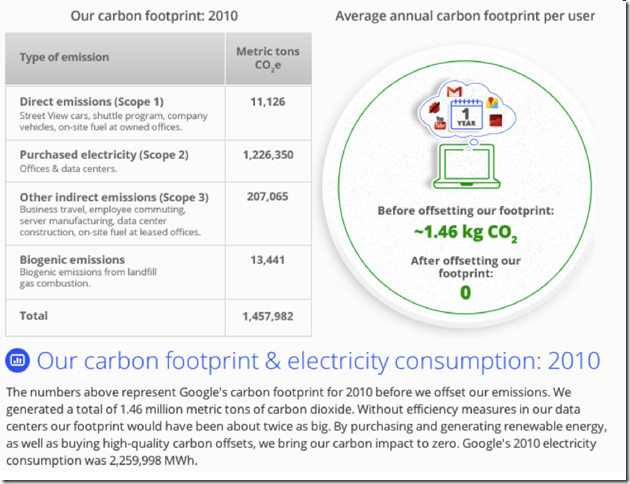
Google sets a High Bar for Tech Industry, discloses 2010 2,259,998 MWh energy use and 1,457,982 tons CO2e carbon emissions

The data center industry is not known for its openness and transparency of its data center’s environmental impact.  Greenpeace and other environmentalist group have made the point that just because a service is in the clouds people need to think about the environmental impact.

Google has taken a leadership position that is going to make others scramble for a response.  What are the equivalent numbers from Microsoft, Amazon, Apple, Yahoo, AOL?  Is this a tipping point where it will be expected that technology companies disclose their energy use and carbon impact?

image

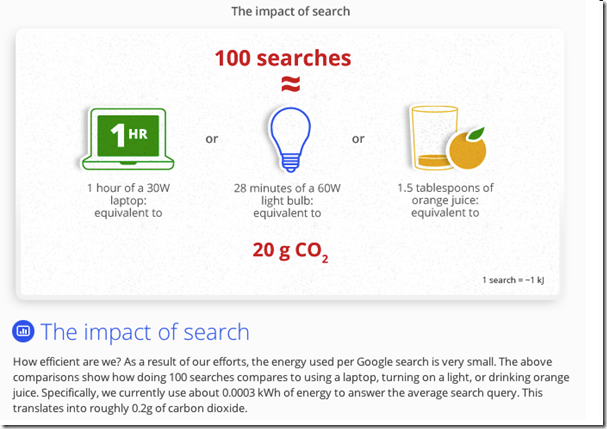
These numbers can be hard to grasp, so Google has created a set of numbers that an individual can relate to on the environmental impact of 100 searches.

image

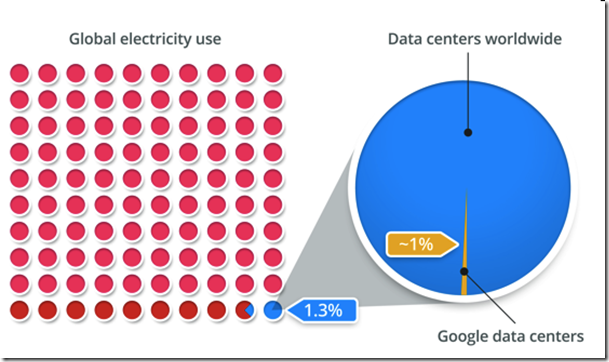
Google is showing even though it is a big user of data center energy it is a small target when you look at the big picture.

image

Google Uncloaks its Carbon Impact and Energy Use of company including Data Centers

3 Years ago I had the pleasure of talking to Google’s Urs Hoelzle regarding Google’s PUE.

And now Urs makes a bigger announcement today.

How our cloud does more with less


Posted by Urs Hoelzle, Senior Vice President, Technical Infrastructure
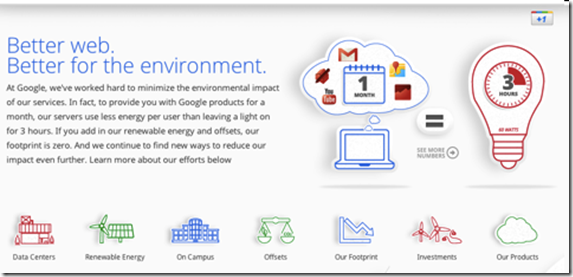
We’ve worked hard to reduce the amount of energy our services use.  In fact, to provide you with Google products for a month — not just search, but Google+, Gmail, YouTube and everything else we have to offer — our servers use less energy per user than a light left on for three hours. And, because we’ve been a carbon-neutral company since 2007, even that small amount of energy is offset completely, so the carbon footprint of your life on Google is zero.

We’ve learned a lot in the process of reducing our environmental impact, so we’ve added a new section called “The Big Picture” [link to come] to our Google Green site with numbers on our annual energy use and carbon footprint.

Google’s greener data centers get #1 position.

We started the process of getting to zero by making sure our operations use as little energy as possible.  For the last decade, energy use has been an obsession. We’ve designed and built some of the most efficient servers and data centers in the world—using half the electricity of a typical data center. Our newest facility in Hamina, Finland, opening this weekend, uses a unique seawater cooling system that requires very little electricity.

image

Renewable Energy gets position #2.

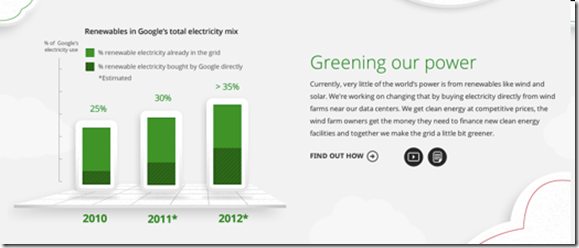
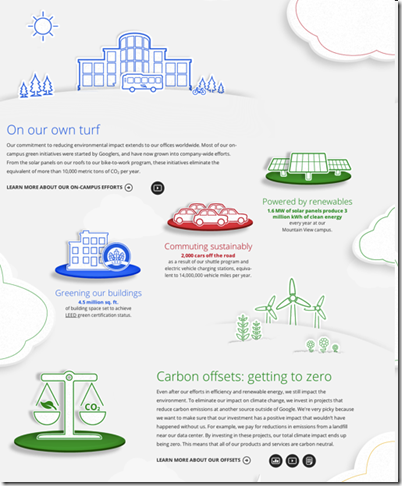
Whenever possible, we use renewable energy. We have a large solar panel installation at our Mountain View campus, and we’ve purchased the output of two wind farms to power our data centers.  For the greenhouse gas emissions we can’t eliminate, we purchase high-quality carbon offsets.

image

The company and carbon impact are #3 and #4.

image

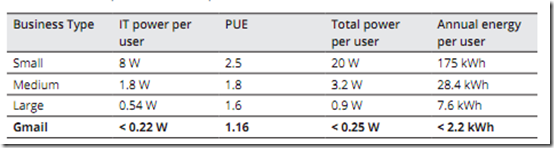
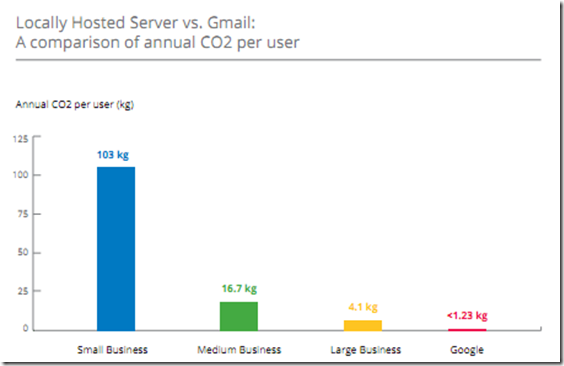
1/4 watt per user to use Gmail, how much energy does your corporate e-mail use? 3x-10x more?

I just posted on Gmail's green data center impact with 1.2kg CO2 per year.  And, the nice folks at Google sent me a link to a PDF that provides much more details for my technical audience.

What kind of details?  How about 0.25 watt is the power consumption accounting for a 1.16 PUE.

image

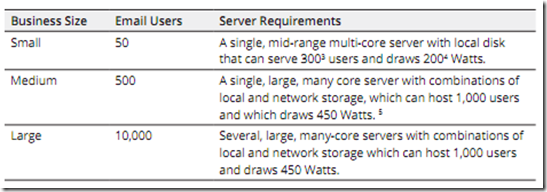
Small, Medium, and Large business sizes were used in the calculation.

image

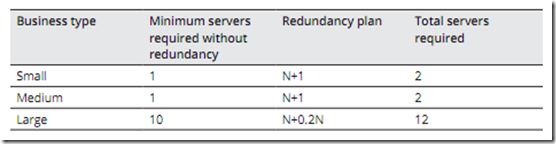
Redundancy calculations are made for each business size.

image

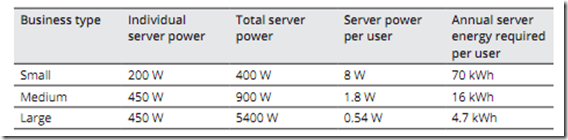
Add all this up accounting for the size of the servers.

image

And you get the first graphic on the amount of power per user.  The biggest gain in energy efficiency is for the small business being 10X more energy efficiency, using 10% of the energy if they chose a gmail solution.

image

I use Gmail for my e-mail accounts and map domains for my own e-mail dave(at)greenm(dot)com.  It is nice to know I am consuming a 1/4 watt per account.