The Two Battles in the Cloud, Brands and Profits

The NYTimes has a post on the idea of the Cloud Cartel.

Here Come the Cloud Cartels

January 30, 2012, 9:00 AM 6

What kind of cartels will deliver business computing, and how should businesses respond?

Forrester, the technology research company, just released its business and technology outlook for 2020. The short version is that cloud computing will come on quicker than you think, it will be controlled by a very few companies that will fight for the right to own your data, and businesses need to think about what software they can write that will differentiate them from all the other customers of these giants.

Like a lot of these reports, Forrester has a couple of clichés (we have entered the era of individual empowerment; change is the only constant) and interesting facts that you don’t really know what to do with (there will be 22 billion connected devices in 2020; Moore’s Law dictates that the computing power of I.B.M.’s Watson will fit into a human hand by then).

One of the points well made is the move to the cloud and mobile,  and how there will be a shift in the IT powerhouses.

The substance of the report, however, is plain: cloud and mobile computing combined will rapidly improve, dislodging many incumbents in enterprise computing, and vastly empowering a few others, becoming what Forrester calls “computing cartels” that control millions of servers in data centers around the globe. These cartels, the report says, will include Amazon, Cisco Systems, Google, I.B.M., Microsoft, Oracle and a few competitors. Like most of these reports, it does not name losers, though Hewlett-Packard and Dell were among those noticeably absent.

The Cloud is very confusing, and one way to filter the communication is to understand whether something is written for a battle of the brands to create awareness for their solution vs. the battle for profits where companies are grabbing market share from others.  You may think they are the same.  But a Brand Battle will be more creative in defining perceptions.  A Profit Battle will be how do I get the money from the IT department.  The Cloud has been succeeding when business units decide to bypass their internal IT department and buy cloud services direct at a lower cost.

The Brand Battles are going to be fought by the established enterprise companies that have the budgets to fund analyst reports - IBM, EMC, Cisco, HP, VMware, Dell, and Microsoft.  The Profit Battle are those who want to disrupt the status quo - Amazon, Rackspace (OpenStack), and many others that don't have a big marketing budget.

The fight for the Cloud is like a big Go Board.

NewImage

There are multiple battles for territory going on, and it easy for a big brand to claim it is winning in its area.  But, there is not a scorekeeper for the complete Cloud game.

You can argue over who is winning the cloud game.  But, it can more interesting to know who has adapted to the cloud to win other games.

The cloud is disruptive and those who understand who is winning these other cloud enabled games has the knowledge to play the cloud game differently than a simple brand or profit game.

 

Amazon Web Services Technology Open House, Feb 8, 2012 Seattle, Mardi Gras Theme

For those of you in the Seattle area there is a Amazon Web Services Technology open house on Feb 8, 2012.

Amazon Technology Open House – February 8, 2012

It’s Mardi Gras time, and Amazon Web Services invites you to come learn about the magic taking place in the cloud with a Mardi Gras-inspired celebration. Amazon CTO Werner Vogels will kick off the evening highlighting recent innovations at AWS and then introduce Seattle’s newest addition to the local tech community - The Climate Corporation. The Climate Corporation combines Big Data, climatology and agronomy to protect the $3 trillion global agriculture industry with fully automated weather insurance products. You’ll hear more about the business from The Climate Corporation’s CEO, David Friedberg, as he discusses this unique application of cloud computing.


We look forward to welcoming you on campus – look for us in the Van Vorst building under the purple, green and gold!

Who should attend:

  • Technology leaders, professionals and educators such as CIO’s, CTO’s, IT managers, consultants, SDEs, solution architects, administrators and professors and students of engineering and computer sciences.

Agenda:

5:30pm – 6:00pm Registration and networking
6:00pm – 6:15pm Introduction with Werner Vogels, Amazon CTO
6:15pm – 6:30pm David Friedberg, CEO of The Climate Corporation
6:30pm – 7:30pm Closing and Networking

Where/When:

February 8, 2012
Van Vorst Building
Amazon’s Campus in South Lake Union
426 Terry Avenue North
Seattle, WA 98109

How important are Data Centers to Facebook? used 42 times is S-1 Statement

People are pouring over Facebook's S-1 statement looking for things to write about.

How about this?

Facebook is mentioned 458 times in the S-1 statement.

Zuckerberg 113.

Software 28.

Zynga 24.

Social 140.

Data Center 42.

Google 14.

Microsoft 5.

Amazon 2.

Technologies 28.

Kind of funny to think what you could make up how Facebook is by analyzing the number of times a word shows up. :-)

Here is a top 10 post on threats to Facebook.

Facebook's Most Serious Threats, According to Facebook

FEB 1 2012, 6:32 PM ET 4


Predictable threat: People find a better product. Surprising weakness: Zynga accounts for one out of eight dollars of revenue for the (potentially $100 billion!) company.

615 facebook.jpg

Facebook's blockbuster IPO filing includes 50 risks the company perceives to its business and public offering. Here are ten of the most interesting and important threats to the company that could be worth$100 billion, with quotes from Facebook's own S-1 document.

1) People stop using Facebook: Well, this one is obvious. "A decrease in user retention, growth, or engagement could render Facebook less attractive to developers and advertisers, which may have a material and adverse impact on our revenue, business, financial condition, and results of operations," Facebook states. Although annual revenue grew 154% between 2009/2010 and 88% between 2010/2011, it relied on user growth that will eventually have to slow due to higher market penetration rates, which is economic-speak for "we're running out of people."

Here is another post on threats.

Facebook’s Risk Factors: Mobile, Gov, Slowed Growth, Google+

Amazon lures Data Center Architect from the Mouse (Disney)

The data center community is small and news travels fast.  One of the moves that became official through LinkedIn is Bill Hunter leaving the Mouse (Disney) for Amazon.

Bill Hunter Moving on. Last day at Disney. Starting at Amazon 2/1/2012. New opportunity! Thanks to all the fantastic people at Walt Disney who made the past 5 years great!

Bill is based out of Seattle so he doesn't have to move, but he will be on the road more than ever.

I expect to be traveling more, and
Globally. Should know more after this week.

Now that Bill has joined amazon he will be less visible, but i am sure the vendor community will be pummeling him with e-mails looking to take him to lunch, dinner, drinks, maybe a party in LV.

Amazon made a good hire and there is a more consistent need for data center capacity than the Mouse.  Especially in emerging markets.


Will Seamicro win the battle to obsolete the dual proc server? 64 Xeon processors in latest Server

I've been writing on the topic of little green servers for a while and discussed the idea of Intel Atoms and ARM processors in servers years ago.

SeaMicro announced its latest servers using the Intel Xeon E3-1260L which now supports a higher compute and memory capacity per core.  The press announcement had SeaMicro, Intel,and Samsung discussing the announcement.

SeaMicro Extends the Benefits of Micro Servers to All Segments of the Scale Out Data Center Market in Collaboration with Intel and Samsung Semiconductor

SAN FRANCISCO, January 31, 2012  – SeaMicro™, in cooperation with Intel Corporation (NASDAQ: INTC) and Samsung Semiconductor, Inc., today announced the widespread availability of the first fabric-based Intel® Xeon® micro server, the SeaMicro SM10000-XE™. The addition of the quad-core Intel® Xeon®-based SM10000-XE to the SM10000™ family makes SeaMicro the first and only company able to bring the massive benefits of micro servers to all segments of the scale out data center market.

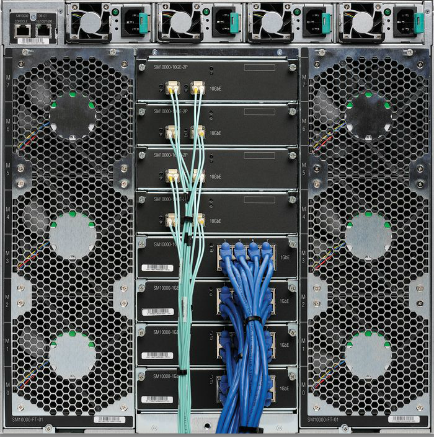
But, if you have 64 Xeon's in a box is this really a micro server?  To give you a different perspective let's look at the back of the latest SeaMicro server.

NewImage

Up to 16 10Gbe connections, above is 8 10Gbe and 24 1Gbe.  This is not good for some one who lives on the quantity and complexity of network ports.

If you have high costs for rack and stack, network support, then a SeaMicro box becomes more appealing.

"We are a trusted partner in the US intelligence community,” said Chad Wagner, president of CompSec.  “We have worked with our customers to deploy both SeaMicro’s Atom™-based and Xeon®-based systems.  The exceptional compute density and low power draw have made them the right choice for mission critical applications.  Our intelligence community customers have also found success using SeaMicro’s Freedom Supercompute Fabric to deliver huge amounts of compute power to remote and hard-to-access locations.  This greatly reduces response times, provides faster and more in-depth analysis, and helps to advance their mission.”