Telling White Lies is common practice for many Doctors, who else is lying to you on a regular basis

Most people don't think other people lie.  The media doesn't lie.  Commercial don't lie.  They just tell stories in a way that fulfills their own needs.

MSNBC posts on how Doctors tell white lies.

Many docs tell white lies, study finds

By MyHealthNewsDaily staff
MyHealthNewsDaily

Everybody lies — even doctors.

A new study finds 11 percent of doctors say that they have told a patient or a child's guardian something that was not true in the past year, and about 20 percent say they have not fully disclosed a mistake to a patient because they were afraid of being sued.

The results also show 34 percent of doctors surveyed did not "completely agree" that physicians should disclose all significant medical errors to affected patients. Instead, these doctors said they only somewhat agreed, or disagreed.

The researchers admit they have more work to do.

To be fair, the researchers acknowledged not knowing the circumstances under which physicians lied, and communication regarding health issues can be complex. Physicians must often wade through conflicting and confusing information as a case goes on. Telling a patient something that turns out to be wrong might not be helpful, the researchers said.

More research is needed to better understand when and why physicians feel justified in a lapse of honesty.

And guess what the minorities and women were more honest than the white men.

Women and minority physicians were more likely than white, male doctors to say they agreed with the principles of honesty and openness, according to the study. This may be because, as underrepresented groups in medicine, women and minorities feel more compelled to comply with such professional codes, the researchers wrote.

If some doctors lie on a regular basis it is hard to believe that in your data center operations, there are not people who accept telling white lies.

Do you think about this when designing monitoring systems?


Google takes the Lead in Greenpeace's Cool IT Climate Leaderboard

Greenpeace's Gary Cook posts on Greenpeace's latest Green IT Scorecard with Google in the leadership position.

Google wrests control of Cool IT climate Leaderboard

Blogpost by Gary Cook - February 8, 2012 at 9:00

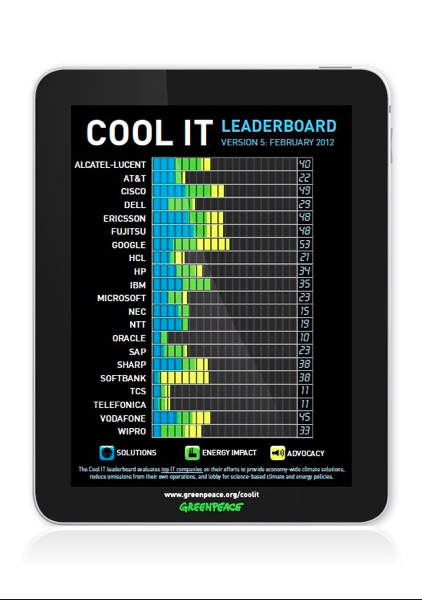
Cool IT Leaderboard 5th edition

The tussle for the top of our Cool IT Leaderboard has taken its latest twist, with Google grabbing the top spot ahead of 20 other tech companies, including Cisco and Ericsson.

Google is singled out as the leader.

Google is way ahead on climate solutions and energy impacts, thanks to its disclosure of its energy footprint, and for providing its impressively detailed mitigation plan for achieving emissions reductions. On top of this, Google continues to speak up on important climate change policies, and make its voice heard on the immediate need for both US and EU governments to aggressively cut emissions.

Last is Oracle with a score of 10 vs Google's 53.  The full report is here.

NewImage

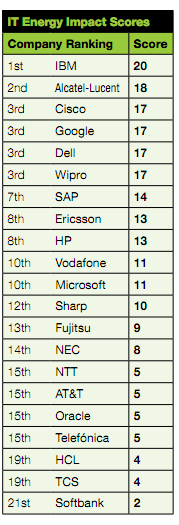
The IT Energy impact score has IBM in the lead.

NewImage

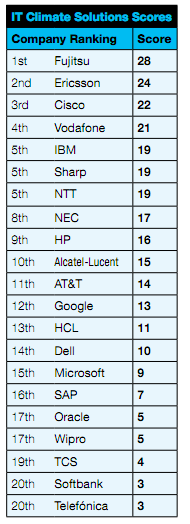
And Fujitsu leading the IT Climate Soltuitons.

NewImage

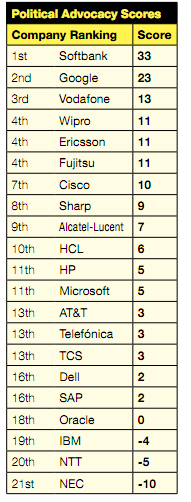
And Political Advocacy has Softbank with high score.

NewImage

IBM and Tulip Telecom launch Largest India Green Data Center in 5MW increments up to 100MW

IBM and Tulip Telecom have worked together to launch the first of 20 modular data center pods in a 100MW four tower building configuration. When you look at this building, it is actually 4 separate buildings connected with an atrium.  One of the top questions that most of you will ask is what kind of power reliability can you get in India for 100MW load.  Speaking to Mike Hogan, Global offering Executive IBM Site and Facilities Services, he shared that the site has two power feeds to the site, and 4 separate network taps, making the site an ideal opportunity for a data center.

NewImage

The building above has a green hue to it, and it has green features.

The new highly efficient data center is designed to international green building standards and engineered with power, chillers, cooling, rack layout and uninterrupted power supply systems.

The expected PUE performance is about 1.6 -1.7.  A lower PUE is challenging in the conditions in Bangalore, and given it is a hosting facility the equipment is not totally controlled by Tulip and IBM.  There is cold aisle containment, raised inlet temperatures and raised chilled water temperatures as well.  Given the cost of electricity and infrastructure challenges electricity is a resource that is used wisely.  Note, this building is a true data center with the staff in the building there to support the IT operations.  Call center operations are not in this building as the space and power were so valuable.

The media has latched on to air side economizers, but when you think of how to build a building in 5% increments of capacity (twenty 5 MW PODs), it can be much more difficult to expand capacity with air handlers vs. chilled water pipes.  The rack density was designed to be in the 4 - 6 kW per rack density.  For higher densities, chilled water can be brought direct to rack.

IBM's top design challenge was how to get the highest density of capacity in the footprint of the building, be cost effective, green, and efficient.  The first of 20 PODs is ready for occupancy and the building is designed for continuous operation as additional diesel generators are installed, power and cooling infrastructure upgraded, and white space is finished.  Going tall is one case where containers where not a viable option for modularity.

Here is an IBM video with Tulip executives discussing  the data center.

The press release from IBM is here.

Tulip Telecom and IBM Build India’s Largest Data Center to Address Rapid Growth of Mobile Consumers in Emerging Markets


Bangalore, India - 07 Feb 2012:

- 900,000 square foot facility uses advanced green design for maximum efficiency
- New IBM SmartCloud services allow Tulip to deliver Infrastructure, Storage and Platform-as-a-Service to customers 
- Modular Data Center design and high reliability supports up to 100 megawatts of power
Virtual tour takes you inside state-of-the-art facility

IBM (NYSE: IBM) today announced it has worked with Tulip Telecom Ltd. to design and help build the largest data center facility in India to deliver new cloud and networking services.


Below is a video of Mike presenting on Green Data Center and the cloud.

Gartner 2012 Conferences

I know Gartner has a lot of conferences, but seeing the North America 2012 list was surprising how many there are.  Note the data center conference is the last one on the list.

North America

Portals, Content & Collaboration Summit
gartner.com/us/pcc
March 12 – 14 Orlando, FL
Customer 360 Summit
gartner.com/us/crm
March 14 – 16 Orlando, FL
CIO Leadership Forum
gartner.com/us/cio
March 25 – 27 Scottsdale, AZ
Enterprise Architecture Foundation Seminar
gartner.com/us/easeminars
April 2 – 3 Los Angeles, CA
Business Intelligence Summit
gartner.com/us/bi
April 2 – 4 Los Angeles, CA
Master Data Management Summit
gartner.com/us/mdm
April 4 – 5 Los Angeles, CA
Business Process Management Summit
gartner.com/us/bpm
April 25 – 27 Baltimore, MD
Supply Chain Executive Conference
gartner.com/us/supplychain
May 21 – 23 Palm Desert, CA
Enterprise Architecture Foundation Seminar
gartner.com/us/easeminars
May 21 – 22 National Harbor, MD
PPM & IT Governance Summit
gartner.com/us/ppm
May 21 – 23 National Harbor, MD
Enterprise Architecture Summit
gartner.com/us/ea
May 23 – 24 National Harbor, MD
IT Infrastructure & Operations Management Summit
gartner.com/us/iom
June 5 – 7 Orlando, FL
Security & Risk Management Summit
gartner.com/us/risk
June 11 – 14 National Harbor, MD
Catalyst Conference
gartner.com/us/catalyst
August 20 – 23 San Diego, CA
Enterprise Architecture Foundation Seminar
gartner.com/us/easeminars
September 10 – 11 Orlando, FL
Outsourcing & Strategic Partnerships Summit
gartner.com/us/outsourcing
September 10 – 12 Orlando, FL
IT Financial, Procurement & Asset Management Summit
gartner.com/us/itam
September 12 – 14 Orlando, FL
Symposium/ITxpo
gartner.com/us/symposium
October 21 – 25 Orlando, FL
Application Architecture, 
Development & Integration Summit

gartner.com/us/aadi
November 27 – 29 Las Vegas, NV
Enterprise Architecture Foundation Seminar
gartner.com/us/easeminars
November 29 – 30 Las Vegas, NV
Identity & Access Management 
Summit

gartner.com/us/iam
December 3 – 5 Las Vegas, NV
Data Center Conference
gartner.com/us/datacenter
December 3 – 6 Las Vegas, NV


James Hamilton and other Amazon execs discuss AWS DynamoDB

James Hamilton posts about DynamoDB.

Finally! I’ve been dying to talk about DynamoDB since work began on this scalable, low-latency, high-performance NoSQL service at AWS. This morning, AWS announced availability of DynamoDB: Amazon Web Services Launches Amazon DynamoDB – A New NoSQL Database Service Designed for the Scale of the Internet.

In a past blog entry, One Size Does Not Fit All, I offered a taxonomy of 4 different types of structured storage system, argued that Relational Database Management Systems are not sufficient, and walked through some of the reasons why NoSQL databases have emerged and continue to grow market share quickly. The four database categories I introduced were: 1) features-first, 2) scale-first, 3) simple structure storage, and 4) purpose-optimized stores. RDBMS own the first category.

DynamoDB targets workloads fitting into the Scale-First and Simple Structured storage categories where NoSQL database systems have been so popular over the last few years.  Looking at these two categories in more detail, Scale-First is:

Scale-first applications are those that absolutely must scale without bound and being able to do this without restriction is much more important than more features. These applications are exemplified by very high scale web sites such as Facebook, MySpace, Gmail, Yahoo, and Amazon.com. Some of these sites actually do make use of relational databases but many do not. The common theme across all of these services is that scale is more important than features and none of them could possibly run on a single RDBMS. As soon as a single RDBMS instance won’t handle the workload, there are two broad possibilities: 1) shard the application data over a large number of RDBMS systems, or 2) use a highly scalable key-value store.

And, here is a video with James and others at Amazon.