Group-think most likely big contributor of Stevens Pass avalanche disaster

This year my family switched to Crystal Mountain Ski resort, but for the last 4 years we skied at Stevens Pass where the Avalanche disaster took three people's lives.

Avalanche killed experienced backcountry skiers

Three skiers killed in a Washington state avalanche on Sunday were highly experienced at backcountry skiing, according to media reports, and one was the head judge of the Freeskiing World Tour, a competitive circuit for extreme skiers in the United States, Canada and South America.

The three, ski tour judge Jim Jack, Chris Rudolph and John Brenan, were among a group of a dozen or so skiers who were attempting to ski down a slope near the Stevens Pass ski area in the Cascade Mountains, about an 80-mile drive from Seattle. Among the group were staffers of both ESPN and Powder magazine, who identified the victims and gave accounts of the incident.

We checked with some of our Stevens Pass friends it was a somber day on the mountain as many knew someone in the group.

One of the points made in the CNN article

Doug Schnitzspahn, editor-in-chief of Elevation Outdoors magazine, told CNN that a kind of group-think takes over in these situations, with skiers wanting to be there with their peers.

"You think, 'All these people are either professional skiers or they knew what they're doing, they are out here,'" he said. "You're trained to make certain decisions, but it's not always humanly possible. If I had been there, I would have skied that line with those guys. That's what shakes me up."

Think about this, the editor-in-chief of Elevation Outdoors would be with these people skiing.  Is this a decision or a group-think mindset?

Identifying group-think-

  • Group members stereotype non-members and label them as enemies or outsiders not worth negotiating with or worrying about
  • People hesitate to air any discomfort, doubts or uncertainties they feel about the group decisions or policies, so that consensus seems unanimous
  • Reluctant to shatter complacency group members do not bring information or evidence that does not conform to the groups expectations and stereotypes to the groups attention
  • The group discusses only a few alternatives and reaches a decision quickly concentrating only on good points
  • The group feels invulnerable leading to excessive optimism and risk taking
  • The group ignores or rationalises warnings or signs that it is operating under false assumptions, making poor decisions or developing poor strategy
  • There is strong pressure on group members to conform to group norms

Many disasters are caused by group-think.  Consider this when you build your data center teams.  How many data center disasters have group-think as a major cause?

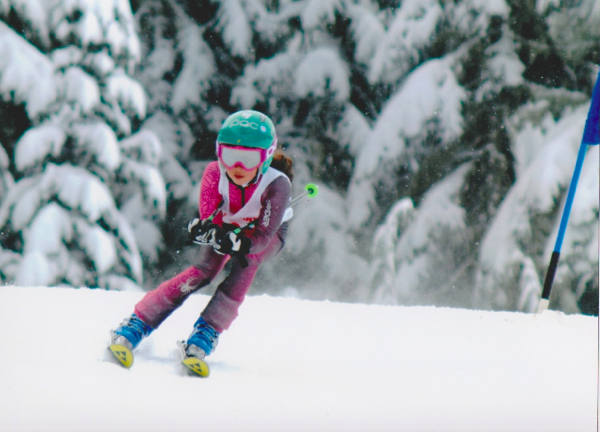
My wife and I never ski back-country, because it is not worth the risk.  I don't think we have super human strength, and no technology is going to save you if something really bad happens.  Skiing fresh powder in low traffic areas may be a thrill, but other than your ego being satisfied, does it do any really good?

When we ski with our kids we are always telling them they need to ski with a buddy and be safe.  and, they are skiing faster than mom and dad now.
NewImage


Accepting the Middle Age Mind, 40 - 65 is not that bad

I've had a bit of a break skiing with the kids, staying at a cabin, and had plenty of time to read with no internet access.  One of the next books I am reading next is about the middle-age mind.

NewImage

The NYTimes has a review.  Here are a few excerpts.

Good news.


Q.

Doesn’t that make sense, since our young adult lives are often marked by bad decisions?

A.

I think most of us think that while we make bad decisions in our 20s, we also have the idea that we were the sharpest we ever were when we were in college or graduate school. People think if I tried to go to engineering school or medical school now, I couldn’t do it. Because of these memory problems that happen in middle age, we tend to think of our brains as, on the whole, worse than in our 20s. But on the whole, they’re better.

Q.

So what’s happening in middle age that leads to these improvements?

A.

What we have by middle age is all sorts of connections and pathways that have been built up in our brain that help us. They know from studies that humans and animals do better if they have a little information about a situation before they encounter it. By middle age we’ve seen a lot. We’ve been there, done that. Our brains are primed to navigate the world better because they’ve been navigating the world better for longer.

There also are some other physical changes that they can see. We used to think we lost 30 percent of our brain cells as we age. But that’s not true. We keep them. That’s probably the most encouraging finding about the physical nature of our brain cells.

And guess what a lot of those ideas about middle age brains are myths.


Q.

What was the most surprising thing you learned about the middle-aged brain?

A.

The hope I saw from real scientists was surprising. A lot of the myths we think of in terms of middle age, myths that I grew up with, turn out to be based on almost nothing. Things like the midlife crisis or the empty nest syndrome. We’re brought up to think we’ll enter middle age and it will be kind of gloomy. But as scientists look at real people, they find out the contrary. One study of men found that well-being peaked at age 65. Over and over they find that middle age, instead of being a time of depression and decline, is actually a time of being more optimistic overall.

Maybe the media trying to sell the products to make you young were ones who convinced us middle age was bad.

I don't know about you, but I enjoy being 51 better than being 21, or 31.  41 wasn't too bad.  Oh yeh, that's when I started middle age.

Apple's Next Green Data Center lands in Prineville, Oregon

Facebook made its decision to go to Prineville, OR for a variety of reasons, but made the mistake of choosing electricity from a coal plant as the power source.  And, became a target for Greenpeace.  One of the last thing a data center operator wants to be is a target for a bunch of Greenpeace activist.

Apple has confirmed it has chosen Prineville, OR as the location its next data center.  Oregon's KTVZ has the news.

Apple Confirms Prineville Data Center Plans

One Day Later, Ore. House Approves Tax Break Fix

POSTED: 4:10 pm PST February 21, 2012
AAAText Size
PrintEmail
UPDATED: 2:26 pm PST February 22, 2012
Tech giant Apple Inc. confirmed Tuesday to NewsChannel 21 that it plans to build a data center at a 160-acre parcel in Prineville it just bought from Crook County for $5.6 million, a stone’s throw from the huge facility built by Facebook.


A statutory warranty deed for the property off Baldwin Court was filed last week with the Crook County clerk’s office, a public document finally breaking the official silence over a long-term courtship with a company formerly known only as “Project Maverick.”


After a leak in December, the officials must have been reminded of their NDA, and how opening their mouths can jeopardize the deal.

No one in Prineville or elsewhere had been able to speak on the record about the deal previously, due to non-disclosure agreements the company has had officials sign. But the Feb. 15 filing is the first public document to identify Apple Inc. as the “Project Maverick” buyer, complete with the “1 Infinite Loop” address in Cupertino, Calif.


The cat started escaping from the bag in December, when The Oregonian quoted “two people with direct knowledge” who said Apple was nearing a decision on the project.

The local judge was even NDA restricted, but now that there is a public disclosure he can say a few things.

Crook County Judge Mike McCabe said Tuesday he was still bound by the non-disclosure agreement, though the filing left him a bit freer to talk.

"We just don't know what their plans are," McCabe said, adding that he's "confident it will be good for Prineville and Crook County."
"These folks have been wonderful to work with," he said. "We will look forward to a long-term relationship with them."

Asked about whether Apple might plan to "out-green" Facebook, which got some flack from Greenpeace for buying coal-generated power for its Prineville data center, McCabe said that actually, "Facebook kind of helped recruit (Apple), saying, 'You've got to come up and look at this community.'"

Dell opens its Quincy Data Center, How big is it? 42MW of diesel generators deployed with an additional 42 permitted

The folks at DatacenterDynamics and DataCenterKnowledge have posts on the opening of Dell's new Quincy Data Center.

Dell opens Quincy data center

Says heat exchangers will make cloud delivery even more cost efficient at its newest data center

The official Dell press release is here.

Dell Opens New Western Technology Center in Quincy, WashingtonDate : 2/13/2012

  • Extends Dell’s delivery capability and enables regionally delivered, high-value solutions, services and cloud-based delivery options around the world


Dell Services today opened a new technology center in Quincy, Wash., that will provide customers in North America access to cloud technologies and IT outsourcing services. The opening is part of Dell’s ongoing commitment to develop new cloud-based services, solutions and delivery options.


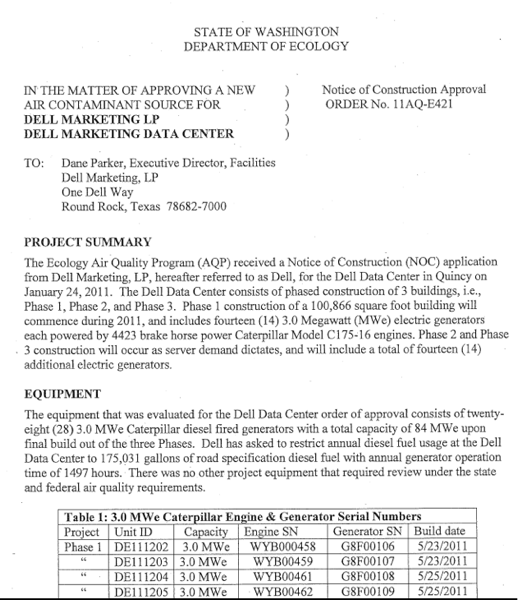
But, I want to know how big the data center is in terms of Power.  The diesel generator capacity is rated at 42 MW = 14 x 3MW Caterpillar Model C175-16.  You can make your own assumptions on the IT load that would be supported by this generator capacity.

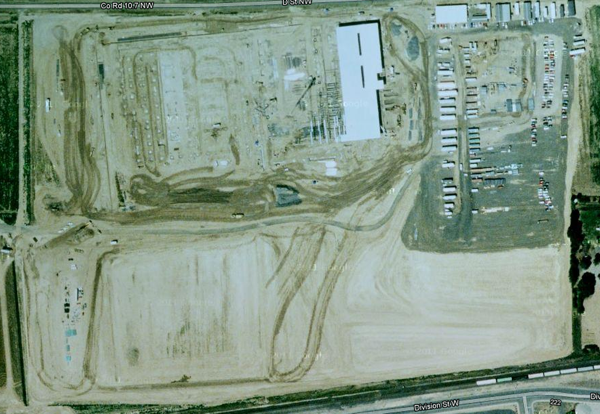
How big is the site?  Here is a google maps snapshot.

NewImage

It isn't that hard to find this information. Especially when a data center is near an elementary school and there is a lot of concern about the health risks from the diesel generator operations.

It was much more interesting to read the public documents than the official press release, but I guess I am too much of a data center geek. :-)

In a few months, it will be interesting to see some if the satellite photos are updated.

The 42 MW of diesel generators are for Phase 1.  An additional 42 MW is approved for Phase II and III.

Public disclosure of diesel permits is here.

NewImage