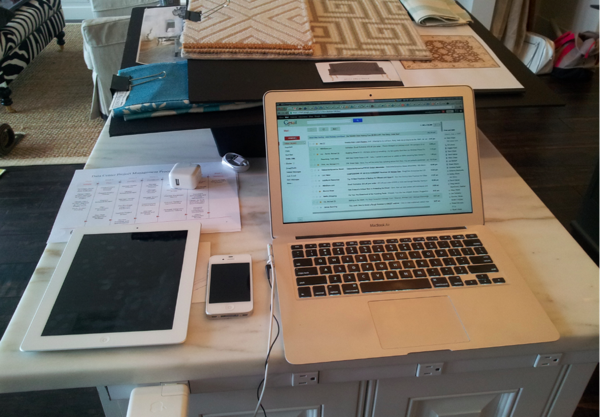
Below to the left is my new 64GB wifi iPad next to my iPhone 4S and MacBook Air. It's been about 6 years since I left Microsoft and it is now 20 years since I left Apple. I use Parallels and Windows 7 on the Mac when i need to run Quickbooks or other Windows apps. But, I am amazed at how much I just stay on OSX.
When I was in Austin with other data center people attending SXSW, we all had Macs.
I am getting back into Apple thinking, not to use Apple products, but it reminds me of how we did things at Apple. Microsoft was great too, but many things were based on iterating on past products. Not creating something brand new.
After 5+ yrs blogging on green data centers, I've figured out a lot of things, and it is time to help some of my friend do things differently. A lot of what I have been studying lately are checklists, habits, workflow, and bouncing lots of ideas off of my friends. There is no market data that supports the ideas, but that's OK. One of the things we learned at Apple is marketing data is useful for looking at the past, but not useful for creating the future.
Off to LV for a day to see more friends. I think I'll use my new iPad to review some of the drawings and diagrams, and leave the MacBook Air at home.
It is sad that most think of a Green Data Center almost exclusively in terms of energy use. Google's Joe Kava has been talking about water publicly since 2009.
Google's Joe Kava discussed water use in data centers in its 2009 data center summit. Joe's presentation on water start at the 9:20 mark.
A green data center has smart water use in addition to efficient power and cooling systems.
Google has a new post on its new recycled/grey water facility in Georgia.
If you’re familiar with the work of the Southern poet Sidney Lanier, you’ll know hewrote about the beauty of the Chattahoochee River in Georgia. “The Hooch,” as it’s known around here, starts up in the northeastern part of the state, runs through Atlanta and down into Alabama before emptying out into the Gulf of Mexico. Those of us who work in Google’s Douglas County, Ga. data center have a special fondness for the Chattahoochee because it’s an integral part of our ability to run a highly efficient facility.
I got an early peak at the Youtube video yesterday which had only 40 views. 24 hrs later the video has 7,488 views. Google, water, and data centers is not as esoteric as you may think.
Google and Douglasville-Douglas County Water and Sewer Authority Unveil Reuse Water Facility
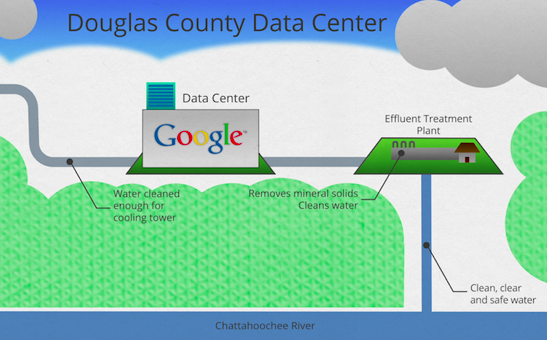
Recycled water used to cool Google’s data center equipment
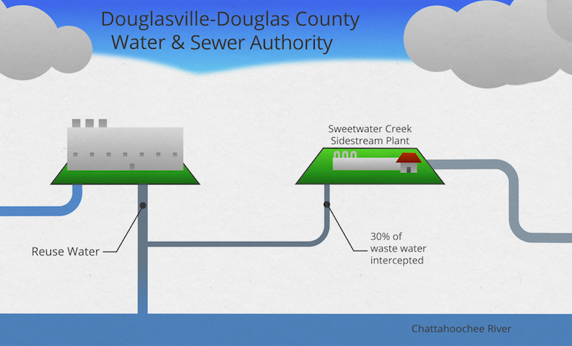
(ATLANTA and DOUGLAS COUNTY, Ga.) - Douglasville-Douglas County Water and Sewer Authority (WSA) officials and Google executives on Thursday announced Google’s first reuse water system for one of their U.S. data centers. Google’s Douglas County data center is also the state’s first data center to conserve water using a reuse water system. The system, financed by Google and owned by WSA, is helping to keep the Chattahoochee River clean and conserving the reservoir's water supply.
“Working with Google on this reuse water system has been a great experience for the WSA. Our water supply gets hit hard during the drought season and in the summer months,” said Peter Frost, executive director of WSA. “The Google-funded sidestream facility is a welcomed reprieve on our reservoir’s water system and saves water capacity for our residents and businesses.”
Some people may flush this idea down the drain as not worth their effort. But, there is another reason that few would think about. One of the top risks to data center operations is the breaking of a water main supplying the data center. Water infrastructure is one of the most ignored parts of society that are critical for life. As one of my data center friends who told the story of having no water in his apartment for 2 days, it is hard to occupy a building without water.
This Google Water story that has been going on for a long time as the original financial investment from Google was in 2008.
In 2008, Google financed the building of the WSA’s Sweetwater Creek Sidestream Plant, which is a reuse treatment facility that intercepts up to 30 percent of the water from the local water and sewer authority’s treatment plant.
“At Google we’re always looking for smart ways to reduce our impact on the environment,” said Joe Kava, Google’s senior director of data center construction and operations. “We’ve been working for years on maximizing the efficiency of our servers and our data center designs so that we can minimize the entire energy footprint consumed by our data centers.”
It can be hard to bring in a 2nd water line to a data center, and on site storage of water is difficulty for a scenario of a week's worth of water.
What Google's recycled water system does is provide an alternative cooling water source that has many benefits. Below are 7.
2nd source of cooling water (recycled water and potable city water)
brand new and will last longer than data center (water mains can be up to 75 years old)
supported by the local gov't (community relations in improved with joint projects)
is part of the city's critical infrastructure which makes it a high priority to operate (Google gets to the top of the list after hospitals, fire, and police)
financed by Google, city owned (Google's cash reserves put to funding innovation and thought leadership in sustainable data centers)
cost effective, reduce cost of water and sewage fees (if you haven't looked at water and sewage costs, the costs are growing faster than any other consumable)
Part of going to SXSW is going to the parties. After going to four different tech parties, one thing was clear the most important part for putting together a good party is the people you work with. I am amazed at how many times people think of picking companies to do the work, and miss the point that is all about what people specific get assigned to the project. A good or bad project manager can make all the difference in your schedule, budget and performance in a data center. The same idea applies to many other complex things, like throwing a popular party.
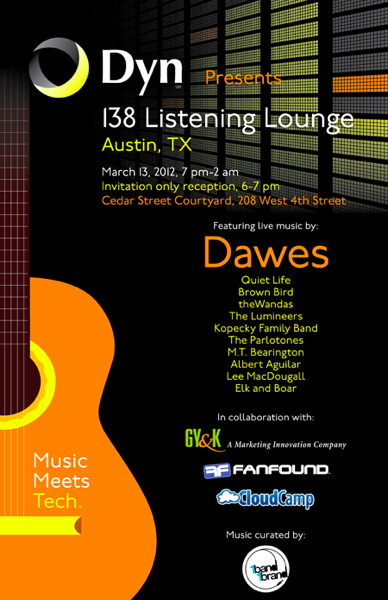
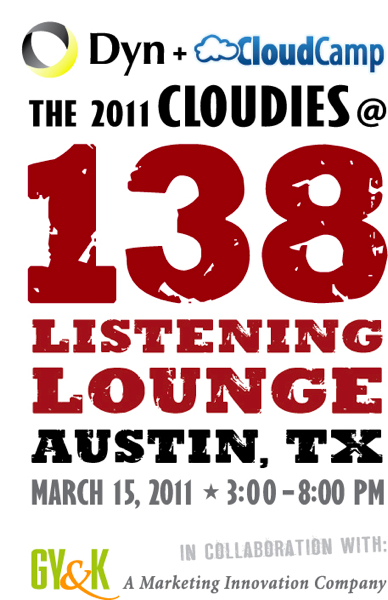
One of the funnest parties was the Dyn party on Tues night at Cedar Street Courtyard.
The venue was the location for GroupMe and FourSquare as well, and my vote goes to the Dyn party with 11 live bands and an in crowd of tech and music people.
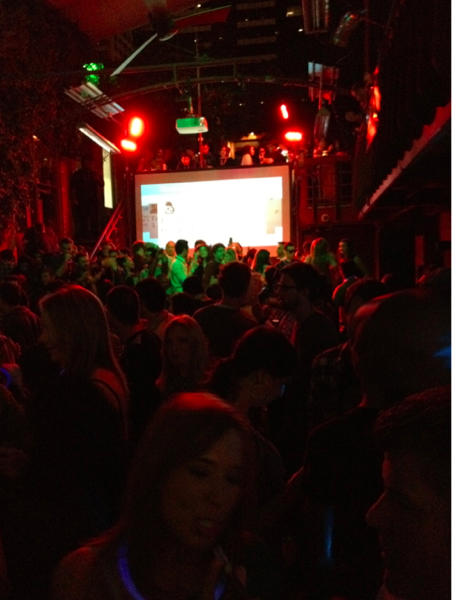
This party had lots of people.
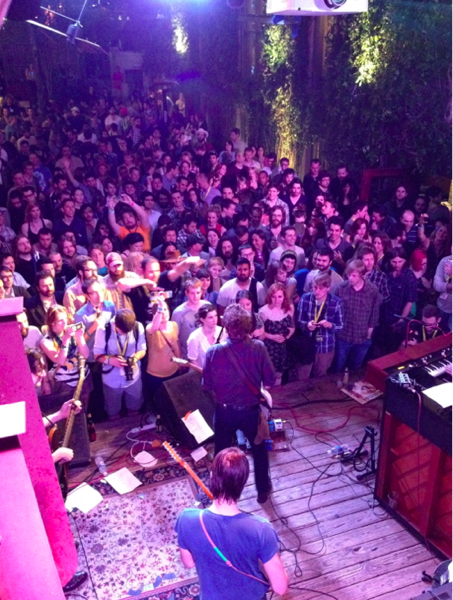
Same venue opposite angle.
Which party would you like to be at? The first one or the Dyn one?
The Dyn party above had 11 live bands vs. the 1st one had a DJ with dancing audience. The 2nd one had a bunch of the musicians hanging around to watch the headline act, Dawes.
Talking to some of the event people it was interesting to see how much work Dyn spent thinking about how to throw a good party at SXSW. Here is a blog post from last year.
Last year, I flew to SXSW Interactive on a mission. I hit Austin, TX, to take it all in and see what campaign slogan of ours had more legs: ‘Tweet Nerdy To Me’ versus ‘DNS Is Sexy’.
I was also super excited to check out trailblazing people and brands from the Web congregate for five days of networking events, parties, schmoozing, boondoggling, drinking, BBq’ing and concert going. The truth is that it was an epic week of hanging with clients and partners like SimpleGeo, Twitter, Media Temple, Mashable and Revision3.
It was the center of the Internet universe and we were right in the middle of it. Well, almost…
The only problem? I was running around like a chicken with my head cut off, hustling but alone, rogue and tired with no event or home base of our own. I traveled with two great friends and Dyn supporters, who both agreed that our disruptive and unique company could make great noise at an event like this.
What became clear as I listened to the 11 live band line-up and chatting with the folks there, there was a lot of time spent to make sure the right people worked on the event. A typical approach would be to pick a budget, pick a venue, and allocate the money to support the event. A smarter approach is to find the people who have hosted many events at the venue and at SXSW and ask "what works?" What does it take to pull off an awesome event that people will twitter about? Then, you look at your budget and see if there is good value. If it is a good event, it is much easier to get sponsors to support the event.
One recurring theme even in data center discussions is getting the right people. People who understand how important people are to the solution are much easier to work with.
March 13, 2012, 6:31 PM — Soon FourSquare won't be the only cool kid on the location-based apps block: A new wave of startups, including Highlight, Zaarly, TaskRabbit and Localmind, are generating buzz at South by Southwest by drawing on smartphone location data to deliver a range of social, commercial and informational experiences.
Highlight is a "social discovery" app that notifies users when they are near someone they don't know with whom they might share interests. It runs in the background, only requiring the user's attention when it has found a potential social contact.
A group of us got a chance to chat with GigaOm's Stacey Higginbotham and asked her as an Austin native what is hot at SXSW. Food and Health. Here is a post that Stacey threw up this morning on Open Data Standards for food.
An open data standard for food has emerged on the web. With such a tool, restaurants, food apps, grocery stores, the government and other interested parties can tell that arugula is also called rocket salad, no matter where on the web it occurs or what a restaurant menu or recipe app calls it. Right now, that’s an impossible task, which leads to inefficiencies in both consumer-facing apps and the supply chains of restaurants and grocery stores.
A group of folks concerned about sustainable foods have built the seeds of an open food database hosted on Heroku, with the code pertaining to it located at Github. The group, which gave an awesome panel at South by Southwest in Austin, consisted of a restaurateur, an urban gardening movement, someone from Code for America and someone who rates sustainable restaurants.
What is cool about this idea is what could be done if we had Open Data Standards for the components in data centers. Like how? Knowing the ingredients in a recipe is useful. Wouldn't it be great if you could get details on the components in any piece of equipment.?
He texted me after the panel to say that his primary concern was that the effort be cautious about how it tries to attribute things to restaurants. For example, while he might gain value from starting from such a database, his real value is the taxonomy his team has created around dishes. So, if one checks out catfish po’ boys on Tasted Menu, his app could use the Open Food data for the catfish or the breading, but his app will also note that the food is Cajun or Creole, fried, a sandwich and other things that will help real users figure out where they want to go and what they want to eat.
I don't know about you, but I am much more excited about the idea of open data standards than another location app.
Venture Capital maven John Doerr of Kleiner Perkins Caufield & Byers coined the acronym SoLoMo to sum up this convergence of 3 major powers and acknowledges they are affecting all aspects of business faster than most managers have realised.
There’s never a big focus on next-generation energy solutions at the annual geekfest South by Southwest — I’ve skipped the show over the past few years. But Spring Ventures founder Sunil Paul braved the rain and the ever-present SoLoMo apps to give a rendition of his presentation on the Cleanweb, or using computing, mobile, and the web to address resource constraints for energy, food and water.
I saw Sunil at GreenNet. Here is his talk at the event.