Review - Sustainable Design: A Critical Guide

I have a copy of the Sustainable Design: A Critical Guide.

The book is new and has two 5-star reviews so far an amazon.com.

Sustainable Design: A Critical Guide [Paperback]

David Bergman (Author)
5.0 out of 5 stars  See all reviews (2 customer reviews)  Like(5)

To me the ultimate test was what the author says about LEED.  

Is he being critical of LEED?  Yes.

But it has been criticized for devolving into more of a game in which racking up the most points sometimes takes precedence over producing the greenest building.

The author does a good job of listing some other issues with LEED and makes a final point.

Another criticism of LEED is that the certification process can be very expensive and time consuming.

The author looks at many of the issues with a critics eye on what to do and why.

If you are looking for a guide to greener/sustainable design, this book is worth checking out.


The Past Retail Giant, Sears, lessons to learn

Amazon.com and Costco are considered some of the most innovative retailers.

75 + years ago, the retailer innovator was Sears.  You can make various arguments why Sears isn't the retail giant.  Amazon has Jeff Bezos.  Costco had Jim Sinegal who just retired.  Sears had General Robert E. Wood.

Aren't data centers part of the retailing of bits?

Who is Robert Wood.  Here is paper on what he did at Sears.

Sears Roebuck: General Robert E. Wood's Retail Strategy
James C. Worthy
Northwestern University
This paper presents an account of the manner in which a well-
established-mail order enterprise serving exclusively a rural and
small-town market was brought into the mainstream of rapidly ur-
banizing America to serve a broad national market concentrated in
but not restricted to the great metropolitan centers. This far-
reaching transformation, which resulted in creation of the world's
largest merchandising organization, was conceived and largely ac-
complished by one man, General Robert E. Wood, a brash newcomer to
the company with no proper grounding in the accepted ways of how
things ought to be done.

Robert was driven by data.

In his drive to expand the retail system, General Wood gave
special attention to the South, the Southwest, and the West where
the census figures with which he was so familiar told him the
principal increases in population were occurring. He was well
aware that growth had levelled off or was actually declining in
New England, the Middle Atlantic states, and the upper Midwest,
and took this phenomenon into account in selecting the cities in
which he placed his stores.

The following totally sounds like inside amazon.com offices and Costco.

Falling back on his Canal and wartime experiences, General
Wood wanted stores without frills. He conceived of Sears serving
as the commissary (his term) of the nation, supplying merchandise
of such values that fancy and expensive surroundings would not
be necessary to bring people into his stores. In keeping with
this spirit, the early Sears stores were austere. Fixtures
bought for the stores during the first few years were as inexpen-
sive as could be found, many picked up locally at second hand.
There was no such thing as merchandise displays in the modern
sense of the term; goods were simply stacked on wooden tables
and customers rummaged to find what they wanted. Because men
were expected to be a large part of store clientele and men were
presumed to be not as finicky as women, housekeeping suffered
and the stores were often less than neat and orderly. The
early Sears stores were functional but drab; they resembled
warehouses, which in fact they were: warehouses open to the
public.

And, here is another part that sounds like Jeff Bezon and Jim Sinegal.

There was much to learn. A salient characteristic of the
Sears organization at this stage of internal evolution was an
openness to learning in the light of experience unhampered by
too many preconceptions of how things "ought" to be done.


General Wood himself did much to set this learning mode.
He did not leave the learning to subordinates. Much of the most
7O useful learning was his own, acquired in direct contact with the
men and women at the scene of action.


During the early retail years, a large part of Wood's time
was spent in the stores working with store managers, department
heads, salespeople, unit control clerks -- anyone in a position
to tell him how things were actually working and what needed to
be done to make them work better. 

Doesn't this sound like a description of Costco and Amazon.

By 1935, the Sears retail system was solidly established.
Its mission was clear, its leadership confident, and its machinery
running smoothly. It had taken 10 years to reach this state.
They had been 10 hard years, but they were years of achievement
in which Wood and the men around him forged a new and highly
effective means for serving the changing needs of a changing
America.
Patent Troll's cause more damage than terrorists

Here is a popular TED talk that many of you will like.

Drew Curtis, the founder of fark.com, tells the story of how he fought a lawsuit from a company that had a patent, "...for the creation and distribution of news releases via email." Along the way he shares some nutty statistics about the growing legal problem of frivolous patents.

Knowledge -> Epistemology -> Information Infrastructure

My wife has said I like to think about thinking.  And, recently at a girl's get away during charades one of the hints was a person spending a lot of time thinking, and then typing.  Thinking more, then typing.  And, they guessed Dave Ohara. :-)  So, outside of work even in social neighbor time, I have the reputation of thinking a lot and writing a lot.

One of the interesting problems I have been working on is what can change the data center industry.  Information architectures is what I have been study lately.

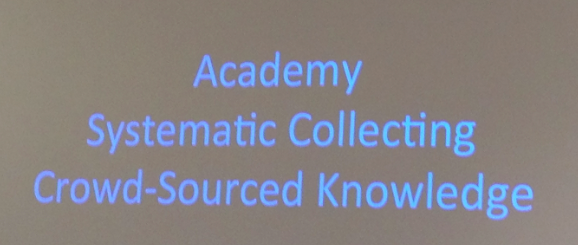
Then yesterday, I saw a talk by John Leslie King Titled - Knowledge Infrastructure: Mechanism and Transformation in the Information.  One of the slides that got my attention was this one.

NewImage

The role of the Academy in a systematic collecting of information for a crowd-sourced knowledge.

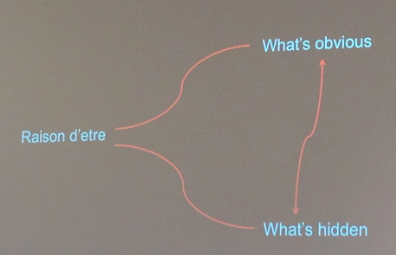
A great point was the knowledge in a perspective of reason for existence, and how what's obvious leads to thinking what's hidden.

NewImage

The other big concept John discussed was Epistemology.

Epistemology Listeni/ɨˌpɪstɨˈmɒləi/ (from Greek ἐπιστήμη (epistēmē), meaning "knowledge, science", and λόγος (logos), meaning "study of") is the branch of philosophy concerned with the nature and scope (limitations) of knowledge.[1][2] It addresses the questions:

  • What is knowledge?
  • How is knowledge acquired?
  • To what extent is it possible for a given subject or entity to be known?

Much of what John King presented is in this PDF.  The last paragraph summarizes the opportunity.

Epistemic infrastructure grew up around selection processes evolved by curators, librarians, and archivists to filter knowledge according to professional norms and standards, subject and domain knowledge, and attentiveness to the needs of user communities. This kind of systematic collecting builds trust in knowledge resources. A knowledge economy built on digital information will likewise depend on clear indicators of quality, authoritativeness, and authenticity. The lessons from the building of epistemic infrastructure in the 19th and early 20th centuries are powerful guides in this evolution. The knowledge economy will undoubtedly need new tools as it grows, but it already has a great deal of capacity and capability in the traditions of museums, archives and libraries. Handled carefully, this traditional epistemic infrastructure will simultaneously build the value of knowledge in the society and decrease disparities between information “haves” and “have-nots” with respect to ability to acquire, evaluate, manipulate, and generate information. This infrastructure is modern society’s most vibrant and effective resource for dealing with extraordinarily challenging and conflicting demands. Those working at the forefront of the knowledge economy should recognize and strengthen it.

If Yahoo, Bing, Yandex, and Baidu fail as search providers, does Google get defined as a monopoly?

The future of Yahoo is not good.

Yandex is having its problems.

Yandex Sinks on Profit Concern as Google Grows: Russia Overnight

Yandex NV (YNDX) tumbled the most this year on speculation the owner of Russia’s most popular Internet search engine will report net income faltered last quarter as competitors such as Google Inc. (GOOG) encroached on its market share.

Baidu is down on weak forecasts.

Baidu shares decline on a weaker than expected forecast

Baidu's chairman introduces the company's search engine Baidu has seen a robust growth in advertising revenue in recent years

Related Stories

Shares in Chinese biggest search engine Baidu fell more than 10% in after hours trading after the firm issued a weaker-than-expected revenue forecast.

Bing is speculated to be sold to Facebook.

The rumor, which started as a prediction in an e-book written by an "anonymous" marketing executive trying to cash in on Facebook's IPO, turns out to be truer than anyone could have guessed.

According to a nugget buried in a New York Times report on Facebook's patent strategyMicrosoft executives approached Mark Zuckerberg to see if he'd like Facebook to acquire Bing.


If no one but Google can make money on search and competitors fold shop, is it possible in the future that Google becomes the monopoly of search?
If Microsoft, Baidu, and Yandex can't beat Google, it seems like governments around the world would think they need to regulate Google Search.