A Data Center Analyst walks into Open Compute Summit and says ...

A funny thing happened at the Open Compute Summit, one of the top data center/server analyst is chatting with the OCP staff.  One of his suggestions is OCP should charge for its events.  

The OCP staff asks why?  The analyst responds, well, we charge $1500 for our data center conference, thousands of people go, they leave happily fed with knowledge.  Compared to our conferences you actually learn more at OCP.  You can make a lot of money charging to attend the Open Compute Summit.

Huh.  Who would have thought. Maybe it was the alcohol.


Difficulty of being a Green Data Center

Some of data center crowd thinks they can be green in the data center with a LEED certification and a low PUE.

Greenpeace has not made these items as a criteria of who dirties the cloud.

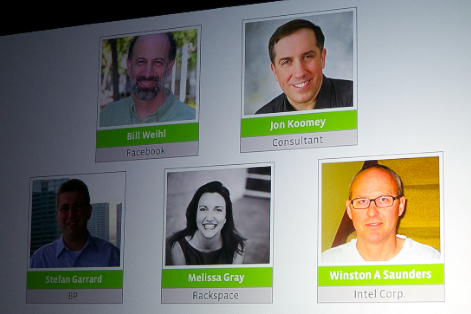
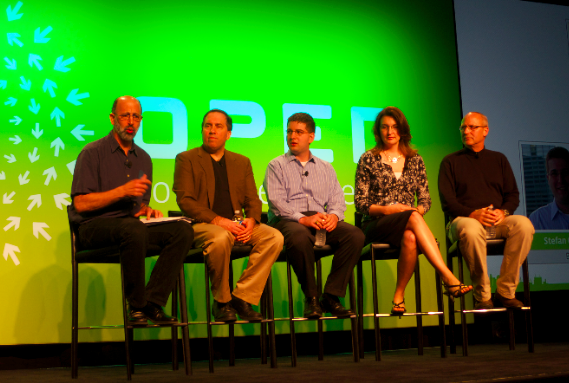
One of the sessions yesterday at OCP was on environmental strategies and the data center.

I was sitting next to Stacey Higganbotham and she did a great job posting on this subject.

It’s not easy being green: Data center edition

Facebook’s Prineville data center.

Building sustainable data centers is hard — especially if you’re trying to do it in office space in Houston. Plus, the idea of operating some kind of power-generation plant for offering renewable energy such as solar or biogas is a scary prospect for data center operators. These were among the key takeaways (along with a few less-obvious lessons) from a panel on sustainable data centers at the Open Compute Summit held today in San Antonio, Texas.


Why write when Stacey already has? I'll just throw up some more pictures of the panel.

NewImage

NewImage

My Two Suggestions to make Open Compute Project better #OCP

I am probably one of the few attendees who has gone to all three OCP Summits in Palo Alto, New York, and San Antonio over the past year.  One of the benefits of attending all of them is I get to see how OCP is developing and how it could be better.

Being Open means the OCP is open to suggestions on how it can be better.  Many conferences/organizations that are organized around a rsearch analyst organization would not be as open and admit its mistakes in running its organization and events.  This is the strength of an an Open approach.

Suggestion #1

During the afternoon there were great educational sessions on environmental issues, supply chain management, and site selection. I sat in these sessions and they were quite good.  The disappointing part was how few people attended these sessions, even though the quality of speakers and content surpass what you would see at a data center conference.

Here is the Supply Chain Management and Site Management talk.

fbtechtalks on livestream.com. Broadcast Live Free
 
What I think is a problem is given the growth of OCP summits and how many people are new to the OCP process there should be an onboarding session for those who are brand new.
Onboarding, also known as organizational socialization, refers to the mechanism through which new employees acquire the necessary knowledge, skills, and behaviors to become effective organizational members and insiders.[1] Tactics used in this process include formal meetings, lectures, videos, printed materials, or computer-based orientations to introduce newcomers to their new jobs and organizations. Research has demonstrated that these socialization techniques lead to positive outcomes for new employees such as higher job satisfaction, better job performance, greater organizational commitment, and reduction in stress and intent to quit.[2][3][4] These outcomes are particularly important to an organization looking to retain a competitive advantage in an increasingly mobile and globalized workforce. In the United States, for example, up to 25% of workers are organizational newcomers engaged in an onboarding process.[5]
The educational session is a good one, and the audience that most needs to be addressed are the new people to keep them engaged with OCP.  Address the new attendees as if they are new employess and develop an onboarding education series.

Suggestion #2

Late into evening party when things were quieting down a bunch of us were sitting together including Frank Frankovsky and we were discussing the OCP foundation.  Then I thought what is needed is a fresh look at how to educate the masses on OCP.  
How about if Facebook reached to Khan Academy's Salman Khan to create videos for OCP to explain what they are doing.
For those of you have not watched Salman Khan here is a video with Salman presenting at TED with Bill Gates as a guest.
How many more people would learn about data centers, servers, and the software that runs their services?
Now to give you an idea of the power of what Salman does, here is an excerpt of the transcript.
First the human interaction of a well done education video.

And as soon as I put those first YouTube videos up, something interesting happened --actually a bunch of interesting things happened. The first was the feedback from my cousins.They told me that they preferred me on YouTube than in person. (Laughter) And once you get over the backhanded nature of that, there was actually something very profound there. They were saying that they preferred the automated version of their cousin to their cousin. At first, it's very unintuitive, but when you actually think about it from their point of view, it makes a ton of sense. You have this situation where now they can pause and repeat their cousin, without feeling like they're wasting my time. If they have to review something that they should have learned a couple of weeks ago, or maybe a couple of years ago, they don't have to be embarrassed and ask their cousin. They can just watch those videos. If they're bored, they can go ahead. They can watch it at their own time, at their own pace. And probably the least appreciated aspect of this is the notion that the very first time, the very first time that you're trying to get your brain around a new concept, the very last thing you need is another human being saying, "Do you understand this?" And that's what was happening with the interaction with my cousins before, and now they can just do it in the intimacy of their own room.

Second is open up the content. share it.

The other thing that happened is -- I put them on YouTube just -- I saw no reason to make it private, so I let other people watch it, and then people started stumbling on it, and I started getting some comments and some letters and all sorts of feedback from random people from around the world. And these are just a few. This is actually from one of the original calculus videos. And someone wrote just on YouTube -- it was a YouTube comment: "First time I smiled doing a derivative." (Laughter) And let's pause here. This person did a derivative and then they smiled. And then in a response to that same comment -- this is on the thread. You can go on YouTube and look at these comments -- someone else wrote: "Same thing here. I actually got a natural high and a good mood for the entire day. Since I remember seeing all of this matrix text in class, and here I'm all like, 'I know kung fu.'"

So my two suggestions to OCP are to 
1) Have a session for onboarding at OCP events
2) Use Khan Academy as a fresh view to explain what OCP is, create videos, and educate the masses.


Open Compute Summit Keynote Summary by Frank Frankovsky OCP Chairman/President

Frank Frankovsky is the executive vision for Open Compute Project and he has posted a summary of points he made in his keynote here.

Enabling Innovation Where It Matters

Wednesday, May 2, 2012 · Posted by  at 15:00 PM

It’s amazing how much can happen in a year. Last April, when we open sourced a set of server and data center designs under the name “Open Compute Project,” we weren’t sure what to expect. It was our hope that we could inspire the industry to be a little more open, a little more innovative, and a little more focused on energy efficiency.

Today, as more than 500 people converge on San Antonio for the third OCP Summit, I think we can safely say that we’ve already achieved much more than that. The momentum that has gathered behind the project – especially in the last six months – has been nothing short of amazing.

For you ADD people who won't be patient enough to read the whole post. The ending is one of the most interesting things to wake you up to what OCP is doing.

On the other side of the equation, we’ve started to see a convergence of voices among the consumers of this technology around where we think the industry would benefit from standardization and where we think the opportunities for innovation are. Open Rack and Project Scorpio are perfect examples of these consumer voices coming together and communicating their needs more clearly – and the new Open Rack designs debuting today from HP and Dell are perfect examples of the supplier community’s response to that emerging clarity.

Perhaps most importantly, though, is the industry’s decreasing focus on what OCP founding board member Andy Bechtolsheim calls “gratuitous differentiation” and its increasing focus on driving innovation where it matters. This is the work we have ahead of us in the coming months, as we pursue even greater advances and efficiencies in scale computing technology. It is no small task that we’ve set for ourselves – but as the last year has proven, we can accomplish anything if we work together in the open.

Frank is founding board member of the Open Compute Project.


GigaOm's post on Open Compute Project, 1 year perspective

GigaOm's Stacey Higgantbotham posts a 1 year perspective on the Open Compute Project.

Stacey is busy writing at the Open Compute Summit here in Austin.

NewImage

And has put her post up.

Open Compute one year later. Bigger, badder and less disruptive than we thought.

It’s been a little more than a year sinceFacebook showed off it’s newly built servers and data center technologies for webscale computing. But at its third Open Compute Summit the social networking giant and other members of the recently formed Open Compute Project are adding new partners, showing off cool use cases and adding new technologies to the standard. And surprisingly, it’s being done in a way that will enable hardware vendors to hold onto some of their margins and still deliver some innovations.

Stacey closes with a perspective of watching what HP and Dell actually will do.

So viva cooperation! Although in this brave new world of webscale architecture, which Frankovsky thinks will influence high-performance computing and enterprise computing, it still remains to be seen how much relevance companies like Dell or HP will continue to have.