Linux is the brand for Open Source Software. There are many who have built on this brand to build their own open source brand.
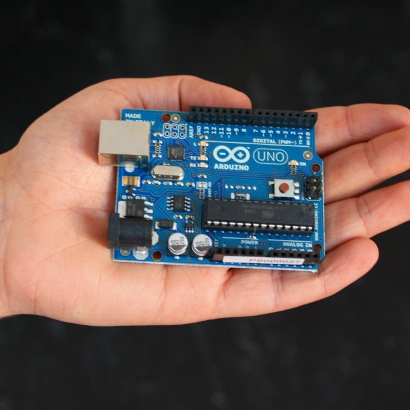
Arduino is a an open source hardware solution for small eletronics prototyping.
Arduino is an open-source electronics prototyping platform based on flexible, easy-to-use hardware and software. It's intended for artists, designers, hobbyists, and anyone interested in creating interactive objects or environments.
Arduino can sense the environment by receiving input from a variety of sensors and can affect its surroundings by controlling lights, motors, and other actuators. The microcontroller on the board is programmed using the Arduino programming language (based on Wiring) and the Arduino development environment (based on Processing). Arduino projects can be stand-alone or they can communicate with software running on a computer (e.g. Flash, Processing, MaxMSP).
Photo by the Arduino Team
When you run a search for Open Source Server Hardware the Open Compute Project shows up as the top results.
The challenge for a project that is open source is what is its business model. Just because the OCP is open source and non-profit doesn't mean they can exist without a business model.
A business model describes the rationale of how an organization creates, delivers, and captures value
GigaOm's Stacey Higganbotham attended the Open Compute Summit and she discusses the business model of Open Source Hardware.
More infrastructure, more users, less money.
What’s occurring here is a shift in the value of a server, and thus of server makers. What used to be high-end machines with features driven by the engineers inside Dell, IBM, HP, etc., have now become a commodity, and not a Dell-like commodity either — a really low-end commodity. These servers are stripped-down machines custom-built by the guys who built Dell’s and HP’s boxes. The rise of manufacturers like Quanta has begun.
This rise was a direct result of the industry refusing to listen to the demands of its customers, especially because those demands didn’t seem to involve a way for the server guys to make much money. At first, Rackable, now called SGI, picked up on the business, but as Forrest Norrad, the VP of servers at Dell pointed out on Wednesday at the Open Compute Summit, Dell realized that companies like Facebook were not just one-off complainers. They were the leading edge of a new way of doing business– and IT was a fundamental element of that business.
...
Throw the server vendors a bone and let’s keep moving.
And here’s where the Open Compute Project comes in. Unlike DCS, which was a successful effort to serve the market once Dell had validated it, the Open Compute Project is a coup by the buyers of servers to take control of their hardware destiny. As such, I wondered if this coup would leave room for Dell or HP to continue to build their businesses. After attending Wednesday’s Open Compute Summit, I can say it seems like it will.
Open Compute is still in the early stages, and it has the potential to be a brand in itself.
I've just spent two days at the Open Compute Summit and my brain is still decompressing from all the activity.
Everybody has a different style on how they attend conferences. Some want to try and meet as many people as they can looking for the whales like the casino industry looks for the high roller. This method is favored by many sales people.
Technology people are looking for newest SW and HW.
Out of 500 people attending the Open Compute Summit, I have 7 new business cards. So, you can tell I don't believe in the idea of having to work a room to build your rolodex.
I focused on talking to the influentials and the thought leaders. People who I met for the first time, we talked about big ideas to see where they are at. Some people I have known in e-mail or phone, but not met in person. But, the vast majority of people i talked to where people I have met in the past, and we can exchange new ideas.
Now, some may attend to catch up almost like a reunion, but that is kind of limiting for me. What is much more interesting is understanding how the ecosystem is working. Who is there. Who is not. Who is talking to who. Who is presenting and driving new ideas. How things are changing vs. previous events. How this event compares to others. Then, you start to discover new patterns of ideas. The ideas that are thought leaderships type.
On the plane trip out I watched Sherlock Holmes 2 and power of deduction has been morphed into almost superhuman powers.
Here is a well thought out 12 steps of How to Develop Sherlock Holmes Intuition. I really like #10.
Talk through your conclusion with a trusted person.
Talk through your conclusion with a trusted person. Holmes was a guarded person andtrusted people only when they had proven themselves trustworthy and loyal. In turn, those persons had Holmes' complete trust, such as Watson. By the same token, "nothing clears up a case so much as stating it to another person.",[13] so be sure to open up and talk through your conclusions with someone you do trust, to use them as a sounding board when you've worked through the deductions.
One of the things that makes a conference more enjoyable is having a partner, like Sherlock Holmes and Dr. Watson, discussing analyzing, criticizing, exchanging ideas. Olivier Sanche was one of those guys who was a partner. And, at OCP i had a partner I trusted to discuss conclusions I had come to.
After 2 days of intense analysis I especially like the last point. Getting home it is family time, and we are getting a new ping pong table to play as a family.
Plan downtime, party time, and leisure time into your life. Sherlock Holmes worked hard when sleuthing but he also loved his leisure and being languid.[15] Deducing things and pushing your intuition to its limits can wear you down and rejuvenation is an essential part of ensuring that you continue to stay sharp, focused, and clever.
A funny thing happened at the Open Compute Summit, one of the top data center/server analyst is chatting with the OCP staff. One of his suggestions is OCP should charge for its events.
The OCP staff asks why? The analyst responds, well, we charge $1500 for our data center conference, thousands of people go, they leave happily fed with knowledge. Compared to our conferences you actually learn more at OCP. You can make a lot of money charging to attend the Open Compute Summit.
Huh. Who would have thought. Maybe it was the alcohol.
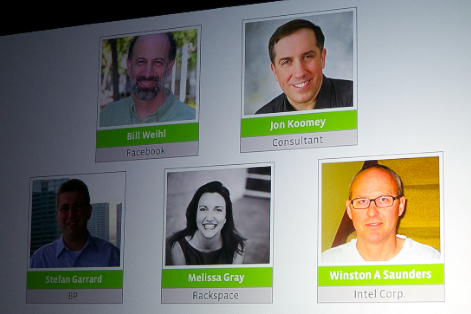
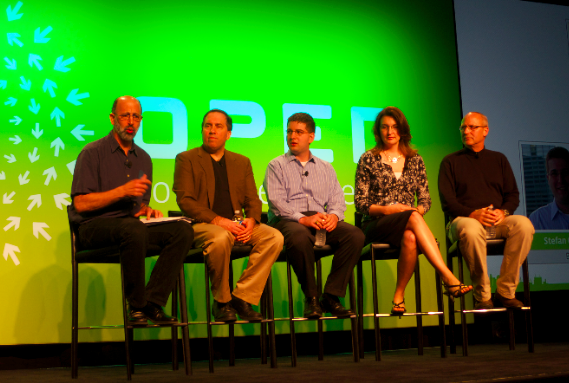
Building sustainable data centers is hard — especially if you’re trying to do it in office space in Houston. Plus, the idea of operating some kind of power-generation plant for offering renewable energy such as solar or biogas is a scary prospect for data center operators. These were among the key takeaways (along with a few less-obvious lessons) from a panel on sustainable data centers at the Open Compute Summit held today in San Antonio, Texas.
Why write when Stacey already has? I'll just throw up some more pictures of the panel.