Three Modular Data Centers that pass the Supply Chain Test - Dell, HP, and Compass DC

Almost everyone in the data center build says they build modular/container data centers.  Uptime says there are 45 suppliers.  Gartner and IDC tell its subscribers that modular should be one of the options they evaluate.  There are no shortage of people who say they can build you a modular data center.

How do you make sense of the marketing hype vs. reality.?

My tip is to get nerdy on the topic of modularity.  The modular approach is a way to address the supply chain.

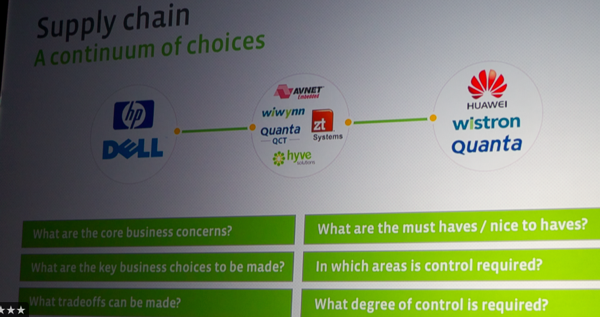
HP and Dell being experienced OEM Server vendors know supply chain.  Frank Frankovsky at Facebook is ex-Dell and he has taken the Supply Chain ideas into Facebook and passed them on to the Open Compute Project.

Open Compute Shakes Up Server Supply Chain
By: Rich Miller
May 8th, 2012

Jason Waxman of Intel (left) moderated a panel of suppliers who are meeting the Open Compute Project standards. Mike Yang of Quanta and Sohrab Modi of Huawei discussed meeting customers' needs while also addressing cap ex and op ex management.

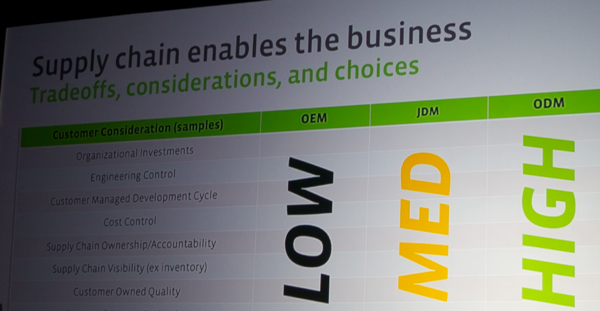
SAN ANTONIO – There is meaningful change occurring in how servers are designed, built and sold. The disruptions in the server ecosystem were on display at last week’s Open Compute Summit in the rising profile of original design manufacturing (ODM) providers and other alternatives to working with original equipment manufacturers (OEMs) like Dell, HP and IBM that have dominated server sales in the U.S.

HP and Dell are both vendors involved in Open Compute.

In discussions with Compass Data Centers's Chris Crosby we have gone into extensive discussions on his supply chain.  So, Compass Data Centers passes this test.

Many Big Brands have supply chain strategies.  Facebook shared some its supply chain practices at the Open Compute Summit.

There are others who may embrace the supply chain approach, but I feel comfortable finding three I can have conversations with - HP, Dell, and Compass Data Centers.

Oh, one problem though if you are looking to use the supply chain test is if you are not experienced at supply chains yourself it can be hard for you to evaluate the suppliers.

When I was getting my degree in Industrial Engineering and Operations Research at UC Berkeley, I spent a lot of time studying queueing theory, probability and statistics, markov chains.  I worked at HP in process engineering and distribution logistics.  At Apple I was in distribution logistics and OEM program management for computer peripherals.  So, all this supply chain in data centers is brushing up on things I did full time for years and years.  So, yes i am biased.  i think supply chain in a key to build modular data centers.

Or you believe in Cargo Cult Science and all data centers will be the same.  

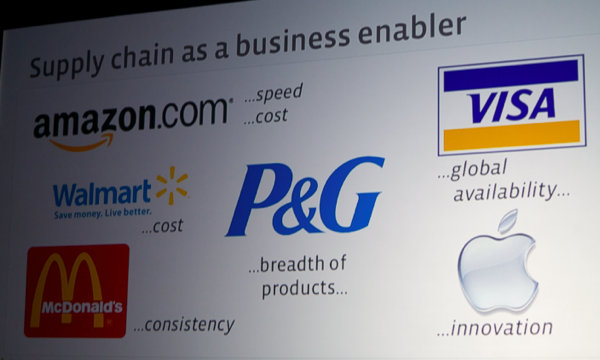
Who cares if they are all the same (which they are not ) if you can't build them with a great supply chain your product will have problems with the issues listed below cost, speed, quality, consistency, innovation, global availability.  

The supply chain is what many of these below brands great.
 

NewImage

NewImage

NewImage

NewImage

See the Cargo Cult Science in Data Centers

Now you may assume you that the data center world is all built on science and facts.  But, the Data Center World is no different than the rest of the world, and unfortunately those who benefit from managing your perception may have little interest in science.

Richard Feynman presented a talk on Cargo Cult Science.

I think the educational and psychological studies I mentioned are examples of what I would like to call cargo cult science. In the South Seas there is a cargo cult of people. During the war they saw airplanes land with lots of good materials, and they want the same thing to happen now. So they've arranged to imitate things like runways, to put fires along the sides of the runways, to make a wooden hut for a man to sit in, with two wooden pieces on his head like headphones and bars of bamboo sticking out like antennas--he's the controller--and they wait for the airplanes to land. They're doing everything right. The form is perfect. It looks exactly the way it looked before. But it doesn't work. No airplanes land. So I call these things cargo cult science, because they follow all the apparent precepts and forms of scientific investigation, but they're missing something essential, because the planes don't land.

If you want a way to detect the Cargo Cult Science in data centers, a pretty good indicator is whether you can find what Richard Feynman tell the graduates to do to not be Cargo Cult Scientists.  How are they credible.

It's a kind of scientific integrity, a principle of scientific thought that corresponds to a kind of utter honesty--a kind of leaning over backwards. For example, if you're doing an experiment, you should report everything that you think might make it invalid--not only what you think is right about it: other causes that could possibly explain your results; and things you thought of that you've eliminated by some other experiment, and how they worked--to make sure the other fellow can tell they have been eliminated.

Details that could throw doubt on your interpretation must be
given, if you know them. You must do the best you can--if you know
anything at all wrong, or possibly wrong--to explain it. If you
make a theory, for example, and advertise it, or put it out, then
you must also put down all the facts that disagree with it, as well
as those that agree with it. There is also a more subtle problem.
When you have put a lot of ideas together to make an elaborate
theory, you want to make sure, when explaining what it fits, that
those things it fits are not just the things that gave you the idea
for the theory; but that the finished theory makes something else
come out right, in addition.

An example of the Cargo Cult Science is IO Data Centers Last Snowflake that 2013 will be the last non-standardized snowflake.  There are many others, but this is one of the more timely ones that just got picked up.

Uptime: CEO of IO reaffirms prediction of the “snowflake’s” last day

Slessman sticks by prediction of end of non-standardized data centers
The world will not see a single non-standardized “snowflake” data center built after May 2013.

There may be people excited about this, but where is the data to support this claim?

When i looked at Slessman's transcript from 2011 where he made this claim.  There is not a single mention of quality or errors in the talk.  What data is shown that every IO data center is the same.   Huh. IO data centers has redefined physics where there are no errors or quality issues with any of their build outs, so every data center is the same.

So, let's go with a brand that prides themselves on quality and german engineering - BMW.

BMW builds 450 cars a day in its South Carolina plant and I am going to point to a bunch of things that make me believe BMW more than IO Data Centers.

BMW has an analysis center to figure out what is wrong.

Analysis Center

analysis

At the Analysis Center, we ignore the BMW mystique, look past the dazzling lines and impeccable paint job. We strip down the BMW and take an honest look at our work. The naked truth in all its beauty is revealed.

The 60,000-square-foot Analysis Center is a fully functioning laboratory that allows us to examine and test every weld, every dimension, and every component on vehicles as they come off the production line. The Analysis Center covers three key areas of vehicle development: Functional Analysis, Manufacturing Analysis and Customer Feedback.

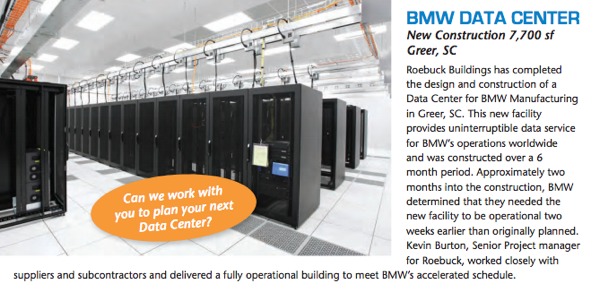
BMW has a 1MW data center to support its operations and analysis.

NewImage

The BMW South Carolina factory is described in this National Geographic Video.  What is not shown in this short video is the camera inspection equipment and many others to detect quality and errors in manufacturing. 

The laws of physics are tough to beat and it is really hard to make hundreds of complex products be exactly the same.  The products are not the same, they are all a bit different.  The issue is whether the products perform within specifications and meet quality standards.

You can believe the Cargo Cult Science that 2013 will be the last snowflake and they will all be the same after that, but you may be like the villagers doing all the those things to bring the cargo planes back.  Wearing wooden headhphones, bulding runways and putting wooden planes out.

NewImage

Or you can go with the view that every data center is a bit different and I want an engineering science backed team who can adapt the manufacturing process to give a quality performing product. 

Are you picking up the habits of the slowest player? Maybe you shouldn't follow the thought leaders

Many of you play Golf.   I don't.  i decided playing golf gave people (including in-laws) the right to grab 4 hours of my time was not something I had interest in.  Maybe if golf was 1 1/2 hrs I would play.

Watching Kevin Na play golf is painful, and few would follow his example.  Although all players have been frustrated by a slow group in front of them.  Almost all amateurs pick up some habit of the pros.

WSJ has a post on this problem.

But the Tour's pace of play is a problem for the rest of golf, since the pros serve as amateurs' primary role model for how the game should be played. We buy the clubs, balls and golf fashions that we do largely based on the pros' example, and the same goes for how everyday players line up putts, take practice swings, throw grass in the air and dither around the course like they're being paid by the hour. Survey after survey show that slow play is a major factor in creating ex-golfers.

Now, as much as you may think this is wrong.  Keep in mind who the tour serves.  The players.

The reasons why the Tour is unlikely to change its current pace-of-play system anytime soon are many and interconnected, but here's a good one to start with: meaningfully speeding up play would, in effect, penalize the Tour's slowest members where it hurts them the most, in their wallets. And the Tour, lest we forget, exists primarily for the benefit of its members.

Think about it.  Just because you are watching someone present at a data center conference should you follow their habits?  Many data center conferences, the #1 customer is the vendor and their needs.  A pro golf player's # 1 revenue is his sponsor money, not the winnings.

Consider Charles Barkley's controversial statement that he is not a role model.  Who is your role model for data centers?  The guys who have vendors sponsoring their performance should have you questioning whether it is best for you.

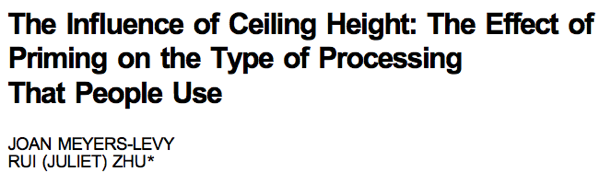
Building a Room to Think, high ceilings work

After three days in the bay area it is nice to get home.  Home is a place to reflect on the week's activities. To meditate.

Meditation is thought of as a self improvement, but I also use the technique of meditation to think of the data center industry.

Meditation is any form of a family of practices in which practitioners train their minds or self-induce a mode of consciousness to realize some benefit.[1][2][3] 

Last week with the DCD Seattle event I got a chance to chat with a bunch of folks who were in town and it turns out some were in town longer than they expected as they flew out from the East Coast and where then going to Uptime Symposium. Fieldview Solutions's John Consoli was one of those who was sticking around so we decided to grab lunch on Friday.  I told him to take a cab over to my house, and we could go to lunch and i would give him a ride back to his hotel.  I gave Fred the 3 minute tour as a complete tour of the house, office, and beach house can take an hour, and is a workout walking down the 200 steps to the beach and back.

When I ran into Fieldview Solutions's CEO Fred Dirla in Santa Clara, he heard about my house and 30ft ceilings.  Actually the ceiling is 13ft, not 30. 

NewImage

I spend more time than I expected in this room, even choosing to work in the room.  Why? I think being in a tall ceiling feels good.  WSJ has a post on the concept.

Today, it turns out, the real cutting edge of architecture has to do with the psychology of buildings, not just their appearance. Recently, scientists have begun to focus on how architecture and design can influence our moods, thoughts and health. They've discovered that everything—from the quality of a view to the height of a ceiling, from the wall color to the furniture—shapes how we think. 


...


It's not just color. A similar effect seems to hold for any light, airy space. In 2006, Joan Meyers-Levy, a marketing professor at the University of Minnesota's school of management, studied the relationship between ceiling height and thinking style. She demonstrated that, when people are in a high-ceilinged room, they're significantly better at seeing the connections between seemingly unrelated subjects. In one experiment, undergraduates came up with nearly 25% more connections between different sports, such as chess and basketball, when sitting in a loft-like space than in a room with an 8-foot ceiling. Instead of focusing on particulars, they were better able to zoom out and see what various things had in common.

I found the research paper by Joan Meyers-Levy on ceiling height.


NewImage
...

We believe that the effects produced by high or low ceilings actually occur because such ceiling heights increase or
decrease vertical room volume, which in turn stimulates
alternative concepts and types of processing. Indeed, this
logic corresponds with Hall’s (1966, 77) earlier discussed
thesis that chapels versus cathedrals communicate our theorized (i.e., confinement vs. freedom-related) associations
“by virtue of the space they enclose.”


FYI, we did not specify 13ft ceilings.  It was the height we needed to make the garage above us be level with the road.  We have no regets having little choice, and made the height one of the main features of the room, and a great place to think.


Greenpeace's claims vs. the facts, Apple fan digs up some facts

Greenpeace and Apple are having a PR war regarding the Maiden Data Center.

Here is a post I found that the data center community is going to like.  The author goes beyond the claims made and looks at the logic of when things occur vs. the perception of events.

NewImage

...

Furthermore, the Maiden land deal didn’t “just happen” over the course of a few fevered weeks following Greenpeace’s April charm offensive. Anyone that’s ever purchased land, especially agriculturally zoned land like Apple acquired to site their second solar array, knows it takes months to negotiate a deal, gain regulatory approval and process the sale.

Apple’s been working on this for months if not years and there’s a paper trail a mile wide showing exactly what they’ve been up to if anyone had chosen to follow it.

If Greenpeace is a public watchdog, what exactly have they been watching? My guess is they’ve been breathlessly watching themselves on TV.

The author then gets more critical.

In “How Clean Is Your Cloud,” Greenpeace claimed Apple’s NC data center would use 60MW of power and that the overwhelming majority of that would be coal-generated electricity from Duke Energy. However, Apple’s public statements and public filings clearly state the facility would use just 20WM — a difference of 300 percent.

Digging up more facts about energy composition.

Moreover, Greenpeace overstated Duke Energy’s reliance on coal (55 percent), citing 2007 data, despite the ready availability of 2010 data filed with regulators showing a greatly reduced coal footprint (45 percent) in its generating mix.

i wonder if the author of this post lives in NC.

And, the NCUC approval process included a public comment period and public hearings — Apple was on the ball and ready to deliver 100 percent green-powered data centers months ago and information showing that was readily available to the public.

Few including the media have spent this time researching the facts that exist in public disclosure.

I like green. I seek out green products and work hard to reduce, reuse and recycle. I despise Greenpeace…