VIdeo of Apple's Solar Farm, Neighbors say nice things about Apple's Renewable Energy Construction

As any of you have gone through a major home remodel know, your biggest nightmares can come from your neighbors who complain to the city.  Well, you think that is tough, can you imagine building megawatts of solar cells and fuel cells, and besides complaining to the city, the press is talking to the neighbors too looking for the dirt on how you are not abiding by buliding codes.

Apple has this problem building one of the largest Solar Arrays and Fuel Cell installations at its data center in Maiden, NC.  Here are images from this news video.

NewImage

NewImage

NewImage

WSOCTV  article has many neighbors comments.  One is pro environment.

Pastor William Painter's church sits right next to the data center and commends Apple for trying to help the environment. 

"It's great that they're using the solar power. We need more of that around. Cleaner powersources," Painter said.

NewImage

Another says the curious are good for business.

But the project has been good for Randy Rush's appliance business. Apple said the renewable energy produced here could power not just refrigerators but more than 10,000 homes. 

"I've got a couple people who stop a week and ask what they're doing and most of the time of they stop they buy something, so it's been good, " Rush said. 
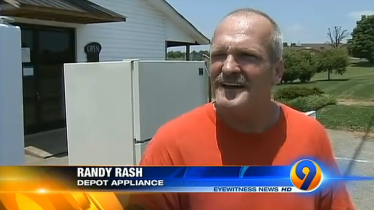
NewImage

There are a few complaints of dust and noise.

Zelda Vosburgh's back yard runs right up to the solar farm. She said she cannot wait for the renewable energy project to be completed. She said she has endured a lot during the construction of the environmentally friendly project. 

"When we get a storm or the wind blows bad this whole place turns into nothing but dust in the air. You can see it flying everywhere," Vosburgh said. 

Trevor Wilson said it's not the dust but the noise he's noticed the most near his parent's home in Maiden. On Monday, crews were working to install the rows of supports needed for the solar panels. 

But, no out right anger.  You can watch the video in the web post to see what people say and their expressions.
Observation: why the press can be difficult sometimes

I laugh when people think of me as media.  I think of myself as an engineer who likes to solve problems.  Being an Industrial Engineer, I spend a lot of time thinking about the human element in projects.  With this blog I can now write a bunch of my observations and share it with anyone who wants to visit this blog. The great thing about blogs, twitter, and other social media is you can now have a voice even if you don't work for a major publication.

One of the observations I want to share is one I made over 25 years ago when i was working for Apple.  There was an evening party after an event like MacWorld with a wide range of people from the Mac ecosystem including Apple HW and SW developers.  There was a particular guy who was dressed poorly, had bags to grab stuff being handed out, and an attitude. This guy was nerdy than the rest, and I worked with the Apple developers with not the greatest social skills who I thought were nerds.  I looked at his badge and he had a media badge.  I watched him a bit more and he had an air of entitlement that said treat me with respect. Why? If not, I'll write something really bad.  Many people kept their distance from him.

To be a technical reporter, you need to have some technical knowledge to understand the press releases. But, in general they are not technical enough to work for the companies that make the stuff. What got me thinking is how does it feel to be constantly looking at the latest technology and know you aren't qualified to work there, the people you are talking to are changing the world, and getting paid really well with stock options.  There are a handful of journalists that are successful, but they don't retire after their company goes IPO.  

It is easy to talk to the press the same way you talk to your peers about a technology.  Keep in mind that your product and its success can actually rub someone the wrong way.

When a person does get rubbed the wrong way, they can spend more time to show this person is wrong by interviewing someone with an opposing view. This can also be called unbiased reporting.  How many times does a journalist say this person is the expert and this other person is some random person I finally found with an opposing view that is not credible as the expert opinion.  The unbiased reporting is an interesting area.

Where can we find unbiased journalism?

A Hemingway novel ends with the line, "Isn't it pretty to think so?" I've always wanted to know what was true, not merely what I might want to believe -- including about Obama. I assume some WSJ readers are the same way.

...

I was a journalist; I know how and how not to game statistics. I suspect this "study" of gaming statistics because it uses two different time periods: recessions post- WWII and post-1960. Isn't that an apples-to-oranges comparison? I suspect the statistics were gamed to make Obama look as bad as possible. I know for sure that's at least one reason why this was published in Opinion rather than the news pages.

In fact, this evident gaming makes me disappointed in the WSJ. But it'll never be a perfect world -- as all conservatives know.


It's tough to be unbiased when you are reporting on a subject that you enjoy, but think you could do.  Imagine if sports journalisms was composed of those who didn't make the team.  If entertainment reporting was composed of the waitresses/waiters who couldn't make it on Broadway.  

One tip about talking to the press is to try and get some background on them.  When you talk to the person keep in mind you could be rubbing them the wrong way.  This is why phone interviews can be so difficult.  When you see the person you can see how they are reacting to you.

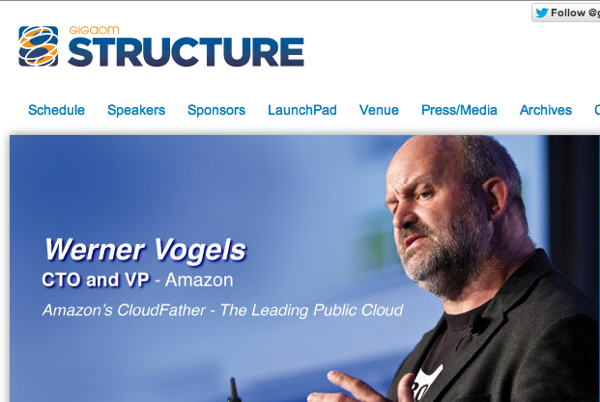
Off to GigaOm Structure

Last year I attended GigaOm Structure for the first time as a blogger.  This year I am attending as a GigaOm Analyst.  

NewImage

The following are some of the sponsors there that are interesting to the data center user.

NewImageNewImageNewImageNewImage

NewImage

I'll be bouncing from data center discussions to Cloud and Big Data.  Looking forward to a great event to network and stimulate new ideas.

Two different styles of reporting on news; BBC (traditional) vs. GigaOm (Web2.0)

There are a bunch of news on Google's reporting of on governments that request Google to remove content from their website.

Google reports 'alarming' rise in government censorship requests

CNN - ‎2 hours ago‎
(CNN) -- Western governments, including the United States, appear to be stepping up efforts to censor Internet search results and YouTube videos, according to a "transparency report" released by Google. "It's alarming not only because free expression ...
 

Google Transparency Report reveals take-down requests from governments

Siliconrepublic.com - ‎5 hours ago‎
The fifth update to Google's Transparency Report reveals an increase in informal requests from governments to remove political speech from their services. Google's Transparency Report first saw the light of day about two years ago.
 

Google Transparency Report: U.S. Content Removal Requests Increased 103%

TechCrunch - ‎1 hour ago‎
To put this into perspective: in the first half of 2011, Google was only asked to remove 757 items in the US and only received 92 removal requests. Google complied with 42% of these requests. According to its reportGoogle received 6321 user data ...
 

Google Transparency Report reveals 'alarming' rise in government censorship ...

GlobalPost - ‎5 hours ago‎
Google has seen an increase in requests from governments to take down internet content they don't like, according to its latest Transparency ReportGoogle has reported a rise in the number of requests it received from governments to censor its search ...

One of the interesting things I find is how a traditional news organization will report vs. a Web2.0.  

The BBC has their article here.

Google reveals 'terrorism video' removals

This article doesn't say who the author is or provide any links to the original content.  Trust us we are the BBC.  We know the facts.

GigaOm has a post its post here.

Google says US government takedown requests have doubled in last six months

New data released by Google shows that US government requests to remove search results, YouTube videos and other content has increased by 103 percent in the last half year. The company also released takedown information from around the world that show countries targeting everything from social network profiles to a citizen peeing on a passport.


This post has the name of the author, multiple links, stats on sharing through Twitter, Facebook, etc.

The original Google post is here.

More transparency into government requests

June 17, 2012 at 8:23 PM
About two years ago, we launched our interactive Transparency Report. We startedby disclosing data about government requests. Since then, we’ve been steadilyadding new features, like graphs showing traffic patterns and disruptions to Google services from different countries. And just a couple weeks ago, we launched a new section showing the requests we get from copyright holders to remove search results.

The traditional way is trust us our brand, our publication.  The Web2.0 is show us where you get your information from and who you are.

Which do you trust more to read?  BBC or GigaOm.  How about your kids or nephews/nieces?

(Disclosure: I work for GigaOm Pro as an analyst.)

Google's Story of Google Apps, 65-85% less energy, US GSA migrates 17,000 for a $285,000 savings (90% energy reduction)

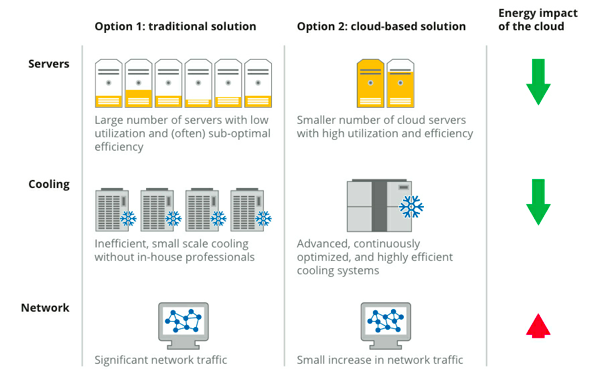
Google had a viral video on The Story of Send.  Google just released a post that fits in the same theme with what could be "The Story of Google Apps."

NewImage

The blog post is backed up with a paper.

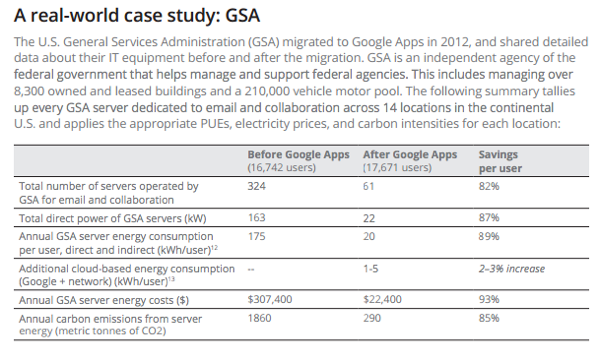
The data that gives this story credibility is the win Google had for Google Apps with the US GSA.

Lower energy use results in less carbon pollution and more energy saved for organizations. That’s what happened at the U.S. General Services Administration (GSA), which recently switched its 17,000 users to Google Apps for Government. We found that the GSA was able to reduce server energy consumption by nearly 90% and carbon emissions by 85%. That means the GSA will save an estimated $285,000 annually on energy costs alone, a 93% cost reduction.

The specifics of the GSA story are here.

NewImage

It wasn't too long ago that any small business that wanted e-mail was seriously looking at putting an e-mail server on site.  What small business does that now?  Along with that came Office licenses.  Google is targeting this whole Office document e-mail system with cloud services that are much more efficient.

A typical organization has a lot more servers than it needs—for backup, failures and spikes in demand for computing. Cloud-based service providers like Google aggregate demand across thousands of people, substantially increasing how much servers are utilized. And our data centers use equipment and software specially designed to minimize energy use. The cloud can do the same work much more efficiently than locally hosted servers.

All of this is built on Google's green data centers.

We’ve built efficient data centers all over the world, even designing them in ways that make the best use of the natural environment, and we continue working to improve their performance. We think using the super-efficient cloud to deliver services like Google Apps can be part of the solution towards a more energy efficient future.

Posted by Urs Hoelzle, Senior Vice President for Technical Infrastructure


(Cross-posted on the Google Green Blog)