Finding Patterns in Places, leads to insight

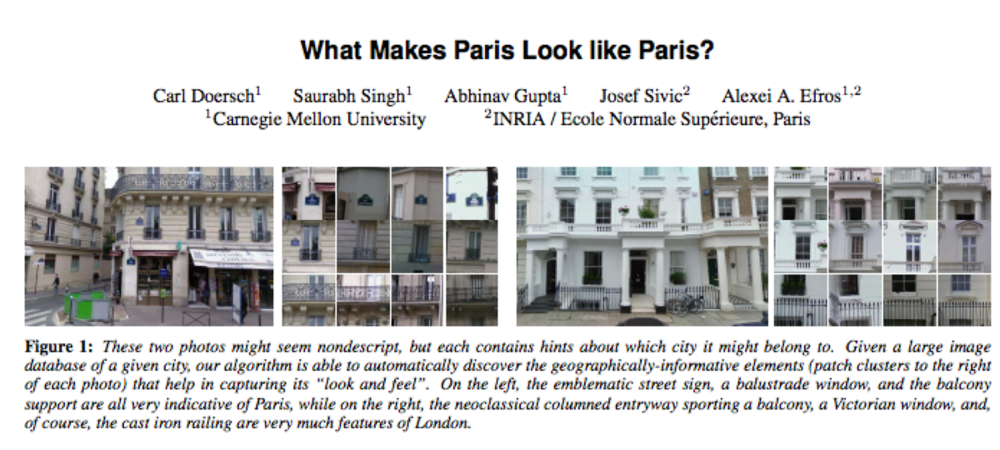
A group of Carnegie Melon Researchers published a Siggraph paper on "What makes Paris look like Paris?"  When I read this paper and watched the video it reminded me of many of the conversations that some of the top data center people have.  Comparing elements of what they see and do with others, discussing what others try and whether it would work in their environment.

Last year a bunch of us went to visit some top financial data center executives and toured their facilities.  We could find elements of the power, mechanical and other systems that told us who designed the building and how it compared to their building.
NewImage

One of the insights from the paper is that the famous landmarks are not what make the look and feel of the city, but the stylistic elements.

6 Conclusion
So, what makes Paris look like Paris? We argued that the “look
and feel” of a city rests not so much on the few famous landmarks
(e.g. the Eiffel Tower), but largely on a set of stylistic elements,
the visual minutiae of daily urban life. We proposed a method
that can automatically find a subset of such visual elements from
a large dataset offered by Google Street View, and demonstrated
some promising applications. 

Do you work best during a sunny or cloud day? Study says bad weather increases performance

HBR has a post that is good for those of you who live in bad weather environments.  

Morning Advantage: Busy Day Ahead? Pray For Rain

Common sense tells us that bad weather makes us blue and therefore less productive at our jobs, but it turns out the opposite is true. As detailed in this executive brief at HBS Working Knowledge, researchers Jooa Julie Lee, Francesca Gino, and Bradley R. Staats found that performance at a mid-sized Japanese bank peaked on the days with the worst weather, as it did in a series of lab experiments they conducted too. Here’s their theory: When the weather’s bad, our minds wander less, and we’re able to focus more because we really can’t do anything else.

Now in data centers, you don't usually get to see the sun that much.  There aren't a lot of skylights or windows, so the weather may not affect you.  Or the weather may affect you because you know what is like outside.

Some suggestions from their research: Save drudge work for the wettest days and creative endeavors for sun-soaked days. Other ideas include using weather reports to determine the best staff size on a given day and moving service centers to cities with poor (but not entirely depressing) weather. Here’s to you, Seattle.

A greener data center should be built on truths, lying is not healthy

I don't know about you, but I am so tired of the over exaggeration of green data centers that I don't pay attention to most statements that data centers are green any more.  People think they are green simply because they are LEED certified, yet they provide so transparency on what they did to be certified. and whether the main reason they got certified was for marketing purposes.  There are quite a few people who have expressed how little the return is for saying their data center is LEED certified.

Low PUEs are an exaggeration as well.  When you know who the people are behind the statements, one of the questions I ask myself is this type of person who regularly tells lies or the truths?

NBC has post on an experiment done to see what happens if people tell the the truth for 10 weeks vs. a control group that does their regular life of lying.

We tell one lie, sometimes two, every day, sharing an average of 11 untruths per week. We tell lies to avoid hurt feelings, or we embellish to make a story more interesting. 

But whether it’s a white or boldface lie, all these fibs harm our health. Researchers discovered that people who lie less experience better physical and mental health than those who commonly bluff.

Just because people are visible speaking at conferences doesn't mean they are lying less.  In fact, the speakers could be lying more than the rest.

“The irony is that now that we have more outlets for disclosure [such as Facebook], it forces us to lie more because now people ask really bold questions,” she says.

Keep in mind that telling the truth doesn't have to be as bad as Jim Carrey's movie Liar Liar.

Telling the truth can be more like this.

Kelly stresses that not lying doesn’t mean sharing harsh truths -- it means telling kind truths or not revealing some information. A kind truth might sound like “I loved how that other dress looked on you,” instead of “you look terrible in this dress.” Participants in the no lie group also avoided exaggerations by changing the subject or not answering questions, politely, of course.

Telling the truth is also better for the soul and your health.

“Good relationships have long been connected to good health,” says Kelly. “The bottom line is this is really about the relationships … being caught in these lies is anxiety [producing] because we don’t want to ruin the relationships.”

Facebook's low power storage data center

Facebook has shared more details with Wired.com on its 3rd data center in Prineville.

The plan is to use the building to house a brand-new type of low-power, deep-storage device that Facebook engineers will cook up over the next six to nine months. They’re designing a hard-disk storage server that powers off when it’s not in use, says Tom Furlong, vice president of site operations at Facebook. “It’s going to sit in a dedicated building that is optimized to support this device that we don’t need to access very often.”

What will this building be like? Boxy and quiet, with rows of low-powered machines clicking on and off, says Furlong.

Olympics show a future with lots of mobile viewing

GigaOm has a post on the viewership of Xfinity customers.

By the numbers: How the Olympics helped to take multi-screen mainstream

On how many different devices did you watch the Olympic games? If you’re anything like the average Xfinity customer, the answer is between two and three – and that’s not even counting your living room TV. Welcome to the first multi-screen Olympics.

Olympics

Comcast released an astonishing piece of data this week: The average Xfinity customer who viewed live streams of the the games online authenticated 2.4 devices. It’s worth noting that this is in addition to millions of TV screens used to watch the London games; those 2.4 devices are just mobile phones, tablets and PCs. In other words: Millions of people used not one or two, but three to four screens to watch the Olympics!

The data that got my attention though is the mobile use by iOS and Android.