Goldman Sachs gains the Green Data Center Capability of the elite from IO, Data Center Capacity deployed annually

What is fundamentally wrong with data centers of the past is it was an exercise in consensus decision making to gain enough votes of confidence to move forward with a major capital investment.  The Real Estate and IT group would go around to all the different business units and other parts of the company to collect the requirements, and alternatives would be presented.  Here is how much it will cost to meet the needs of the business for the next 15 years.

This method was fine when Data Centers were a fraction of the IT costs.  Now with the web and surge of data, it is reasonable for the top financials to have 50k - 100k of servers.  Some of these servers need to meet regulatory requirements from dozens of gov't agencies.  Some of these servers have minimal regulatory issues and can be spread around in low cost data centers.  Google, Amazon, Facebook, and Microsoft are building some of the lowest cost data centers that are tuned to their high server counts with geo-redundant homogenous architectures.  Google has 5 data centers support a major geographic region for ad services where 24x7x365 services are requirement.  In contrast the gov't  financial regulators will require an A + B data center and disaster recovery site strategy within a specific distance of Manhattan.  These requirements push the costs of data centers to be one of the highest costing in the industry as Active-Active fail over with full capability to run services if the other goes down.

With todays current financial climate, it is time for a change.

And one of the first financials to make the change is Goldman Sachs.  Don Duet is quoted in the press release.

"Their innovative technology and services will allow Goldman Sachs to scale its data center operations more efficiently, and further advance the firm's broader commitment to environmental stewardship and reduced carbon footprint."

The three points that GS focuses on are part of a green data center strategy.

1) Efficient operations

2) Commitment to environmental stewardship

3) Reduced Carbon footprint

The money savings isn't mentioned by Don in the quote, but it is highlighted as a feature of a data center 2.0 strategy

 In addition to greater operating and capital expense savings

Add all these things up and one way to look at GS's strategy is to gain the capabilities that Google, Facebook, Amazon, and Microsoft have to design data centers that meet their business needs in a way that data centers capacity can be deployed yearly vs. the past where data centers were built every 3-5 years.

The WSJ highlighted the GS announcement as part of a post here.

Data- and technology-driven organizations like Goldman Sachs are particularly vulnerable to the pace of technological change, because the huge investments they make today could cripple them tomorrow. Whatever competitive advantage they may have earned today can be swept away in the next tide of change, particularly if their hardware investments prevent them from reacting in an agile manner. That’s why Don Duet, the global co-chief operating officer of Goldman’s technology division, is building modular data centers that depend more on software than hardware, so that his team can react to “the pace of technological change,” he said during a phone conversation Monday.

WSJ also reported on Allianz Global Investors questioning its data center strategy.

The economic crisis in Europe is forcing Allianz Global Investors of America to reconsider its data center consolidation strategy. Daniel Stroot, CIO of Allianz, says the company considered opening two data centers in Europe and two in Asia, in addition to the two it maintains in the U.S., but is now planning to add just one more. “We had planned to have two in each region but now we’re thinking maybe we only need three globally,” Stroot told CIO Journal in an interview. “The crisis in Europe has continued to force us to look at being more efficient.”

At this point, the company no longer owns its own data centers, having in 2011 consolidated five data centers down to two private clouds operated by data center service provider IO. The original reasons for consolidation were as much circumstantial as a reaction to other changes in technology, namely software-as-a-service. The company was moving two of its offices into new buildings in New York and San Francisco that either wouldn’t support a data center, or where running a data center represented too great a cost from a power and cooling perspective. The new offices were “the trigger event to rethink what we’re doing and get out of the business” of maintaining data centers in-house, Stroot said.
The Future of NYTimes Data Centers 10 steps to a Lean Power Diet, No Diesel Generators, No Batteries and PUD best friends

Jim Glanz is becoming infamous in the data center industry with his two posts on 

THE CLOUD FACTORIES

Power, Pollution and the Internet

&

Data Barns in a Farm Town, Gobbling Power and Flexing Muscle

I was talking to one of the smart data center guys, and we joked that the series will continue and maybe the possible conclusion is the NYTimes showing us all how they can be different than the rest in how they host the NYTimes in a data center.  How?  Here are 10 steps that would follow Jim Glanz's suggestions.

1) The NYTimes commits to run its server at 50% utilization or more. Comatose servers are decommissioned  Consolidating all their IT resources into a 200kW space or less. 

2) The NYTimes eliminates the pollution from diesel generators and environmental impact of UPS battery back-up by connecting straight to the Utility.

3) This constant predictable load of 200kW causes no problem for the Public Utility Department, so all is happy.  We all know the PUD like nice steady loads.

4) Peak traffic usages that push beyond server capacity are redirected to those power hungry polluting news organizations - CNN, Foxnews, NBC, ABC, Huffington Post you will be the polluters of the world not the NYTimes.

5) Power hungry hard drives will be replaced with tape drives.  As long as the NYTimes can stream content faster than people can read it is OK.

6) Images will be phased out for words to reduce information required to deliver news. Embedded links will point to Instagram and Google Images.

7) Redundancy is wasteful and polluting. Single point of failures are standard practice.

8) When the power goes off, we'll turn off too.

9) The NYTimes will make the ultimate commitment to a zero carbon impact commitment by going out of business.

10) Data Centers are causing the destruction of the USA, polluting the air we breath.  There are so few people employed by the data center industry, send the data centers outside the USA.  Decomission those server farms and let's go back to an agricultural society where methane is the pollution.

The secret plan for word domination.

11) in this new (retro) agrarian society, we will be the only ones to know how make ink from berries and hand press our newsprints (as we will have bought up all ancient printing presses with the money we save).  Then, and only then, we will truly fulfill our mission of "all the news that is fit to print"

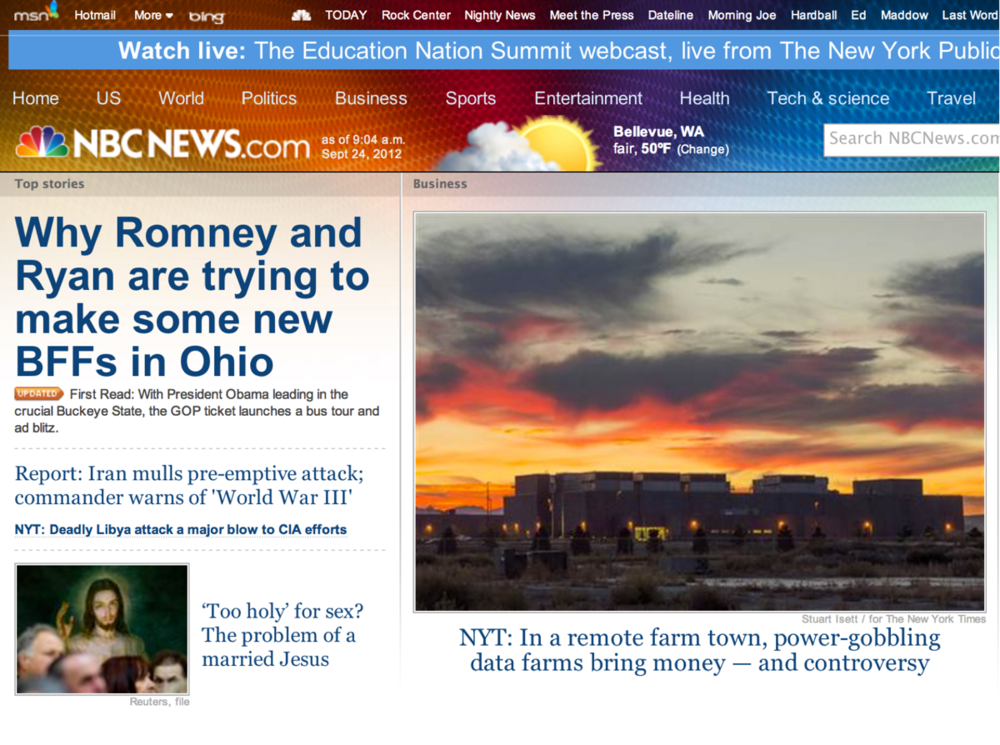
NYTimes article lands on NBCNEWS Homepage

You may be thinking the NYTimes article on Polluting Data Centers will fizzle out.  But, guess what, NBCnews.com puts the 2nd article focusing on Microsoft on its home page.

NewImage

When NBCnews.com was MSNBC.com there would have been the disclosure that MSNBC is a Microsoft & NBC collaboration, but that has ended.  And, now NBCnews is just NBC.  

DatacenterKnowledge collected a roundup of reactions to the 1st post.

And, Mike Manos has posted his response to the 2nd post.

NYTimes throws its 2nd punch at Microsoft Data Centers, Diesel Generators, and Policy

NYtimes had its 1st article on Power, Pollution and the Internet.   The 2nd punch (article) focusing on Microsoft as the bad guy who consumes huge amounts of power, pollutes with diesel generators, and plays hard ball.

But for some in Quincy, the gee-whiz factor of such a prominent high-tech neighbor wore off quickly. First, a citizens group initiated a legal challenge over pollution from some of nearly 40 giant diesel generators that Microsoft’s facility — near an elementary school — is allowed to use for backup power.

Then came a showdown late last year between the utility and Microsoft, whose hardball tactics shocked some local officials.

In an attempt to erase a $210,000 penalty the utility said the company owed for underestimating its power use, Microsoft proceeded to simply waste millions of watts of electricity, records show. Then it threatened to continue burning power in what it acknowledged was an “unnecessarily wasteful” way until the fine was substantially cut, according to documents obtained by The New York Times.

The story spins inconsistencies between Christian Belady who has Mike Manos's old job.

Mr. Belady, the Microsoft official, said the board’s resolution “eliminated the illogical financial incentive for Microsoft to consume unnecessary power in order to avoid a larger fine.”

Mr. Manos, the former Microsoft data center chief who had pledged to operate in an environmentally sensitive way, said he was surprised by the company’s response to the penalty. “Those types of decisions would not have been part of the program’s initial inception,” he said.

Note how the author closes, questioning the value of data centers to the local economy.

But Mr. Morgan, the president of Double Diamond Fruit, said the positive impact over all had been far less than many people imagined. As for all the digital services that data centers power around the country, Mr. Morgan said, “I understand that it’s a necessary situation for us as a society and the way we want to live.”

“But I don’t think it’s benefiting Quincy,” he said. “I think we’re taking one for the team, to tell you the truth.”

We'll see who he goes after next after Microsoft

THE CLOUD FACTORIES

This is the second article in a series about the physical structures that make up the cloud, and their impact on our environment.

Part 1: Power, Pollution and the Internet

Google, Amazon, Apple, Facebook?  Amazon has had Diesel Permit issues in VA.  

This kind of feels like a data center witch hunt or McCarthyism trial.  

One good lesson to learn from the NYTimes DC article, too many times the #1 goal of media is traffic

I was exchanging e-mail with a friend who said the NYTimes contacted him months ago for the interview of the now infamous Power, Pollution, and the Internet article.

THE CLOUD FACTORIES

Power, Pollution and the Internet

Ethan Pines for The New York Times

Data centers are filled with servers, which are like bulked-up desktop computers, minus screens and keyboards, that contain chips to process data.

As you can see there are 280 comments.  Many critcizing the article, many praising it.  

What do I think?  Was I mad at the inaccuracies?  Did I get frustrated at how facts were use?  No.  I just wrote my own post with my own observation that the people who talked to him were probably worried what the author would write next?

Ken Brill is in a 8 minute video.

One lesson I would say that is a good one to learn is media's #1 goal many times is traffic.  So, even though you explain the facts, the reporter is looking for things that get people's interest and gets them to read more.

All of you getting mad, forwarding the post are driving up the traffic of the article.  When a person is measured on traffic, there is no way to tell if the traffic is being read by a fan or a critic, whether or not you are consider accurate by the experts and insiders is not a priority.  Keep in mind this publication was not in DatacenterDynamics or Mission Critical Magazine.

Luckily my friend who was contacted by the NYTimes could tell the reporter was negative on data centers, and he passed on the interview.

The author has a PhD astrophysical sciences which in theory means he should be able to understand data centers.  But he has worked for the NYTimes since 1999, so he is well indoctorined to how things work at a news publication.  The way he writes you wouldn't think he was a PhD physicist.

James Glanz
Science Reporter

James Glanz is a physicist who received his Ph.D. in astrophysical sciences from Princeton University. He started his career in journalism with Research and Development Magazine, before moving to Science magazine, the premier science research publication in the United States.

Since 1991 he has reported on astronomy, cosmology and physics as well as military and technological topics like missile defense and nuclear weapons.

He joined The New York Times in 1999. Stories he wrote with Eric Lipton and others on the World Trade Center were chosen as a finalist for a Pulitzer in explanatory journalism in 2002. Stories Lipton and Glanz wrote were also a part of the Nation Challenged package that won a Pulitzer for Public Service in 2002.

The benefit the NYTimes has is when they call for an interview, few refuse.

But, now a call from the NYTimes's James Glanz is going to be as feared as a call from an environmental group who thinks data centers are dirty coal spewing cloud factories.