NYTimes Data Center articles miss the target, comments cut off, little traffic, truth in whose view?

I am sure many of you have discussions with your friends on the NYTimes infamous articles. I had friends call me, and it is dinner/bar conversation that inevitably comes up.

Here are some facts that you may like to use in a conversation.

The 1st and 2nd articles by Jim Glanz no longer accepts comments.  Huh?

Comments are no longer being accepted. Please submit a letter to the editor for print consideration.

There is a correction posted on Sept 24.

Correction: September 24, 2012

A previous version of this article misstated why Microsoft wasted millions of watts of electricity, according to records. It was an attempt to erase a $210,000 penalty the utility said the company owed for overestimating its power use, not underestimating its power use.

The NYTimes Public Editor has an article on balanced reporting and the pitfalls of "false equivalency".   The editor closes with a statement that is hard to believe is  a truth applied to the data center articles.

It ought to go without saying, but I’m going to say it anyway: Journalists need to make every effort to get beyond the spin and help readers know what to believe, to help them make their way through complicated and contentious subjects.

The more news organizations can state established truths and stand by them, the better off the readership — and the democracy — will be.

When you look at the last 7 days.

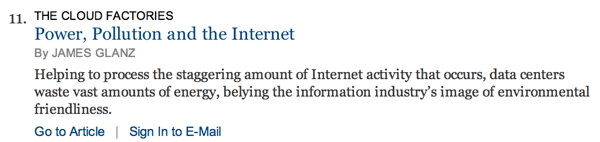
The most e-mailed shows the Power, Pollution and Internet at #11.

NewImage

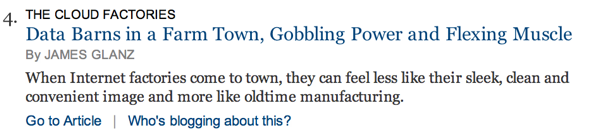
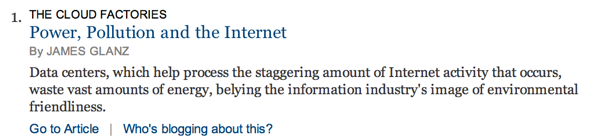
The article does get most blogged with #1 and #4 positions for the two articles

NewImage

NewImage

But the article doesn't make the Top 20 views for NYTimes overall or in Science over the last 7 days.

So this would seem like the articles stirred up the tech savvy data center community with e-mail forwarding and blog posts, but net didn't get that much traffic for the NYTimes.  

If you ran the NYTimes would you give the go ahead for more articles or not?

Why did the NYTimes cut off comments for both articles?


Why Renewable Energy is the Right Decision for Google's Green Data Center

Google was nice enough to let me know yesterday that they would make a renewable energy announcement today, and I have a bit of time to think about the impact of the announcement.

More renewable energy for our data centers

September 26, 2012
We announced our commitment to carbon neutrality back in 2007, and since then we’ve been finding ways to power our operations with as much renewable energy as possible. In our latest step toward this end, we just signed an agreement with the Grand River Dam Authority (GRDA) to green the energy supply to our Oklahoma data center with 48 MW of wind energy from the Canadian Hills Wind Project in Oklahoma, which is expected to come online later this year.
...
This brings the total amount of renewable energy for which Google has contracted to over 260 MW.

The press release went live at 7:00a PT this morning and as expected GigaOm's Katie Fehrenbacher and DatacenterKnowledge's Rich Miller put up posts quickly.

http://gigaom.com/cleantech/google-powers-a-data-center-with-wind-for-the-first-time/

http://www.datacenterknowledge.com/archives/2012/09/26/google-provisions-more-wind-power/

What comes to mind when I see Google's actions is a speech from UPS's Scott Davis Chairman and CEO about Right Turns at the Right Time.

Here are parts of the speech that support the idea of doing the Right Thing for the environment.

Why are so many companies struggling to survive, let alone grow in value?

 Making the right choices for the long time is part of his theme, and how it fits into sustainability.

I believe that some companies made expedient decisions¿ or took ill-advised shortcuts¿ that compromised their reputations, and in the long-term, their underlying value.

There is no question that this is a challenging economic environment. It's very tempting to take the quick, cost-cutting approach without carefully considering the impact on your company's reputation.

In the short time we have together today, I'd like to share my perspective on the vital role your company's reputation should play in your strategy and decisions.

I'd like to address two topics:

* First, why reputation should matter to every company, large and small, and why you should guard it zealously. Why, in my view, it's the bedrock of long-term profit, and sustainability.

* Second, what we can do to ensure that our companies' reputations do not become the victim in this belt-tightening environment . And

Why is this so important?  This is part of your brand and choices customers make.

Let me frame my comments by saying that reputation to me essentially means the degree of trust, admiration, and esteem that stakeholders have for a company.

Jeff Bezos, the CEO of Amazon, and someone I admire greatly, defines reputation in a more candid way : He says "reputation is what people say about you when you leave the room."

Yeh, yeh doing the right thing is important, but I am about the bottom line.  Well the bottom line is your reputation in the customers mind is worth billions of dollars, even to Google.

According to most reliable sources that study issues involving corporate reputation, the value of a company's reputation capital¿ its intangible assets such as brand equity, intellectual capital, and goodwill¿ is enormous.

It can constitute between 70-80%, and in some cases, such as Google and Coca Cola as much as 90% of a company's market value.

UPS's brand value has been placed as high as $21 billion dollars. That's "B" as in billions . . .

I see a few CFO's out there, and I can tell by the smiles on their faces that I just got their attention!

The environmental aspect is key to UPS's strategy.

We have implemented many environmental programs company-wide, but our efforts in this area are perhaps best illustrated by our initiatives relating to our vehicles.

For nearly 80 years, we've been focused on fuel conservation, long before it became the critical issue that it is today.
In the 1930s, for example, we pioneered the use of electric-powered vehicles in New York City.

Today we operate the world's largest fleet of low-emission vehicles, approximately 20,000 of them, and that number will continue to grow.

We also operate the largest alternative fuel-fleet in private industry. That includes natural gas, liquefied natural gas, propane, fuel cell, electric, hybrid electric, and hydraulic hybrid fleets.

Our entire delivery network has been re-engineered for more environmental benefit. You may have heard it described in the press as the UPS Right Turn Policy .

I can see a few of your smiling out there, and I know what you may be thinking¿ but it really works.

We carefully map-out routes for all our drivers to reduce the number of left-hand turns they make.

And, here is a statement that will really get your attention.

The bottom line for us is that our stakeholders need to know that when it comes to the environment, we intend to be part of the solution, not part of the problem.

Who would think that this is a speech that comes from UPS's CEO?

But when it involves your company's reputation, you have to have the courage for the long haul :

* The courage to cling to your convictions
* The courage to place reputation at the head of the line...Every Time!!
* The courage to maintain, despite all the howls of protest, clarity of purpose, and relentless focus on your company's reputation

Second, do the right thing at the right time . . . repeatedly.

...

In closing, let me leave you with this challenge: When it involves your company's reputation, do what's right over what's easy.

I hope this helps you look at how Google's Green Data Center efforts fit in an overall strategy and it is important enough to hit the Official Google Blog.

we’re a growing company with a corporate mandate to use clean energy for our operations in a scalable way.
Developing Creativity for a Knowledge Economy, play more, obsess less

Being Asian I am used to the concept of Tiger Mom.  WSJ wrote an article on why Chinese Mothers are superior.  Many of you may think these are the type of people you want to have on your team, obsessed over achievers.

A lot of people wonder how Chinese parents raise such stereotypically successful kids. They wonder what these parents do to produce so many math whizzes and music prodigies, what it's like inside the family, and whether they could do it too. Well, I can tell them, because I've done it. Here are some things my daughters, Sophia and Louisa, were never allowed to do:

Erin Patrice O'Brien for The Wall Street Journal

Amy Chua with her daughters, Louisa and Sophia, at their home in New Haven, Conn.

• attend a sleepover

• have a playdate

• be in a school play

• complain about not being in a school play

• watch TV or play computer games

• choose their own extracurricular activities

• get any grade less than an A

• not be the No. 1 student in every subject except gym and drama

• play any instrument other than the piano or violin

• not play the piano or violin.

Luckily, my mom was not a tiger mom.  She let us play which was way more fun and creative.

Guess what one of the most successful economies in the world Singapore with a large chinese influence has the Prime Minister challenging the role of the tiger mom.  The Economist covers this topic.

ONCE upon a time most of the tiny island-state of Singapore was a jungle. That is nearly all gone now, but the country is still heavily populated by tigers. These strict, unyielding felines, celebrated by Amy Chua in her book on the superiority of Chinese parenting, “The Battle Hymn of the Tiger Mother”, load their cubs down with extra homework and tuition to make them excel at school. Western parents are usually horrified at the pressure the tiger mums exert on their children to get better grades or become concert violinists, preferably before puberty. But in Singapore this style of parenting, especially among the ethnic Chinese majority, is rarely questioned.

The controversial part is

Imagine, then, the surprise when the prime minister, Lee Hsien Loong, launched an attack on tiger mothers in a speech in late August to mark Singapore’s national day. Most of his remarks celebrated Singapore’s success, as usual. But then he berated parents for coaching their three- or four-year-old children to give them that extra edge over the five-year-old competition. And he added: “Please let your children have their childhood…Instead of growing up balanced and happy, he grows up narrow and neurotic. No homework is not a bad thing. It’s good for young children to play, and to learn through play.”

...

But the anxiety behind the comments is that hard-studying Singaporeans lack creativity and an ability to think laterally. This is now seen as a competitive disadvantage in what are often called “knowledge economies”, where innovation and inventiveness are at a premium. Are the tiger mothers, Mr Lee seems to be wondering, now putting Singapore’s future prosperity at risk?

The Knowledge Economy is the future built on top of the data centers being built now.  Would you rather have a room of anti-social over achievers or a out of the box creative innovators analyzing your data?  

Can the innovative services of the future be created by the kids who were raised by tiger mom's?  It looks like the Singapore Prime Minister has figured this out.


Mike Manos tells the rest of story - NYTimes DC cont.

Mike has posted the rest of the story on what happened in Quincy, WA in response to the NYTimes' 2nd story on Microsoft's efforts.

Insider Redux: Data Barn in a Farm Town

I thought I would start my first post by addressing the second New York Times article first. Why? Because it specifically mentions activities and messages sourced from me at the time when I was responsible for running the Microsoft Data Center program. I will try to track the timeline mentioned in the article with my specific recollections of the events. As Paul Harvey used to say, so then you could know the ‘REST of the STORY’.

One of the main points of the NYTimes is the air pollution.  Mike tells the rest of the story.

The article then goes on to talk about the permitting for the Diesel generators. Through the admission of the Department of Ecology’s own statement, “At the time, we were in scramble mode to permit our first one of these data centers.” Additionally it also states that:

Although emissions containing diesel particulates are an environmental threat, they were was not yet classified as toxic pollutants in Washington. The original permit did not impose stringent limits, allowing Microsoft to operate its generators for a combined total of more than 6,000 hours a year for “emergency backup electrical power” or unspecified “maintenance purposes.”

Goldman Sachs gains the Green Data Center Capability of the elite from IO, Data Center Capacity deployed annually

What is fundamentally wrong with data centers of the past is it was an exercise in consensus decision making to gain enough votes of confidence to move forward with a major capital investment.  The Real Estate and IT group would go around to all the different business units and other parts of the company to collect the requirements, and alternatives would be presented.  Here is how much it will cost to meet the needs of the business for the next 15 years.

This method was fine when Data Centers were a fraction of the IT costs.  Now with the web and surge of data, it is reasonable for the top financials to have 50k - 100k of servers.  Some of these servers need to meet regulatory requirements from dozens of gov't agencies.  Some of these servers have minimal regulatory issues and can be spread around in low cost data centers.  Google, Amazon, Facebook, and Microsoft are building some of the lowest cost data centers that are tuned to their high server counts with geo-redundant homogenous architectures.  Google has 5 data centers support a major geographic region for ad services where 24x7x365 services are requirement.  In contrast the gov't  financial regulators will require an A + B data center and disaster recovery site strategy within a specific distance of Manhattan.  These requirements push the costs of data centers to be one of the highest costing in the industry as Active-Active fail over with full capability to run services if the other goes down.

With todays current financial climate, it is time for a change.

And one of the first financials to make the change is Goldman Sachs.  Don Duet is quoted in the press release.

"Their innovative technology and services will allow Goldman Sachs to scale its data center operations more efficiently, and further advance the firm's broader commitment to environmental stewardship and reduced carbon footprint."

The three points that GS focuses on are part of a green data center strategy.

1) Efficient operations

2) Commitment to environmental stewardship

3) Reduced Carbon footprint

The money savings isn't mentioned by Don in the quote, but it is highlighted as a feature of a data center 2.0 strategy

 In addition to greater operating and capital expense savings

Add all these things up and one way to look at GS's strategy is to gain the capabilities that Google, Facebook, Amazon, and Microsoft have to design data centers that meet their business needs in a way that data centers capacity can be deployed yearly vs. the past where data centers were built every 3-5 years.

The WSJ highlighted the GS announcement as part of a post here.

Data- and technology-driven organizations like Goldman Sachs are particularly vulnerable to the pace of technological change, because the huge investments they make today could cripple them tomorrow. Whatever competitive advantage they may have earned today can be swept away in the next tide of change, particularly if their hardware investments prevent them from reacting in an agile manner. That’s why Don Duet, the global co-chief operating officer of Goldman’s technology division, is building modular data centers that depend more on software than hardware, so that his team can react to “the pace of technological change,” he said during a phone conversation Monday.

WSJ also reported on Allianz Global Investors questioning its data center strategy.

The economic crisis in Europe is forcing Allianz Global Investors of America to reconsider its data center consolidation strategy. Daniel Stroot, CIO of Allianz, says the company considered opening two data centers in Europe and two in Asia, in addition to the two it maintains in the U.S., but is now planning to add just one more. “We had planned to have two in each region but now we’re thinking maybe we only need three globally,” Stroot told CIO Journal in an interview. “The crisis in Europe has continued to force us to look at being more efficient.”

At this point, the company no longer owns its own data centers, having in 2011 consolidated five data centers down to two private clouds operated by data center service provider IO. The original reasons for consolidation were as much circumstantial as a reaction to other changes in technology, namely software-as-a-service. The company was moving two of its offices into new buildings in New York and San Francisco that either wouldn’t support a data center, or where running a data center represented too great a cost from a power and cooling perspective. The new offices were “the trigger event to rethink what we’re doing and get out of the business” of maintaining data centers in-house, Stroot said.