Wired's Steven Levy tells the Google Hamina Story - mines, views of Russia, sizzling water, swirling blood & batman

Wired's Steven Levy has an insider story of Google's Hamina data center.  It is entertaining.  Here are a few parts that caught my eye that I wouldn't put in a story, but I am not Steven Levy.

And as with most of Google data centers, the company’s secrecy fomented loony speculation about what those geeks were up to. In this case a rumor sprung up that Google had planted mines in the sea to keep away fishermen.

...

But the signature feature of the Hamina center arose from its coastal setting on the Gulf of Finland.This allows Google to claim, on a very clear day: “I can see Russia from my data center!” The border is only 40 miles away.

...

The pipes are color-coded: Blue represents cool water, and orange is hot. Both sea water pipes and those carrying hot water from The Floor go into giant heat exchangers whereupon the chilly seawater heats up and the sizzling data center water cools down. (Another connection to the sea is a thick fiber cable that Google submerged to connect the Hamina center to the rest of Europe.)

...

The space is a vast industrial ruin, big and high enough to entertain a reasonable amusement park. It has its own misty microclimate, the dust sometimes stirred by dive-bombing birds. Basically, it’s the kind of place where the early Batman might wind up fighting an all-star squad of marquee villains.

The highlight of the Hamina tour is tracking the journey of the seawater, the swirling blood of this data center.

I've gone to Finland and the custom of following a hot sauna with a dip in cold water is a tradition at the Hamina data center.

When Google bought the site, the sauna remained, and in keeping with its egalitarian ethic, the company opened this once-exclusive perk to all employees. Local Googlers accustomed to the true Finnish regimen are welcome to dash out of the hot steam room for a dunk into the same chilly seawater that cools Hamina’s servers.

Google shares its data center cooling best practice - water and hot aisle containment "hot huts"

Google has an end user friendly explanation of its data center cooling.

Our emphasis on cooling systems might come as a surprise, until you consider how warm a personal computer can become during use. Data centers, which house thousands of computers, need to stay within a specific operating temperature range. Even though we run our facilities hotter than a typical data center, we need cooling systems - both to prevent server breakdowns and to provide a reasonable working environment for technicians working on the data center floor.

After servers, the second largest consumer of power in a data center is the cooling system. We needed a cooling system which minimized our overall energy consumption. For this reason, we designed our own cooling systems from the ground up. 

The interior of a hot hut row

Google uses hot aisle containment (hot huts) creating a higher delta T  across the water cooling coils at the top of the hot huts.

IBM has used water cooling in its supercomputers for years and even used the waste heat for heating homes.

SuperMUC combines its hot-water cooling capability, which removes heat 4,000 times more efficiently than air, with 18,000 energy-efficient Intel Xeon processors. In addition to helping with scientific discovery, the integration of hot-water cooling and IBM application-oriented, dynamic systems management software, allows energy to be captured and reused to heat the buildings during the Winter on the sprawling Leibniz Supercomputing Centre Campus, for savings of one million Euros ($1.25 million USD) per year.

Now for those of you who think Google should use its waste heat to heat homes, there is the problem that Google data centers are not close to residential or commercial businesses that can use the low grade heat.

In some data centers there is a hard fast rule of keeping water out of the data center, but if you want to be the most efficient you need to break some rules.

Google's Data Center Videos, 1 week 2.2mil views vs. 2 1/2 yrs 1.3 mil views

Google made a lot of news with its data center photography and video.

One way to look at how well the videos is to looking at the traffic.  The latest video exceeded the first video in less than a week vs. 2 1/2 years of steady views.

The Latest Video.

Video statistics

Views and discovery

2,228,718

Views
 

Key discovery events

A

First referral from: Google

Oct 11, 2012 - 76,628 views

B

First embedded on: wired.com

Oct 16, 2012 - 53,618 views

The first Container Data Center video in 2009. 

Video statistics

Views and discovery

1,315,216

Views
 

Key discovery events

A

First embedded on: www.google.com

Apr 7, 2009 - 14,171 views

B

First embedded on: blogoscoped.com

Apr 7, 2009 - 15,559 views

Amazon Web Services has another outage, is there a pattern

Amazon Web Services has another outage.  The news is about the sites that are down.

Update: Amazon Web Services Down In North Virginia — Reddit, Pinterest, Airbnb, Foursquare, Minecraft And Others Affected

ROMAIN DILLET

posted 10 hours ago
amazon web services

What started as a small issue affecting some instances of Amazon’s Elastic Cloud Compute (EC2) in North Virginia became a full-blown outage of AWS in North Virginia. Major services, such as Reddit, Foursquare, Minecraft and Heroku, are down. GitHub, imgur, Pocket, HipChat, Coursera and others are affected. 

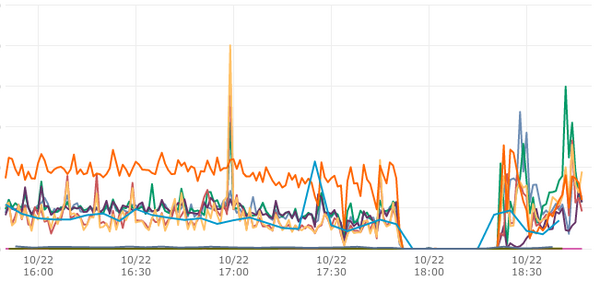
CTO of Fast Company tweets on what this outage can look like.

Here’s what an aws outage looks like from within: notice the dip to zero, then how chaotic things are to the right.

Amazon Web Services outages are so common there is a possible pattern.  

Why we write about Google, traffic

Apple and Google are some of the top data center topics to write about.  Apple doesn't say a lot, but when they do, there is traffic all over the place.

Google is saying more than Apple with its photography and data center web site.

NewImage

So, why does the media write so much about Apple and Google.  Simple.  Traffic.

Here is my traffic over the last few days when I wrote about Google data center photography.

NewImage

This is one huge advantage Google has telling its data center story.