Tip for IT to control the cloud, don't control it, get data

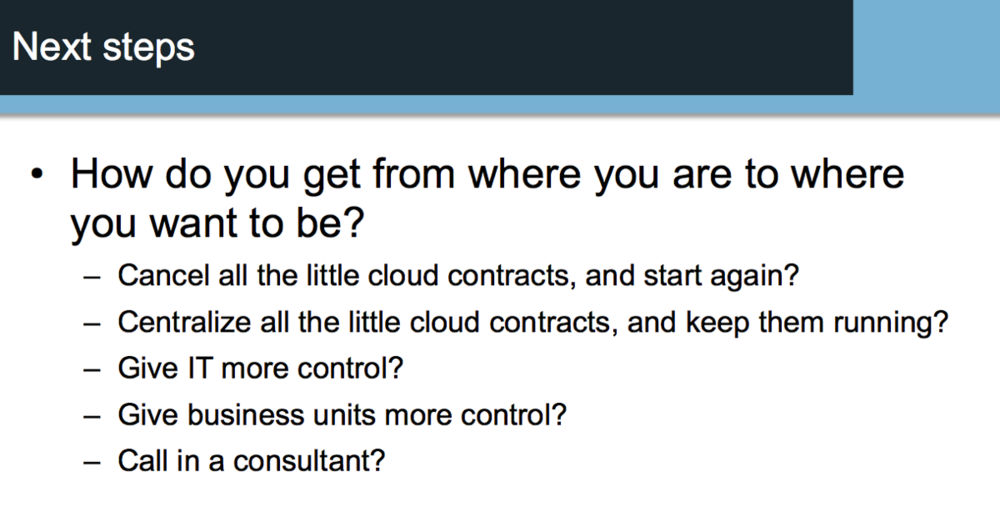
I was on a webinar yesterday to discuss the best route to the cloud.  One of the last questions was 
NewImage

The day before I had a conversation with Luke Kanies, CEO of Puppetlabs to catch up.  I was introduced by a mutual friend a couple of years ago, and we have had always had great discussions.

I told Luke I was participating in a webinar on the cloud and it would seem like a tool like Puppet Enterprise could be used to get the data on what clouds are being built and deployed.

Puppet Enterprise is IT automation software that gives system administrators the power to easily automate repetitive tasks, quickly deploy critical applications, and proactively manage infrastructure changes, on-premise or in the cloud. Learn more about Puppet Enterprise below, or download now and manage up to 10 nodes free.

Download Free

Puppet Enterprise automates tasks at any stage of the IT infrastructure lifecycle, including:

  • Provisioning
  • Discovery
  • OS & App Configuration Management
  • Build & Release Management
  • Patch Management
  • Infrastructure Audit & Compliance

I didn't specifically mention Puppetlabs, but I made the point that the biggest step taken to take control of the cloud is to get data. Data from the deployment tools.  If central IT bought a tool that helped all the users, then they could get the data.

If Puppet Enterprise logs were sent to a central IT function they would have the data to determine what the users are doing in the cloud.  With the data you can determine how best to serve the needs.

This recommendation flies in the face of what I think of what 80% of the people would do which is to just take control.  This makes sense as these same 80% of the people would have no idea what a puppet enterprise log means.

I constantly tell people the misperception of corporate IT is it is technical organization.  No, IT is not necessarily technical.  Take a look around how many of these people are CS degrees, let alone MS or PhD.  What is technical?  Google, Apple, Facebook, Microsoft product development teams are technical.  PuppetLabs is also technical, and they have a good method to manage the IT infrastructure.

How Puppet Works

Puppet uses a declarative, model-based approach to IT automation.

  1. Define the desired state of the infrastructure’s configuration using Puppet’s declarative configuration language.
  2. Simulate configuration changes before enforcing them.
  3. Enforce the deployed desired state automatically, correcting any configuration drift.
  4. Report on the differences between actual and desired states and any changes made enforcing the desired state.

Which reminds me one of the things I enjoy talking to Luke and why another Portland friend introduced us is we both like the use of Models.

Enforce Desired State

After you deploy your configuration modules, the Puppet Agent on each node communicates regularly with the Puppet Master server to automatically enforce the desired states of the nodes.

  1. The Puppet Agent on the node sends Facts, or data about its state, to the Puppet Master server.
  2. Using the Facts, the Puppet Master server compiles a Catalog, or detailed data about how the node should be configured, and sends this back to the Puppet Agent.
  3. After making any changes to return to the desired state (or, in “no-op mode,” simply simulating these changes), the Puppet Agent sends a complete Report back to the Puppet Master.
  4. The Reports are fully accessible via open APIs for integration with other IT systems.

Uh, BTW, this is the way I think a data center should work as well. 

Have you hired a person based on their tweets? Some people are

AOL Jobs has post that will get you thinking.

Is Twitter Killing The Resume?


The death of paper resumes has been predicted ever since the advent of email. And now some tech-savvy employers are even refusing to look at traditional resumes or conduct in-person interviews, instead relying on applicants' postings on Twitter in the pursuit of top talent.

It may not be the death of the resume, but your tweets may be more important than a reference.

The larger lesson, she says, is that social media is becoming more pervasive in hiring. Though you may not be screened based on your ability to tweet for a job, she says, "it is becoming more and more important for any professional to maintain a digital profile," which appears on social-media sites such as TwitterGoogle PlusFacebook and LinkedIn.

Did you get the advertisement handout at CapRate for the Schneider giveaway? (humor)

At CapRate's NYC event there was the typical data center vendor with swag.

A slang term used to describe free stuff and giveaways offered by vendors at trade shows to encourage attendees to visit their booth. Swag is usually company-branded merchandise and is given away as a form of advertising.

Did you grab the #1 that promotes entering your name in a drawing for a Bose Bluetooth speaker or a noise cancellation headphone from your energy management partner.

NewImage

Can you imagine the marketing person?  I am looking for a big wide one so I can use it for a marketing promotion.

Did you hear that? It was the sound of Samsung shipping a Server, Homesync

Google is even getting scared by Samsung's growth in the Mobile market.

Google executives worry that Samsung has become so big—the South Korean company sells about 40% of the gadgets that use Google's Android software—that it could flex its muscle to renegotiate their arrangement and eat into Google's lucrative mobile-ad business, people familiar with the matter said.

Samsung's latest move is Homesync.

HomeSync will be available from April 2013 in select countries and continue to expand globally.

Samsung Homesync Specifications

 Some companies took the move to use hundreds of Mac Minis as servers for a rendering environment. If you squint your eyes and look at the above specifications you can see the start of a server that could fit in a data center.  Throw out the HDMI and media chips.  Add more cores, memory and disk IO and you have a data center server.
 
We'll see what the price point is for Homesync.  Then you can extrapolate a price point for a Samsung server.

The next Cloud Feature - Frequent Flyer program to lock you in

I am participating in a Route to the Cloud webinar tomorrow and one the points I want to make is whether you want to be cloud independent or not is an important decision.  What fool would want to be locked into a cloud?  In fact GigaOm's Barb Darrow just posted on the issue of lock-in preventing movement to the cloud.

Fear of lock-in dampens cloud adoption

SUMMARY:

Data portability — the ability to move your information between clouds (or in and out of clouds) with relative ease — is a key concern of companies considering a cloud move.

It’s become a truism to say that data is the new gold –but that doesn’t mean there are easy answers about where to store this gold. For now, many corporate customers will hold back on full cloud computing adoption until they’re convinced that they can move their data off a given cloud as easily as they put it there in the first place. Face it: fear of vendor lock-in is not limited to the on-premises IT world and it’s time enlightened vendors get this problem in hand.

What would motivate people to accept a lock-in?  Frequent Flyer program.  The human behavior to get points is ingrained in people.  

Can you imagine if AWS launched a point program for the amount of Cloud Services used and gave program owners the ability the redeem points for Amazon.com merchandise?  Users would then have the incentive to have larger AWS bills and loyalty to a cloud provider is common.

No one in the cloud service has a frequent flyer program, and this probably will never happen.  Note: this is a what if AWS launched a frequent flyer program, not they have.  

This may sound crazy, but we have all seen people who go through extreme lengths for Frequent Flyer Points.  You cloud kind of do this already if you set up a Amazon.com Rewards Visa card.  If you spent a $1,000/month on AWS that would be 3 points/$1 = 3,000 points / 100 points/$1 = $30.  You spend $10,000 a month on AWS.  Not hard to do. You get $300 a month in your account.

Companies tried to take away an employees frequent flyer points, but that didn't work.

Welcome Amazon.com Rewards Visa Cardmember


Earn points on every purchase*

  • 3 Points per $1 spent on Amazon.com
  • 2 Points per $1 spent at gas stations, restaurants, drugstores, and office supply stores
  • 1 Point per $1 spent on all other purchases

Redeem your points instantly at checkout with Shop with Points

You can use the points you earn to buy the stuff you want right at checkout.

  • See your points automatically
  • Pay for all or part of your purchase - there's no minimum
  • Every 100 points = $1.00 towards your purchase