Why I write, why do you?

I write this blog to ingrain ideas into my memory.  In the process of writing over 3,000 posts, I've learned a lot.  If I forget I can run a search on this blog. :-)

I don't look at the comments for feedback which is why many say it is good to blog.  What I do find quite useful with my blog is it speeds up the conversations I have with my friends who regularly read what I post.  Olivier Sanche was a great example and others from his teams.  At first it would be confusing to me, but after awhile it was amazing what we could cover in 15 minutes as we bounced over 10 different topics.  Part of the problem is they would remember my posts better than I would as I would tend to write then flush the idea and move on.

What is interesting to observe is why people write.  So many people think writing are facts.  Writing is simply words in a language.  You need to know the context of the author to know how to interpret their writing. George Orwell has an essay on "Why I write."

In the beginning he tells his childhood story.

NewImage

I was the middle child of three, but there was a gap of five years on 
either side, and I barely saw my father before I was eight. For this and 
other reasons I was somewhat lonely, and I soon developed disagreeable 
mannerisms which made me unpopular throughout my schooldays. I had the 
lonely child's habit of making up stories and holding conversations with 
imaginary persons, and I think from the very start my literary ambitions 
were mixed up with the feeling of being isolated and undervalued.

...

Then Orwell makes his point.

I give all this background information because I do not think one can 
assess a writer's motives without knowing something of his early 
development.

and the great observation.

he will have acquired an emotional 
attitude from which he will never completely escape.

Which then flows into the 4 reasons to write besides money.  I am more of the 3rd category, historical impulse.

Putting aside the need to earn a living, I think there are four great motives for 
writing, at any rate for writing prose. They exist in different degrees 
in every writer, and in any one writer the proportions will vary from 
time to time, according to the atmosphere in which he is living. They 
are: 

(i) Sheer egoism. Desire to seem clever, to be talked about, to be 
remembered after death, to get your own back on the grown-ups who snubbed 
you in childhood, etc., etc. It is humbug to pretend this is not a 
motive, and a strong one. Writers share this characteristic with 
scientists, artists, politicians, lawyers, soldiers, successful 
businessmen--in short, with the whole top crust of humanity. The great 
mass of human beings are not acutely selfish. After the age of about 
thirty they almost abandon the sense of being individuals at all--and 
live chiefly for others, or are simply smothered under drudgery. But 
there is also the minority of gifted, willful people who are determined 
to live their own lives to the end, and writers belong in this class. 
Serious writers, I should say, are on the whole more vain and 
self-centered than journalists, though less interested in money. 

(ii) Aesthetic enthusiasm. Perception of beauty in the external world, 
or, on the other hand, in words and their right arrangement. Pleasure in 
the impact of one sound on another, in the firmness of good prose or the 
rhythm of a good story. Desire to share an experience which one feels is 
valuable and ought not to be missed. The aesthetic motive is very feeble 
in a lot of writers, but even a pamphleteer or writer of textbooks will 
have pet words and phrases which appeal to him for non-utilitarian 
reasons; or he may feel strongly about typography, width of margins, etc. 
Above the level of a railway guide, no book is quite free from aesthetic 
considerations. 

(iii) Historical impulse. Desire to see things as they are, to find out 
true facts and store them up for the use of posterity. 

(iv) Political purpose.--Using the word 'political' in the widest 
possible sense. Desire to push the world in a certain direction, to alter 
other peoples' idea of the kind of society that they should strive after. 
Once again, no book is genuinely free from political bias. The opinion 
that art should have nothing to do with politics is itself a political 
attitude. 

Many of you who live in a corporate environment spend your time writing in #4, Political Purpose.

One of the zingers is Orwell's comment on writers.

All writers are vain, selfish, and lazy, and at the very bottom of their motives there lies a 
mystery.

But, keep in mind all of us write to some degree.  Your e-mails, tweets, Facebook posts are all writing.  Can you even say your instagram posts are a kind of visual writing?

I think about why I write.  Why do you write?
Tip for IT to control the cloud, don't control it, get data

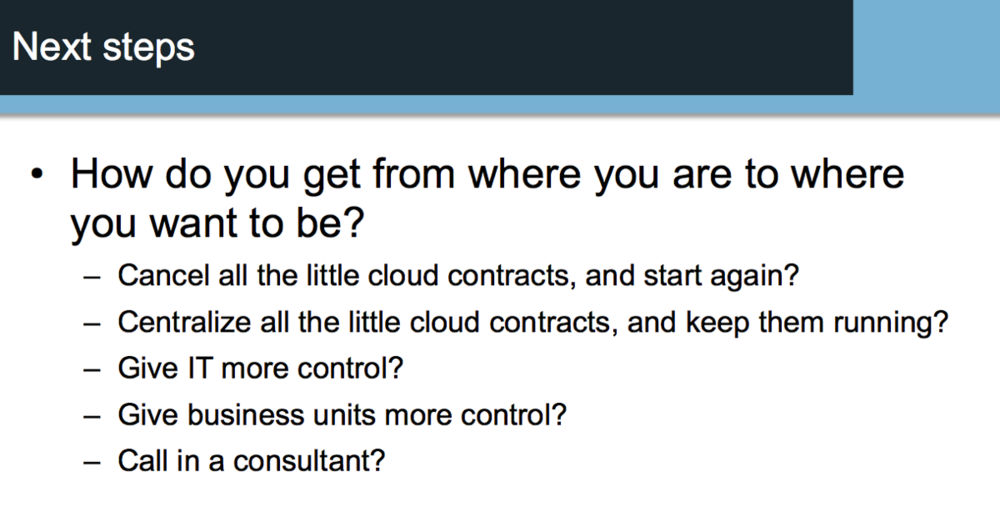
I was on a webinar yesterday to discuss the best route to the cloud.  One of the last questions was 

NewImage

The day before I had a conversation with Luke Kanies, CEO of Puppetlabs to catch up.  I was introduced by a mutual friend a couple of years ago, and we have had always had great discussions.

I told Luke I was participating in a webinar on the cloud and it would seem like a tool like Puppet Enterprise could be used to get the data on what clouds are being built and deployed.

Puppet Enterprise is IT automation software that gives system administrators the power to easily automate repetitive tasks, quickly deploy critical applications, and proactively manage infrastructure changes, on-premise or in the cloud. Learn more about Puppet Enterprise below, or download now and manage up to 10 nodes free.

Download Free

Puppet Enterprise automates tasks at any stage of the IT infrastructure lifecycle, including:

  • Provisioning
  • Discovery
  • OS & App Configuration Management
  • Build & Release Management
  • Patch Management
  • Infrastructure Audit & Compliance

I didn't specifically mention Puppetlabs, but I made the point that the biggest step taken to take control of the cloud is to get data. Data from the deployment tools.  If central IT bought a tool that helped all the users, then they could get the data.

If Puppet Enterprise logs were sent to a central IT function they would have the data to determine what the users are doing in the cloud.  With the data you can determine how best to serve the needs.

This recommendation flies in the face of what I think of what 80% of the people would do which is to just take control.  This makes sense as these same 80% of the people would have no idea what a puppet enterprise log means.

I constantly tell people the misperception of corporate IT is it is technical organization.  No, IT is not necessarily technical.  Take a look around how many of these people are CS degrees, let alone MS or PhD.  What is technical?  Google, Apple, Facebook, Microsoft product development teams are technical.  PuppetLabs is also technical, and they have a good method to manage the IT infrastructure.

How Puppet Works

Puppet uses a declarative, model-based approach to IT automation.

  1. Define the desired state of the infrastructure’s configuration using Puppet’s declarative configuration language.
  2. Simulate configuration changes before enforcing them.
  3. Enforce the deployed desired state automatically, correcting any configuration drift.
  4. Report on the differences between actual and desired states and any changes made enforcing the desired state.

Which reminds me one of the things I enjoy talking to Luke and why another Portland friend introduced us is we both like the use of Models.

Enforce Desired State

After you deploy your configuration modules, the Puppet Agent on each node communicates regularly with the Puppet Master server to automatically enforce the desired states of the nodes.

  1. The Puppet Agent on the node sends Facts, or data about its state, to the Puppet Master server.
  2. Using the Facts, the Puppet Master server compiles a Catalog, or detailed data about how the node should be configured, and sends this back to the Puppet Agent.
  3. After making any changes to return to the desired state (or, in “no-op mode,” simply simulating these changes), the Puppet Agent sends a complete Report back to the Puppet Master.
  4. The Reports are fully accessible via open APIs for integration with other IT systems.

Uh, BTW, this is the way I think a data center should work as well. 

Have you hired a person based on their tweets? Some people are

AOL Jobs has post that will get you thinking.

Is Twitter Killing The Resume?


The death of paper resumes has been predicted ever since the advent of email. And now some tech-savvy employers are even refusing to look at traditional resumes or conduct in-person interviews, instead relying on applicants' postings on Twitter in the pursuit of top talent.

It may not be the death of the resume, but your tweets may be more important than a reference.

The larger lesson, she says, is that social media is becoming more pervasive in hiring. Though you may not be screened based on your ability to tweet for a job, she says, "it is becoming more and more important for any professional to maintain a digital profile," which appears on social-media sites such as TwitterGoogle PlusFacebook and LinkedIn.

Did you get the advertisement handout at CapRate for the Schneider giveaway? (humor)

At CapRate's NYC event there was the typical data center vendor with swag.

A slang term used to describe free stuff and giveaways offered by vendors at trade shows to encourage attendees to visit their booth. Swag is usually company-branded merchandise and is given away as a form of advertising.

Did you grab the #1 that promotes entering your name in a drawing for a Bose Bluetooth speaker or a noise cancellation headphone from your energy management partner.

NewImage

Can you imagine the marketing person?  I am looking for a big wide one so I can use it for a marketing promotion.

Did you hear that? It was the sound of Samsung shipping a Server, Homesync

Google is even getting scared by Samsung's growth in the Mobile market.

Google executives worry that Samsung has become so big—the South Korean company sells about 40% of the gadgets that use Google's Android software—that it could flex its muscle to renegotiate their arrangement and eat into Google's lucrative mobile-ad business, people familiar with the matter said.

Samsung's latest move is Homesync.

HomeSync will be available from April 2013 in select countries and continue to expand globally.

Samsung Homesync Specifications

 Some companies took the move to use hundreds of Mac Minis as servers for a rendering environment. If you squint your eyes and look at the above specifications you can see the start of a server that could fit in a data center.  Throw out the HDMI and media chips.  Add more cores, memory and disk IO and you have a data center server.
 
We'll see what the price point is for Homesync.  Then you can extrapolate a price point for a Samsung server.