Off to my 1st GigaOm Structure Data Conference

I have spent so much of my life traveling I really don't like getting on a plane for longer than 2 hours.  In general I try not to make East Coast trips.  But, I do get to the East Coast a couple of times a year.  Tomorrow I head to NYC for my first GigaOm Structure Data Conference. 

Structure:Data
Mar. 20 & 21, 2013 – New York

The volume of enterprise data has moved past terabytes and into the petabyte scale. Companies need to determine the best way for them to store, manage and analyze all that information. GigaOM’s Structure:Data, now a two-day conference, assembles the world’s leading technologists, practitioners and business leaders to offer solutions and uncover new business opportunities.

The main reason I am heading out is to moderate the below panel discussion.  I do freelance for GigaOm Pro, so I get to chat with the GigaOm folks often, and I am looking forward to connect with East Coast crowd as I tend to stay on the West Coast.  Ins fact, I was able to get two people from the West Coast to come out for this panel.

SEEING EVERYTHING TO GET READY FOR ANYTHING: CAPACITY PLANNING AT SCALE


Do you have a problem planning for future infrastructure needs? Deciding on what to buy and what capacity to provision for? Then you should attend this session, where we examine the stories of four people with some of the most extreme use cases on the planet. Come listen and learn from those with responsibility for the biggest purse strings.

Moderated by:Dave Ohara - Founder, GreenM3 and Analyst, GigaOM Research
Speakers:Tamara Budec - VP Critical Systems and Engineering, Goldman Sachs & Co
 
Heather Marquez - Manager, Asset Strategy and Optimization, Facebook
 
Amaya Souarez - Director, Datacenter Services, Microsoft 

Quanta's Direct sales transformation 65% in 2012, expected to be 85% in 2013

Quanta was mostly known as an ODM, the guys who the OEMs went to make their hardware.  But, Quanta has made the move to be in the direct sales business and guess what they are moving very fast.

Compaq was the beginning of the some of the first dual processor, dual hard drive, x86 based servers. In the beginning it was Compaq, HP and IBM who had the knowledge to build servers.  Over time to reduce costs the manufacturing was move to Asia and eventually the engineering was moved to Asia, leaving the OEMs to have the customer relationship.  In the shift to the bigger data center players.  Remember 5 years ago how small Google, Facebook, Amazon, Microsoft, and Apple's data centers were?  Now they are the dominant players and there has been a shift to the economies of scale with 10,000s of servers a small yearly order.  The big guys buy 100,000s of servers a year.

This shift benefits a player like Quanta.

GigaOm has an article on Quanta.

How an unknown Taiwanese server maker is eating the big guys’ lunch


MAR. 16, 2013 - 1:30 PM PDT

No Comments

SONY DSC
SUMMARY:

In the server business, Taiwanese hardware company Quanta has shifted from an original-design manufacturer to much more of a direct seller. It wants to extend the trend and sell other products, too.

Here is the part that caught my eye.

Back then, Quanta didn’t sell servers directly to customers, it only built them for traditional server vendors who then put their name on them and sold them to customers. Fast forward a few years, and a majority of Quanta’s server revenue stems from direct deals — 65 percent in 2012, and a forecasted 85 percent this year.

Quanta is expanding the cloud hub of development in Seattle.

Next month, the company will open an office in Seattle in order to be closer to customers. Yang said Quanta has several customers in the area, although he declined to name them. Microsoft, which is building huge data center capacity for Windows Azure and its Live offerings, is a short drive from Seattle, in Redmond, Wash., and Seattle is much closer to Quincy, Wash., a hotbed of data centers, than the Fremont office. Quanta will add more U.S. offices for sales and service this year, Yang said.

$9 megawatt-hr difference in profit margin for coal makes it hard for Europe to pass on Coal

National Geographic has a post on the shift in the USA to cleaner Natural Gas and the rise of coal exports.

The reality is it is hard for European power producers to pass on a $9 megawatt-hour difference in profit margin if they use coal vs. natural gas.

European utilities are now finding that generating power from coal is a profitable gambit. In the power industry, the profit margin for generating electricity from coal is called the "clean dark spread"; at the end of December in Great Britain, it was going for about $39 per megawatt-hour, according to Argus. By contrast, the profit margin for gas-fired plants—the "clean spark spread"—was about $3. Tomas Wyns, director of the Center for Clean Air Policy-Europe, a nonprofit organization in Brussels, Belgium, said those kinds of spreads are typical across Europe right now.

The article has lots of data like the drop in US coal powered electricity from 50% to 37.4%.

The reason is clear: Coal, which in 2005 generated 50 percent of U.S. electricity, saw its share erode to 37.4 percent in 2012, according to EIA's new short-term energy outlook. An increase in U.S. renewable energy certainly played a role; renewables climbed in those seven years from 8.7 percent to 13 percent of the energy mix, about half of it hydropower. But the big gain came from natural gas, which climbed from 19 percent to 30.4 percent of U.S. electricity during that time frame, primarily because of abundant supply and low prices made possible by hydraulic fracturing, or fracking. (Related: "Natural Gas Stirs Hope and Fear in Pennsylvania" and interactive, "Breaking Fuel From the Rock")

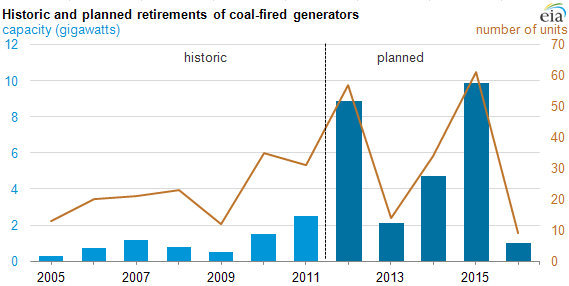
And points to other sources like the US Energy Information Associations data that 27 gigawatts of coal-fired capacity to be retired in 5 years.

27 gigawatts of coal-fired capacity to retire over next five years

graph of Historic and planned retirements of coal-fired generators, as described in the article text

Source: U.S. Energy Information Administration, Form EIA-860, "Annual Electric Generator Report." 
Note: Data for 2005 through 2011 represent actual retirements. Data for 2012 through 2016 represent planned retirements, as reported to EIA. Data for 2011 through 2016 are early-release data and not fully vetted. Capacity values represent net summer capacity

Plant owners and operators report to EIA that they expect to retire almost 27 gigawatts (GW) of capacity from 175 coal-fired generators between 2012 and 2016. In 2011, there were 1,387 coal-fired generators in the United States, totaling almost 318 GW. The 27 GW of retiring capacity amounts to 8.5% of total 2011 coal-fired capacity.

Modular Construction moving forward, present and past

Found this Construction article on Modular Construction.  I found it interesting because it discusses the past and present.

While modular building dates back at least a century, it gained national attention as troops returned home after World War II, when it became the preferred building method for housing in rural and suburban settings across the United States.

The 1960s and 1970s gave rise to more complicated designs as consumer demands became more sophisticated, and in the 1980s, even more intricate modular homes began to take shape across the Northeast, in New Jersey, Pennsylvania and, to a lesser degree, New York.

“The New Jersey suburbs are full of beautiful, custom-designed houses that were executed in modular factories,” Mr. O’Hara said.

Slowly, modular seeped into the commercial industry, becoming popular for building low- to mid-rise structures—affordable housing, hospitals and other medical facilities, schools and office complexes—with companies like Capsys, Deluxe Building Systems and NRB among those paving the way in the Northeast.

Note:  in the above the O'Hara quoted is not me.  My name is Ohara, but people stick an apostrophe in my name all the time.  Makes it a really pain for medical records reconciliation.

The construction industry can be slow to change, and a recent project may help to change the perception.

Proponents of the method have treated modular design as gospel for years, and real estate industry professionals (even those not directly involved in modular building) agree that the cost and time savings afforded in smaller-scale projects translates into larger, taller buildings.

“It’s one of the best-kept secrets in the real estate industry, but I think that this building will change that,” said Amy Marks, owner and president of XSite Modular, the modular consultant on the Atlantic Yards project. “If you’re building a building today and not considering some sort of modular or prefab, you’re missing out on a tremendous value.”

Modular is not anything new, but not used by all.

But most agree that incorporating at least certain elements of modular design is beneficial, with firms across the city opening up to the idea.

Wouldn't it be cool if someone made a Data Center video like Pepsi's false identity ones?

Pepsi Max has a new video with Jeff Gordon pretending to test drive a car.

Pepsi gets 7 mil hits in 2 days.

NewImage

Seems like the idea is viral.  

Wouldn't it be cool if a Google, Microsoft, or Amazon could pull off a data center stunt like this.  Some unsuspecting hoster saying they have power and cooling capacity.  We're looking for 500kW of data center space.  Next thing you know a semi pulls up with thousands of servers ready deploy the cloud. 

A couple of fun Pepsi videos are Kyrie Irving.