Oops, just because you access data doesn't mean it is OK to use it, Bloomberg reporters cross ethical boundaries

It may seem like common sense that if you set up camera to watch what someone surfs on the web it is illegal and unethical to report on those activities. But, when you are a media reporter who is driven to get more traffic, you think it is OK to do what others have been doing.  Crawling through user activity logs of Bloomberg services to ascertain what people are thinking about doing.

The news is spreading over the weekend.

Salon


Bloomberg bars reporters from client log-in data - USA Today

USA TODAY-2 hours agoShare
LOS ANGELES (AP) — Financial data and news company Bloomberg LP said Friday that it had corrected a "mistake" in its newsgathering ...

Even if you are not a reporter, you need to watch out for the same mistakes.  I have repeated said one of the dangers of big data environments is to put a bunch of silo'd data in one area, the problem is it can get you arrested as you may violating privacy laws by putting all the data in one environment where it is open to users to analyze.

Goldman Sachs is the one who is complaining.

A source at Goldman tells us that the firm was dumbfounded and outraged to discover what Bloomberg reporters were doing. The source says that, until recently, Bloomberg News reporters were able to see not just when individual Bloomberg subscribers logged in (and via what device), but what they did while they were logged in.

Specifically, the source says, Bloomberg News reporters were able to see: 

  • When individual subscribers logged in and logged out (and from where).
  • What type of information these individual subscribers looked at and how often they looked at it.


This is not a unique situation, and we'll probably hear more about as people  start to look for the signs of whether people are violating privacy laws.
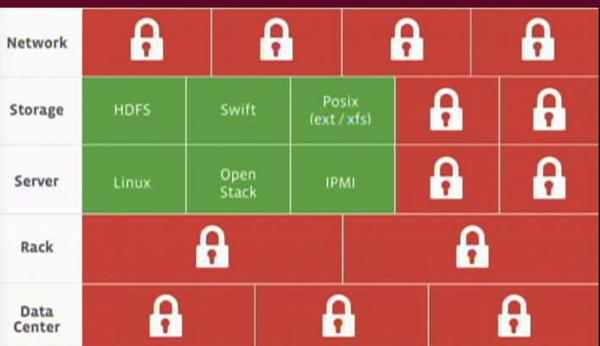
Open Compute Project History described in a Taxonomy Map

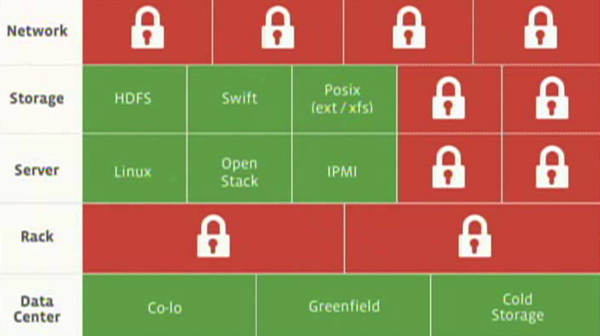
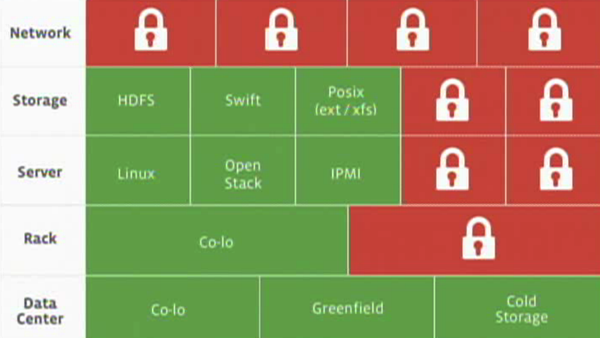
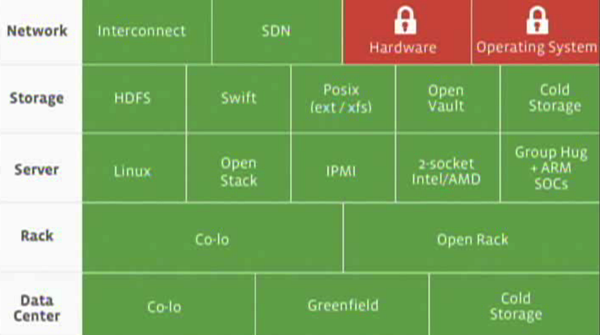
In Frank Frankovsky's keynote at Interop he showed the progression from red to green of the open compute project from data center, rack, server, storage and now network.

Frank started with the open source software used.

NewImage

Then Facebook shared its data center practices.

NewImage

Next came racks in the co-lo

NewImage

Eventually building to the complete taxonomy below.

NewImage

What's next?  The Open Compute Project comment is the one who asks for new things as well as Facebook deciding to contribute in an open source manner.

Open Compute Project's Frank Frankovsky launches Network Initiative

The folks at Open Compute Project are on a roll, driving open source ideas into servers, data centers, racks, etc.

NewImage

And now their latest move is networking.

With that in mind, we are today announcing a new project within OCP that will focus on developing a specification and a reference box for an open, OS-agnostic top-of-rack switch. Najam Ahmad, who runs the network engineering team at Facebook, has volunteered to lead the project, and a wide variety of organizations — including Big Switch Networks, Broadcom, Cumulus Networks, Facebook, Intel, Netronome, OpenDaylight, the Open Networking Foundation, and VMware — are already planning to participate.

Facebook is a big sponsor of Open Compute Project which is non-profit organization, and a driving force.

Who competes against Open Compute Project?  The visibility for Open Compute Project has increased and is referenced by almost all the tech media point with an article at some point.  There isn't really much competition.

What Open Compute Project does threaten is the event conference vendors.  When you have a non-profit focused on end user benefits and changing the industry, the for profit event staff who are driven to maximize revenue will maneuver to out market their event as the premier event in the industry.  Note: watch for those words when someone claims they are the premier event.  

BTW isn't it ironic that Interop has Frank keynote what a message that Open Compute Project is revolutionizing the industry.


Location: Mandalay Bay H
Wednesday, May 8, 2013, 8:30 AM-10:15 AM

Billions of people and their many devices will be coming online in the next decade, and those who are already online are living ever-more connected lives. The industry is building out a huge physical infrastructure to support this growth, but we are doing so in a largely closed fashion, inhibiting the pace of innovation and preventing us from achieving the kinds of efficiencies that might otherwise be possible.

In this keynote, Frank Frankovsky will provide an overview of the Open Compute Project, a thriving consumer-led community dedicated to addressing this issue, promoting more openness and a greater focus on scale, efficiency, and sustainability in the development of infrastructure technologies. Frank will delve into the brief history of the project and describe its vision for the future.

Seems like Interop just gave Frank a chance to market to the audience they need to go to the next Open Compute Summit and attend for free.  Or be a sponsor where there is more transparency in how their sponsorship is used.

We'll see what kind of networking guys show up to the next Open Compute Summit.  In some data center IT environments the network gear can be 50% of the IT budget.  Networks are important, but it is hard for most to accept a 50% spend.

Not a data center tour we usually get, Google shows the media parts of its Douglas data center

We're all used to getting a data center tour.  When someone is trying to sell you space or IT Services, they will bring you through the server space.  Here is an example of a Softlayer tour.

Local media was let into parts of Google's Douglas Data Center and this below video is posted.  Most of you haven't seen this as there a whopping 18 views. :-)  

One of the rules Joe Kava explains is only those who must go into server room have access, and many who work in the data center aren't allowed in the server room.

At least the folks at WPXI11News have better color matching then the Sentinel folks.  Joe Kava looks much better in the video than the sentinel camera shot.

NewImage

I think what the folks at the sentinel did is they needed to adjust the exposure/contrast and that really messed up the color.  Besides the color in Joe's face look at the difference in the color of his shirt.

NewImage

What if ARM isn't more efficient than the other Server processors?

Wired has a post on why Google will embrace cell phone chips (aka ARM).

I've blogged on the concept of little green servers built on Atom and ARM, but what if ARM isn't more efficient than an x86 server?  Here are some thoughts that are running through my mind.

  1. ARM is built on RISC which is more efficient
    1. The ARM architecture describes a family of RISC-based computer processors designed and licensed by British company ARM Holdings.
  2. Intel has not stood still and its processors are focused on efficiency and they have embraced the micro server category with the Intel Atom
    1. NewImage
    2. And focuses a lot on migrating users from RISC to Intel. http://www.intel.com/content/www/us/en/risc-migration/server-migration-transition-to-intel-based-solutions.html
    3. Which would make you think Intel has focused on how it can outperform RISC when there is heavy IT loads.
  3. Part of the ARM energy savings for mobile is the ability to shut down energy consumption during idle times.  But, if you have a highly utilized server with many VMs on it, when is the idle time?
  4. IBM has shipped RISC server chips for years and it works for IBM well enough that there are no rumors of them to switch to ARM.
    1. The POWER7 superscalar symmetric multiprocessor architecture was a substantial evolution from the POWER6 design, focusing more on power efficiency through multiple cores and simultaneous multithreading (SMT).[6] The POWER6 architecture was built from the ground up for frequencies, at the cost of power efficiency and achieved a remarkable 5 GHz.
  5. HP had PA-RISC.  Sun/Oracle has SPARC.
Intel's biggest margin business is its server processors and they will do anything to defend its market share.

The way some people write it is absolute that ARM's arrival will replace x86 servers.  What if they are wrong and x86 has a price performance that meets the market needs. Intel can survive longer than most of the ARM developers, except Samsung.  Samsung are the one guys who you don't want to under estimate.  Now if you think about Samsung being able to create new always-on servers for things like your home, media centers, cars, small offices, then that is different.  When you think of all the disconnected ARM processors in your home in your Routers is one example.  Should there be a better home server appliance that can connect your home devices.

ARM's potential in servers may be in new markets, not in the data center.