The story behind the 400 ppm CO2 emissions

There was all kinds of news about CO2 level reaching 400 ppm.

National Geographic

Climate Change and CO2 400 ppm

Energy Collective-by Lou Grinzo-May 11, 2013
Climate Change and CO2 400 ppm ... on 400ppm, which is to say, an amount of CO2 in the atmosphere that's 400 parts per million, by volume.
Heat-Trapping Gas Passes Milestone, Raising Fears
Highly Cited
-New York Times-40 minutes ago

 Out of all the hype, National Geographic and The Economist tell the story behind the 50+ years of measurement started by Charles David Keeling.

Here is the National Geographic post.

Climate Milestone: Earth’s CO2 Level Passes 400 ppm

Greenhouse gas highest since the Pliocene, when sea levels were higher and the Earth was warmer.

Two teams of scientists at the Mauna Loa Observatory in Hawaii have been measuring carbon dioxide concentration there for decades, and have watched the level inch toward a new milestone.

Photograph by Jonathan Kingston, National Geographic

Robert Kunzig

National Geographic News

Published May 9, 2013

An instrument near the summit of Mauna Loa in Hawaii has recorded a long-awaited climate milestone: the amount of carbon dioxide in the atmosphere there has exceeded 400 parts per million (ppm) for the first time in 55 years of measurement—and probably more than 3 million years of Earth history.

And here is The Economist post.

Environmental monitoring

Four hundred parts per million

The only good news about the Earth’s record greenhouse-gas levels is that they have been well measured

May 11th 2013 |From the print edition

CHARLES D. KEELING, mostly known as Dave, was a soft-spoken, somewhat courtly man who changed the way people and governments see the world. A slightly aimless chemistry graduate with an interest in projects that took him out into the wild, in 1956 he started to build instruments that could measure the proportion of carbon dioxide in the atmosphere, a scientific topic which, back then, was barely even a backwater. In 1958, looking for a place where the level of carbon dioxide would not be too severely influenced by local plants or industry, he installed some instruments high up on Mauna Loa, a Hawaiian volcano. He found that the level fluctuated markedly with the seasons, falling in northern summer as plants took up carbon dioxide and rising in northern winter as dead foliage rotted. And he found that the annual average was 315 parts per million (ppm).

The Economist honors the effort by Dave.

Scientists involved in other measurements of the Earth, and those who pay for their work, need to build on his legacy. So does anyone taking a position on global-warming, where numbers as clear as Keeling’s are a rarity. Measurements of the temperature of the ocean depths and the acidity of its surface waters, of the volume of the planet’s forests and the mass of its ice sheets (see article), need to be made not just for the few years of a specific research project. Their ceaseless continuance needs to be built into the planet’s infrastructure. A world in which governments claim to be committed to spending trillions of dollars to change the shape of the Keeling curve decades hence, but do not find the funds to produce consistent records of the change going on today, is one that still has lessons to learn from the patient chemist.

And National Geographyic as well.

When the elder Keeling started at Mauna Loa, the CO2 level was at 315 ppm. When he died in June 2005, it was at 382. Why did he keep at it for 47 years, fighting off periodic efforts to cut his funding? His father, he once wrote, had passed onto him a "faith that the world could be made better by devotion to just causes." Now his son and the NOAA team have taken over a measurement that captures, more than any other single number, the extent to which we are changing the world—for better or worse.

Oops, just because you access data doesn't mean it is OK to use it, Bloomberg reporters cross ethical boundaries

It may seem like common sense that if you set up camera to watch what someone surfs on the web it is illegal and unethical to report on those activities. But, when you are a media reporter who is driven to get more traffic, you think it is OK to do what others have been doing.  Crawling through user activity logs of Bloomberg services to ascertain what people are thinking about doing.

The news is spreading over the weekend.

Salon


Bloomberg bars reporters from client log-in data - USA Today

USA TODAY-2 hours agoShare
LOS ANGELES (AP) — Financial data and news company Bloomberg LP said Friday that it had corrected a "mistake" in its newsgathering ...

Even if you are not a reporter, you need to watch out for the same mistakes.  I have repeated said one of the dangers of big data environments is to put a bunch of silo'd data in one area, the problem is it can get you arrested as you may violating privacy laws by putting all the data in one environment where it is open to users to analyze.

Goldman Sachs is the one who is complaining.

A source at Goldman tells us that the firm was dumbfounded and outraged to discover what Bloomberg reporters were doing. The source says that, until recently, Bloomberg News reporters were able to see not just when individual Bloomberg subscribers logged in (and via what device), but what they did while they were logged in.

Specifically, the source says, Bloomberg News reporters were able to see: 

  • When individual subscribers logged in and logged out (and from where).
  • What type of information these individual subscribers looked at and how often they looked at it.


This is not a unique situation, and we'll probably hear more about as people  start to look for the signs of whether people are violating privacy laws.

Open Compute Project History described in a Taxonomy Map

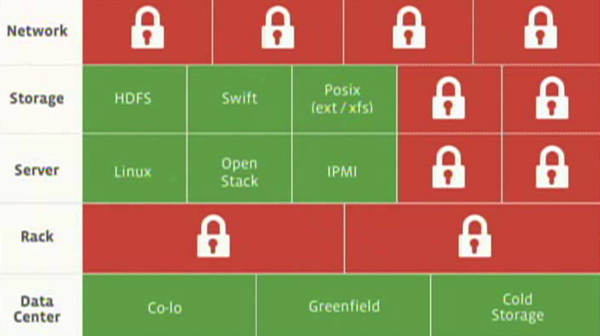
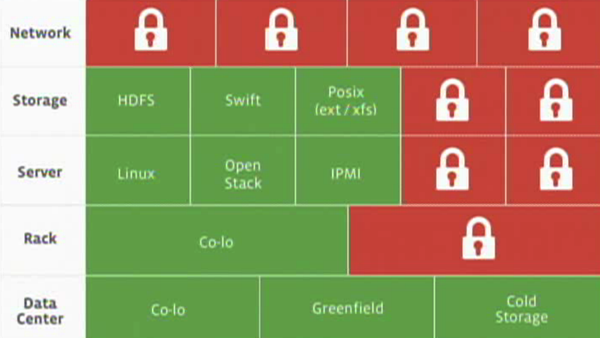
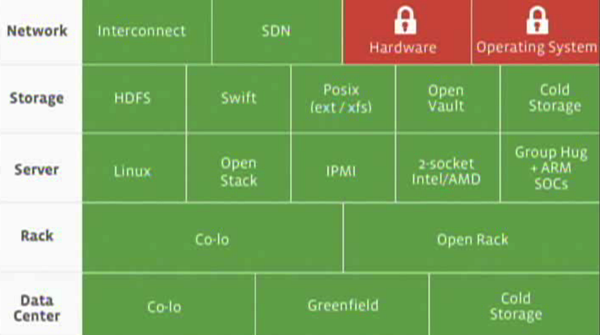
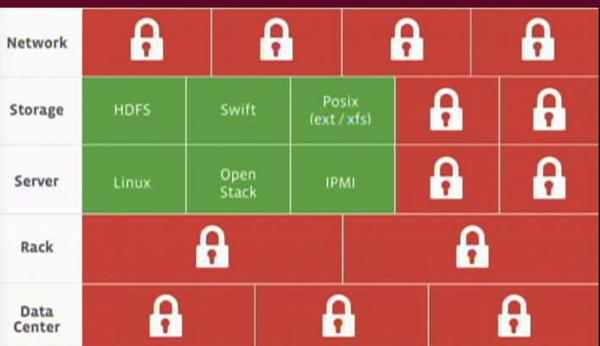
In Frank Frankovsky's keynote at Interop he showed the progression from red to green of the open compute project from data center, rack, server, storage and now network.

Frank started with the open source software used.

NewImage

Then Facebook shared its data center practices.

NewImage

Next came racks in the co-lo

NewImage

Eventually building to the complete taxonomy below.

NewImage

What's next?  The Open Compute Project comment is the one who asks for new things as well as Facebook deciding to contribute in an open source manner.

Open Compute Project's Frank Frankovsky launches Network Initiative

The folks at Open Compute Project are on a roll, driving open source ideas into servers, data centers, racks, etc.

NewImage

And now their latest move is networking.

With that in mind, we are today announcing a new project within OCP that will focus on developing a specification and a reference box for an open, OS-agnostic top-of-rack switch. Najam Ahmad, who runs the network engineering team at Facebook, has volunteered to lead the project, and a wide variety of organizations — including Big Switch Networks, Broadcom, Cumulus Networks, Facebook, Intel, Netronome, OpenDaylight, the Open Networking Foundation, and VMware — are already planning to participate.

Facebook is a big sponsor of Open Compute Project which is non-profit organization, and a driving force.

Who competes against Open Compute Project?  The visibility for Open Compute Project has increased and is referenced by almost all the tech media point with an article at some point.  There isn't really much competition.

What Open Compute Project does threaten is the event conference vendors.  When you have a non-profit focused on end user benefits and changing the industry, the for profit event staff who are driven to maximize revenue will maneuver to out market their event as the premier event in the industry.  Note: watch for those words when someone claims they are the premier event.  

BTW isn't it ironic that Interop has Frank keynote what a message that Open Compute Project is revolutionizing the industry.


Location: Mandalay Bay H
Wednesday, May 8, 2013, 8:30 AM-10:15 AM

Billions of people and their many devices will be coming online in the next decade, and those who are already online are living ever-more connected lives. The industry is building out a huge physical infrastructure to support this growth, but we are doing so in a largely closed fashion, inhibiting the pace of innovation and preventing us from achieving the kinds of efficiencies that might otherwise be possible.

In this keynote, Frank Frankovsky will provide an overview of the Open Compute Project, a thriving consumer-led community dedicated to addressing this issue, promoting more openness and a greater focus on scale, efficiency, and sustainability in the development of infrastructure technologies. Frank will delve into the brief history of the project and describe its vision for the future.

Seems like Interop just gave Frank a chance to market to the audience they need to go to the next Open Compute Summit and attend for free.  Or be a sponsor where there is more transparency in how their sponsorship is used.

We'll see what kind of networking guys show up to the next Open Compute Summit.  In some data center IT environments the network gear can be 50% of the IT budget.  Networks are important, but it is hard for most to accept a 50% spend.

Not a data center tour we usually get, Google shows the media parts of its Douglas data center

We're all used to getting a data center tour.  When someone is trying to sell you space or IT Services, they will bring you through the server space.  Here is an example of a Softlayer tour.

Local media was let into parts of Google's Douglas Data Center and this below video is posted.  Most of you haven't seen this as there a whopping 18 views. :-)  

One of the rules Joe Kava explains is only those who must go into server room have access, and many who work in the data center aren't allowed in the server room.

At least the folks at WPXI11News have better color matching then the Sentinel folks.  Joe Kava looks much better in the video than the sentinel camera shot.

NewImage

I think what the folks at the sentinel did is they needed to adjust the exposure/contrast and that really messed up the color.  Besides the color in Joe's face look at the difference in the color of his shirt.

NewImage