Ahh, now I get it Google uses Clusters the way others use Containers

Containers work if you want to have a unit of deployment with up to 2,000 servers.  Google used containers early on, but doesn't use them anymore.  Some of the biggest use of Containers is by Microsoft's data center group.  DCD covers Microsoft discussing how containers contain outages.

 “In the electrical and mechanical design of this data center, we considered each container as a discrete failure domain and modeled the availability of power and cooling with the expectation that maintenance events and unplanned outages would occur in the environment,” Gauthier writes. Failures would also be compartmentalized in a standard and predictable way.

I was looking at this presentation of Google's cluster system.  Note how the network and power topology is deployed to support a cluster.

NewImage

Mike Manos and I talked long time ago about how containers encapsulate compute, network, storage, power and cooling, but you can also encapsulate these principles if your data center uses the same principles to support a cluster of functionality.

Google achieves the same containment of power, cooling, compute, storage, and network as Microsoft does in a container, but without the physical container.

What is nice to see is that the SW team knows they have a big role in saving energy.

NewImage

Fixing the method of Triumvirate organization to make it more useful

Last year I was lucky to get some time to chat with RISD's President John Maeda after he spoke at GigaOm Roadmap.  We chatted about typography and his presentation.  Then I shared the idea I am working on with two other business partners.  And how we set up with a company of three executives.  He instantly recognized the structure as a triumvirate.

triumvirate (from Latin, "triumvirātus") is a political regime dominated by three powerful individuals, each a triumvir (pl. triumviri). The arrangement can be formal or informal, and though the three are usually equal on paper, in reality this is rarely the case.

John continued by saying that the beauty of a triumvirate is as long as two agree then you move forward.

One of the more famous triumvirate's now is Google's three executives.

Eric Schmidt, CEO of Google has referred to himself, along with founders Larry Page and Sergey Brin as part of a triumvirate, stating, "This triumvirate has made an informal deal to stick together for at least 20 years"

I then told John we modified the Triumvirate method by requiring unanimous support for a decision to be made, and the company is divided into 1/3 ownership.  John's response, "but doesn't that make you slower."

It may slow things down a bit, but it makes sure that every person is heard for their opinion, and for the overall success we consider the others view.  

An example of the problem being addressed is illustrated by the Minority Report's precogs requiring only two votes to convict someone for a crime.  The two male precogs could ignore the female precog and move forward which made the establishment happy, ignoring the issue that the decision was wrong.

Anderton seeks the advice of Dr. Iris Hineman (Lois Smith), the lead researcher of the PreCrime technology. She explains to Anderton that sometimes the three precogs see different visions of the future, in which case the system only provides data on the two reports which agree; the "minority report", reflecting the potential future where a predicted killer would have done something different, is discarded. According to Dr. Hineman, the female precog Agatha is most likely to be the precog that witnesses the minority report.

After two years of using this modified Triumvirate, we have established a higher of trust and understanding within our partnership.  Sometimes, we debate an issue, and we work together to come up something that works for all. Think of it as a peer review for decisions.  We all want the company to succeed, and even though you are in minority it doesn't mean you are wrong.  The majority may be wrong.  Sometimes are made, then someone says it really doesn't make that much difference to me, I just wanted to bring up an issue.  I trust you guys to make the right decision.

Having three minds think about customers, technology, and other things to run the business is something we have gotten so used to it is hard to think of having a typical hierarchical structure.  Oh yeh, we don't have any backseat drivers from Angels or VC either.  They would upset the balance of power to be equal.  Can you imagine a VC putting his money in and we tell him you get a vote, but your vote is no better than any one else's.

There are many things that we don't need to have a consensus on.  The industry relationships/partnerships and operations is my responsibility.  One guy focuses on the technologies and operations.  Another focuses on analytics, operations, and finance.  We all are concerned about operations which I guess is the glue that pulls everything together and we can measure alternatives against.

I am writing this post to share the idea of a modified triumvirate and maybe one of these days I'll run into another company that uses the same structure, but I am not holding my breath.

The power of two founders is well known.  Apple, Hewlett-Packard, Microsoft, and Google.

BTW, there was an attempt for a third founder at Apple.  Someone to settle the disputes between Wozniak and Jobs.

Apple's lost founder: Jobs, Woz and Wayne

Updated:   07/26/2010 03:59:17 PM PDT
...

He was present at the birth of cool on April Fool's Day, 1976: Co-founder — along with Steve Jobs and Steve Wozniak — of the Apple Computer Inc., Wayne designed the company's original logo, wrote the manual for the Apple I computer, and drafted the fledgling company's partnership agreement.

That agreement gave him a 10 percent ownership stake in Apple, a position that would be worth about $22 billion today if Wayne had held onto it.

...

"It was at that point he said, 'Let's form a company,' " Wayne recalls. Like a quarterback drawing a play in the dirt, Jobs came up with the idea of giving himself and Wozniak each 45 percent, the final 10 percent going to Wayne, who would mediate disputes between his headstrong partners. "That would resolve any problems forever and ever," says Wayne, who drew up the contract on a typewriter. There was no such thing as a word processor yet. They were about to invent it.

One way to view what is important to Google's data center group look at the Google search UI

It is interesting thought experiment to be low level in data centers discussing sites, power, cooling, etc, then sometimes pop your head up and get a big picture view what you can see.  

I was chatting with a Google person last week and I was thanking him for a response to an e-mail I sent a year ago to check on their data center calculations on their web site.  Thanks X number of data centers is what you have and Y number of data centers will come on line within the next 12 months.  He was surprised I knew.  I told him I can count the number of announcements made over the past year.  It's easy to see when you know where to look.

When I was at another data center conference someone asked me what is Google going to do with all that capacity.  I don't know.

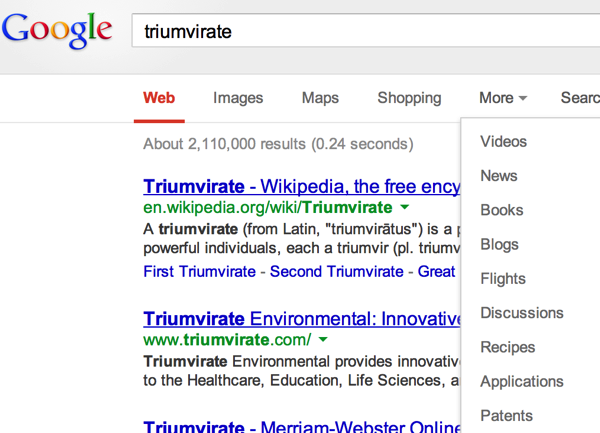
Then I saw the below graphic when I was playing around with some ideas of a Triumvirate.

And, then it is was simple to say.  Google is focused in order of priority - web, images, maps, shopping, videos, news, books, blogs, flights, discussions, recipes, applications, and patents.

I have a friend who is starting a company about recipes with plenty of funding.  Seeing the fact that Google is looking at recipes may mean a potential business model for her is be like Waze have a huge following and sell your company for cash to Google.  :-)

NewImage

Facebook finally opens Lulea Data Center, 18 months after announce

One of the conversations I have had with data center friends is when will Facebook bring its Lulea data center online.  The project was publicly announced in Oct 2011.

There was Swedish papers covering the commissioning process in May 2013.  

Uhh, 18 months after project announce Servers are deployed.  Building in Sweden was not as easy as it looks.  Facebook has built 2 data centers in Prineville and Forest City.

Facebook posts on Lulea coming on line.

Luleå goes live

by Luleå Data Center (Notes) on Wednesday, June 12, 2013 at 6:14am


On the edge of the Arctic Circle, where the River Lule meets the Gulf of Bothnia, lies a very important building. Facebook's newest data center - in Luleå, Sweden - is now handling live traffic from around the world.
One of the speaking points is the green data center aspect.
As our systems come online for the first time, we are proud to say that this is likely to be one of the most efficient and sustainable data centers in the world. All the equipment inside is powered by locally generated hydro-electric energy. Not only is it 100% renewable, but the supply is also so reliable that we have been able to reduce the number of backup generators required at the site by more than 70 percent. In addition to harnessing the power of water, we are using the chilly Nordic air to cool the thousands of servers that store your photos, videos, comments, and Likes. Any excess heat that is produced is used to keep our office warm.

Business Model of Waze, sell for big bags of Google cash

Next week is GigaOm Structure.  I have gone from attending as a blogger, to working freelance as a GigaOm Pro Analyst, to speaking at the conference.  This next one I am moderating a panel discussion on a Private Cloud with Revlon and NetApp.

HOW INFRASTRUCTURE CAN TRANSFORM BUSINESS SUCCESS


In this session we focus in on how the right IT infrastructure can create significant competitive advantage. Understanding that IT’s job is to make systems work for people rather than people work for systems, Revlon sought to align IT to the business with the successful implementation of a private cloud. Its resulting infrastructure turned 3.6 PB of data into a business driver and runs more than 500 applications in a virtualized environment. Its initiative has demonstrated clear ROI.

Moderated by:Dave Ohara - Founder, GreenM3 and Analyst, GigaOM Research
Speakers:David Giambruno - SVP and CIO, Revlon
 
Cynthia Stoddard - SVP and CIO, NetApp 

You could look at what I did as like coming up through the mail room, but another way is I was spending time in various roles to get a better understanding.  The folks at GigaOm eventually figured out how much I knew and started using my skills more.  One of the latest insights on GigaOm was when I was talking to one of my old bosses at Microsoft Frank Artale.  Frank is a partner at the VC firm Ignition Ventures.  Besides working for Frank on Windows 2000 he is also on Lake Sammamish and he likes to cook.  Next time I see Frank we need to talk about his kitchen vs. my woodstone oven.  But more relevant is the last time I saw Frank at GigaOm Structure Data he mentioned how many VCs are at the show.  I paid more attention and have gone through the attendee list and 2nd after the the technology companies (which have the highest attendee) is the VC community.  There are more VC than press.  There are more VC than infrastructure or cloud people.  And when I started hanging out with a few folks their most often side conversation was with another VC.

NewImage

NewImage

GigaOm's Om Malik posts on the Waze business model of selling to Google for $1 bil and cuts to the point of the challenge for Waze's business model.

Actually, selling to Google (or anyone else) was actually the only outcome for this company — even though it had tens of millions of people using the software in dozens of countries worldwide, it would have been pretty hard for them to turn social commuting into a real business. Google, on the other hand, can simply layer this on its maps and try and use the data to drive more real world transactions.

As I pointed out in a post about the new Google Maps, Google will ultimately create more natural advertising formats for maps-driven interfaces and Waze helps them towards that objective. That said, it is a great exhale for Waze’s investors, who were facing the prospect of building a real business — a much harder proposition than most in Silicon Valley understand or are willing to admit.

I've had chances to chat more with Om and shared cab rides in NYC.  Om knows lots of stuff including how the VC community works and how to look at start ups.  The #1 issue for selling a company is whether the VCs who supplied the money approve of the sale.  If they don't, you can't sell.

The big winners in this deal are investors that include Magma Ventures, Blue Run Ventures and Vertex Ventures, who were earliest backers of the company. Sources say they each made well north of $100 million from the deal. The surprise (and ironic) winner might be Microsoft, which is rumored to have invested in the company as a strategic investor.