Coal Pollution is projected to cut 5.5 yrs off of 5mil Chinese People

WashingtonPost covers a study that says coal pollution in China will cut 5.5 years off of 5 million people.

What they found was surprising. Concentrations of “total suspended particulates” were about 55 percent higher in the north, thanks to the heavy coal burning. And life expectancy for those living in the north was also about 5.5 years shorter — an effect due entirely to differences in cardio-respiratory problems, which is exactly what you’d expect if pollution was the cause. (There’s a long appendix detailing all the different controls they applied.)

...

The study concluded that nearly 500 million people living north of the Huai River will lose an estimated 2.5 billion life years because of pollution from widespread coal burning, compared with those south of the river. The study is based on analyses of health and air-quality data from 1981 to 2000.

The study is here.

Abstract

This paper's findings suggest that an arbitrary Chinese policy that greatly increases total suspended particulates (TSPs) air pollution is causing the 500 million residents of Northern China to lose more than 2.5 billion life years of life expectancy. The quasi-experimental empirical approach is based on China’s Huai River policy, which provided free winter heating via the provision of coal for boilers in cities north of the Huai River but denied heat to the south. Using a regression discontinuity design based on distance from the Huai River, we find that ambient concentrations of TSPs are about 184 μg/m3 [95% confidence interval (CI): 61, 307] or 55% higher in the north. Further, the results indicate that life expectancies are about 5.5 y (95% CI: 0.8, 10.2) lower in the north owing to an increased incidence of cardiorespiratory mortality. More generally, the analysis suggests that long-term exposure to an additional 100 μg/m3 of TSPs is associated with a reduction in life expectancy at birth of about 3.0 y (95% CI: 0.4, 5.6).

Wow.  2.5 billion life years vs. coal power.  Could you imagine if you were told given where you live you'll die 5.5 years earlier than others in a lower carbon region?

Thinking like Data Centers are Plumbing for IT services, Markit is an example of Plumbers in Suits

I've joked that part of the reason I can talk to so many different companies in the data center business is because we are talking at a low level that most don't care about - the plumbing in data centers.

Competing at a low level in data centers is as if BofA and Wells Fargo said they wanted to compete on Plumbing.  That's silly.  BofA and Wells Fargo both want the best plumbing to run their business.  What connects to the plumbing and goes through the pipes we don't really talk about.

The Economist has a post on Plumbers in Suits, Markit an unknown company to many that connects much of the financial system.  This financial plumbing is the data goes through the pipes and what it is connected to.

Markit

Plumbers in suits

A private company controlled by banks connects much of the financial system

Jul 6th 2013 |From the print edition

FEW people outside finance have heard of Markit. This week afforded two examples of how the company has worked itself into the fabric of the financial system. On July 1st it released a decent set of purchasing-managers’ indices (PMIs), a closely watched series of confidence gauges it compiles each month. That sparked a day-long rally. That same day the European Commission accused 13 big investment banks of having rigged the market for credit derivatives. The complaint also cited Markit for allegedly helping to prevent exchanges from entering the business.

Plumbing may not be glamorous, but Markit has visions of high growth.

Mr Uggla thinks Markit can double in size again in the next three to five years, and then again shortly thereafter. That would put it in the same league as Bloomberg, Thomson Reuters or McGraw-Hill Financial (the owner of Standard & Poor’s, a ratings agency). Its hope is that post-crisis regulations will prove so complex as to send banks scurrying to Markit asking it to take over even more of their back-office operations.

That kind of growth rate sounds like some of the top data center companies.

China's Labor Market opportunities look like they are cooling for outsiders, Economist discusses Chinese Nationals returning

The Economist has a post on Chinese Nationals returning to China after a foreign education and work experience.  Given many Chinese Nationals have a hard time returning for a job makes you wonder how easy it is for foreign companies to do business in China.

The author did a good job of tying in the idea of Sea Turtles returning.

Plight of the sea turtles

Students coming back home helped build modern China. So why are they now faring so poorly in the labour market?

Jul 6th 2013 | SHANGHAI |From the print edition

“I LEFT in 1980 with only three dollars in my pocket,” recalls Li Sanqi. He was one of the first allowed to study overseas after the dark days of the Cultural Revolution. Like most in that elite group, he excelled, rising to a coveted position at the University of Texas, while launching several technology firms. Now he is a senior executive at Huawei, a Chinese telecoms giant, enticed back by the chance to help build a world-class multinational.

Mr Li seems the perfect example of a sea turtle, or hai gui (in Mandarin, the phrase “return across the sea” sounds similar to that animal’s name), long applauded in China for bringing back advanced skills. In the past such folk reliably reaped handsome premiums in the local job market, but no longer. Sea turtles are not universally praised, the wage differential is shrinking and some are even unable to find jobs. Wags say they should now be called hai dai, or seaweed. This is a startling turn, given their past contributions.

To read the story you need to keep in mind that the turtles are the foreign nationals returning.  But, part of the problem for the returning is they picked up bad western habits.  Like, transparency, meritocracy, and ethics.

As China has boomed, its managers have started to shed their inferiority complex. A senior executive at Tencent, a Chinese social-media giant, says he still poaches sea turtles from foreign firms, but finds they have difficulty managing local engineers. A European investment banker says turtles often cling to quaint Western notions like transparency, meritocracy and ethics, which puts them at a disadvantage in China’s hyper-Darwinian economy, where locals are more willing to do whatever the boss or client wants.

The article closes going back to the beginning of Mr Li who joined Huawei as an executive.  His wife and children choose to live in America.

The hard truth is that Chinese abroad often have ambivalent attitudes towards their homeland. The wife and children of Huawei’s Mr Li, the seemingly archetypal sea turtle, still live in America. Rather than just shovelling out subsidies, Chinese officials might do better to strengthen the rule of law, root out corruption and clean up China’s air, water and food. Sea turtles would be sure to notice.

Ferrari makes bold move, Limits email to three addresses, Encouraged to talk more, write less

It's been 7 years since I walked out of a corporate environment and one of the things I don't miss is the corporate e-mail system.  

NBCNews covered the move by Ferrari to limit email use in the company.  One of the things I find frustrating reading articles like this is where is the Ferrari statement referenced?  Many times journalists will make it appear like they talked to the company and have access to exclusive content. 

WSJ blog has a ahttp://blogs.wsj.com/corporate-intelligence/2013/07/05/ferraris-new-strategy-make-fewer-cars-send-fewer-emails/ that references Ferrari's statement.

In a bid to make them work more efficiently and effectively, the Italian maker of luxury sports cars and Formula 1 racers has a new email policy. Aimed at limiting the endless chain of reply-all emails that are a curse of office life, the new rule is pretty simple: An internal email can only be sent to a maximum of three people. According to a statement by the company:

“The injudicious sending of emails with dozens of recipients often on subjects with no relevance to most of the latter is one of the main causes of time wastage and inefficiency in the average working day in business.

Ferrari has therefore decided to nip the problem in the bud by issuing a very clear and simple instruction to its employees: talk to each other more and write less.”

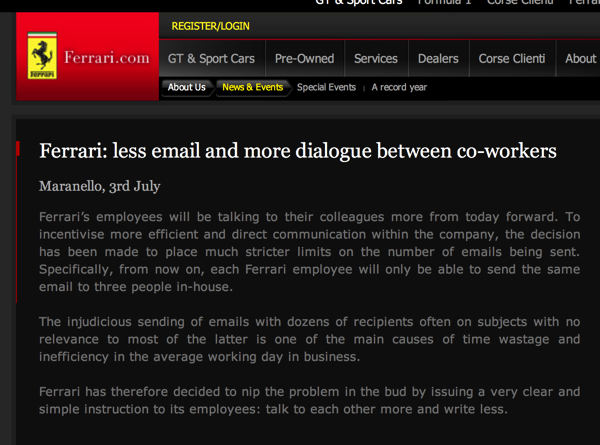
The Ferrari web site looks so much cooler too.

NewImage

The Ferrari statement closes with the main point.

Ferrari has therefore decided to nip the problem in the bud by issuing a very clear and simple instruction to its employees: talk to each other more and write less.

I would bet that Ferrari management is tired of resolving issues between departments where the groups don't talk to each other.  I would agree that writing is over rated.  

How many of the users of DCIM were asking for a new management approach?

I saw this DCK article that goes to nowhere.


Using DCIM to create a common data center management approach

Data Center Knowledge-by Bill Kleyman-6 hours agoShare
The modern data center is beginning to be considered the data center of everything. This means that more platforms, services and users are ...

Sorry, but we can't find that page ...


We're not able to find the file you are looking for. But we have more than 6,500 articles about data centers on our site, so we're sure it's here somewhere.

Got me thinking.  How many DCIM users want to create a new management approach?  Wouldn't people want software that supports the way they work and not force a change in management approach? 

This is why I when I wrote this post on DCIM and made the point that maybe the M in DCIM should be dropped.

Data Center Infrastructure Management.  Sometimes I think the solution would be better solved if the M - Management was dropped.  What is needed in Data Center Infrastructure.