The next big thing in data centers is low maintenance

Saving energy in the data center is old news.  The smart companies can easily achieve 1.2 PUE or lower.  They are being careful with their capital costs as well to build data centers.  More companies are looking at the data center holistically.

Google built its first data center in 2006.

Google is proud to call Oregon home to Google's first owned and operated data center.

We opened our data center at The Dalles in 2006—investing $600 million in the facility and establishing a long-term commitment to the region and state. Now a fully operational site, we've created over 80 full-time jobs on site, and we work hard to support the communities in which our employees live and work.

After 7 years of operation and opening another thirteen data centers, Google has plenty of data to make the next move to design data centers for low maintenance.  Google has made no announcement of this idea focusing on maintenance.  

I am making this statement because it is the logical progression in the life cycle of running efficient operations.

First phase is you want the facility to work.

Second phase you want to make sure it is available and performs.

Third phase is you drive efficiency and cost reduction while accounting for functionality, availability or performance.

The fourth phase is maintenance affects all these factors, but many times low maintenance was not designed into the data center.  You can only reduce maintenance costs so far.  Think of the per mile maintenance costs of your Ferrari vs. your Toyota.  Audi wins Le Mans because the cars are design for maintenance events.

With years of operation data, you can now design for operations and maintenance.  Low maintenance should use less resources which is greener and ideally lower cost.
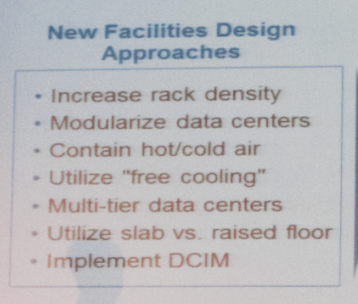
Aiming at the wrong results, increase rack density vs. NOT stranding power

I was listening to a data center analyst and they made the point increase rack density as one of the top things to do to increase efficiency in the data center.

NewImage

This is a clear target to hit, but it is the wrong one.  This situation reminds me of the 2004 Olympic target shooter who had one bullet to shoot to win the gold.  He hit the bulls eye in lane three.  He was in lane 2.

Emmons fired at the target in lane three while he was shooting in lane two. When no score appeared on the electronic scoring device for his lane, he turned to officials and gestured there was some sort of error.

"I shot," he appeared to say with a quizzical look as three officials in red blazers approached.

The officials went back and huddled briefly before announcing that Emmons had cross-fired — an extremely rare mistake in elite competition — and awarded him a score of zero.

It is easy to claim you increased the rack density, hitting the bulls eye.  But in the same way that Emmons lost because he shot the wrong target, there is a different target to aim at that would be more important if you have had judges.

If you deployed 2 kW in a rack, but also stranded power in the process why should you claim the increased rack density as a win?  The bigger picture to look at is did you use power without stranding power.  There are many other factors that influence where a piece of equipment should be placed.

Increase rack density is a great way for the Blade vendors to sell more blades.  But, the smartest data center operators don't make rack density a target to hit.

Do you?

That Olympian had instant feedback he missed the target.  Here is the story after and how he met his wife after the mistake.  

Matt and Katerina Emmons

At Athens 2004, Matt Emmons missed his target but found love. He recalls:

"That was the last shooting event of the Games so a bunch of athletes and coaches went up to this beer garden between the ranges.

"We were taking it easy and relaxing, I'm there with some friends, and Czech shooter Katerina Kurkova [who had been commentating on the final as Emmons missed the target] came up to say how sorry she was about what happened, and how she admired how I'd handled the situation.

"At that time I just knew who she was, we'd never really spoken. But we hit it off really well, we started dating a year later and we were married in 2007. She's now Katerina Emmons."

Jeff Bezos invests in reinventing the Physics of the newspaper business buying Washington Post

Jeff Bezos has spent $250 mil of his own money to buy the Washington Post.

The LA Times discusses the possibility of Jeff Bezos creating a new business model for newspapers.

Washington Post buy: Can Jeff Bezos fix newspapers' business model?

Amazon's Jeff Bezos, buyer of the Washington Post, has shown success at experimentation and great patience about turning a profit.

I've worked on Publishing technologies way too long, starting in 1987 on displays, printers, fonts at Apple, then continued working on the publishing technologies at Microsoft.  Back in 1997 Bill Gates was focused on winning the battle for publishing vs. Apple.  Microsoft didn't win that battle.  Google changed the game sucking the air out of print advertising model.

Jeff Bezos in 1994 started Amazon.com and has seen the transition of Books and DVDs to digital. While this all going on Jeff has got an insider's look at the business models of media companies.  Jeff Bezos started college as a physicists and switched to computer science.

Bezos often showed intense scientific interests. He rigged an electric alarm to keep his younger siblings out of his room.[citation needed] The family moved toMiami, Florida, where Bezos attended Miami Palmetto Senior High School. While in high school, he attended the Student Science Training Program at the University of Florida, receiving a Silver Knight Award in 1982.[9] He was high school valedictorian.[10] He attended Princeton University, with an intention to study physics, but soon returned to his love of computers and graduated summa cum laude, with a Bachelor of Science in Engineering in electrical engineering and computer science. While at Princeton, he was elected to the honor societies Phi Beta Kappa and Tau Beta Pi. He also served as the President of the Princeton chapter of the Students for the Exploration and Development of Space.[11]

Jeff's love to understand how things work and make them better is what he did to retail.  Why can't he do the same with newspapers.  Once he figures out newspapers he can move on to other things that shape human perception.

Here is a progressive view of journalism.

So then what the hell is journalism?

It is a service. It is a service whose end, again, is an informed public. For my entrepreneurial journalism students, I give them a broad umbrella of a definition: Journalism helps communities organize their knowledge so they can better organize themselves.

Thus anything that reliably serves the end of an informed community is journalism. Anyone can help do that. The true journalist should want anyone to join the task. That, in the end, is why I wrote Public Parts: because I celebrate the value that rises from publicness, from the ability of anyone to share what he or she knows with everyone and the ethic that says sharing is a generous and social act and transparency should be the default for our institutions.

Is there a role for people to help in that process? Absolutely. I say that organizations can first help enable the flow and collection of information, which can now occur without them, by offering platforms for communities to share what they know. Next, I say that someone is often needed to add value to that process by:
* asking the questions that are not answered in the flow,
* verifying facts,
* debunking rumors,
* adding context, explanation, and background,
* providing functionality that enables sharing,
* organizing efforts to collaborate by communities, witnesses, experts.

40 Days of Dating goes Viral, Could 40 Weeks of a Data Center work too?

I was reading Om Malik's post on 40 days of dating.

40daysofdating: An awesome new kind of long-form story telling


AUG. 4, 2013 - 12:16 PM PDT

3 Comments

40daysofdating
SUMMARY:

40daysofdating is a website that combines text, photos and video to tell the story of two friends Jessica Walsh and Timothy Goodman who after failing at finding love, are dating each other and sharing the experience. It is like reality television, except for the web.

I've been waiting for when someone would have an interesting web site that tells a story.

Needless to say, we have barely scratched the surface. At some level, 40daysofdating is like reality television — reality web if you will — and a good signpost for what could be a more episodic approach to content and story telling. In the past, it was comic books and stories in noir magazines that kept you hooked. So why not web-based episodic story telling?

In the data center world, there could be 40 weeks of a data center.  But, it could be 40 years before the data center world would adopt story telling as a way to share its ideas. :-)

Getting some good laughs from the Federal Data Center Consolidation

I  don't know about you, but from the beginning when the US Fed Gov't announced they were going to close data centers, I was getting some good laughs.  Really you think the way to close a data center is tell the staff that their data center will be shut down?  IT staff has learned to ignore the strategic projects from the CIO as he/she will be gone in 2 years. 

Vivek Kundra who announced the Federal data center consolidation lasted 2 1/2 years.

Vivek| Kundra (Hindiविवेक कुंद्रा; born October 9, 1974) is an Indian American administrator who served as the first chief information officer of the United States from March, 2009 to August, 2011 under President Barack Obama.

Network computing has a post on the three lessons learned from the Fed's data center consolidation.  Jumping to the last two paragraphs.

To understand just how wrong a data center consolidation can go, consider the findings of MeriTalk’s recent survey of 200 federal data center operators. Not only did 56 percent give their agencies’ consolidation efforts a grade of C or below -- a clear sign of a project headed south -- a whopping 45 percent believe that it’s more likely they’ll win the lottery, the Washington Redskins will win the next Super Bowl, or another large meteor will hit the Earth than agencies will meet FDCCI objectives.

Far from a glowing endorsement, but it serves as a third lesson -- an important reminder to IT execs that they’d be well advised to consider their data center teams’ perspectives before going full steam with consolidation mandates.

The IT staff is getting a good laugh as they continue to do same job they did yesterday, the month before, the year before, and last decade. :-)