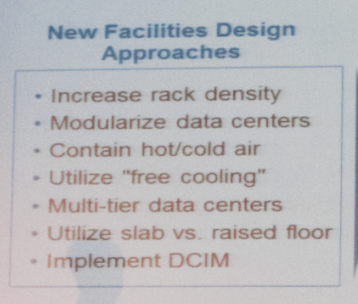
Design for Manufacturing is an old concept. The ideas of Design for Manufacturing have been applied to construction in the Lean Construction ideas.
Data Centers are some of the most expensive construction space, consuming a large amount of power and hosting equipment well over the cost of the building. Over the life of a building many systems may be completely replaced which multiplies the ease or pain of install as you remove the old equipment and install the replacement.
Wouldn't it be great if data centers were designed for repair and replace type of operations.
Here is Audi rebuilding a Le Mans car in 15 minutes.
1. Reduce the total number of parts. The reduction of the number of parts in a product is probably the
best opportunity for reducing manufacturing costs. Less parts implies less purchases, inventory, handling,
processing time, development time, equipment, engineering time, assembly difficulty, service inspection,
testing, etc. In general, it reduces the level of intensity of all activities related to the product during its
entire life. A part that does not need to have relative motion with respect to other parts, does not have to
be made of a different material, or that would make the assembly or service of other parts extremely
difficult or impossible, is an excellent target for elimination. Some approaches to part-count reduction
are based on the use of one-piece structures and selection of manufacturing processes such as injection
molding, extrusion, precision castings, and powder metallurgy, among others.
2. Develop a modular design. The use of modules in product design simplifies manufacturing activities
such as inspection, testing, assembly, purchasing, redesign, maintenance, service, and so on. One reason
is that modules add versatility to product update in the redesign process, help run tests before the final
assembly is put together, and allow the use of standard components to minimize product variations.
However, the connection can be a limiting factor when applying this rule.
3. Use of standard components. Standard components are less expensive than custom-made items. The
high availability of these components reduces product lead times. Also, their reliability factors are well
ascertained. Furthermore, the use of standard components refers to the production pressure to the
supplier, relieving in part the manufacture’s concern of meeting production schedules.
4. Design parts to be multi-functional. Multi-functional parts reduce the total number of parts in a
design, thus, obtaining the benefits given in rule 1. Some examples are a part to act as both an electric
conductor and as a structural member, or as a heat dissipating element and as a structural member. Also,
there can be elements that besides their principal function have guiding, aligning, or self-fixturing features
to facilitate assembly, and/or reflective surfaces to facilitate inspection, etc.
5. Design parts for multi-use. In a manufacturing firm, different products can share parts that have been
designed for multi-use. These parts can have the same or different functions when used in different
products. In order to do this, it is necessary to identify the parts that are suitable for multi-use. For
example, all the parts used in the firm (purchased or made) can be sorted into two groups: the first
containing all the parts that are used commonly in all products. Then, part families are created by defining
categories of similar parts in each group. The goal is to minimize the number of categories, the variations
within the categories, and the number of design features within each variation. The result is a set of
standard part families from which multi-use parts are created. After organizing all the parts into part
families, the manufacturing processes are standardized for each part family. The production of a specific
part belonging to a given part family would follow the manufacturing routing that has been setup for its
family, skipping the operations that are not required for it. Furthermore, in design changes to existing
products and especially in new product designs, the standard multi-use components should be used.
6. Design for ease of fabrication. Select the optimum combination between the material and fabrication
process to minimize the overall manufacturing cost. In general, final operations such as painting,
polishing, finish machining, etc. should be avoided. Excessive tolerance, surface-finish requirement, and
so on are commonly found problems that result in higher than necessary production cost.
7. Avoid separate fasteners. The use of fasteners increases the cost of manufacturing a part due to the
handling and feeding operations that have to be performed. Besides the high cost of the equipment
required for them, these operations are not 100% successful, so they contribute to reducing the overall
manufacturing efficiency. In general, fasteners should be avoided and replaced, for example, by using tabs
or snap fits. If fasteners have to be used, then some guides should be followed for selecting them.
Minimize the number, size, and variation used; also, utilize standard components whenever possible.
Avoid screws that are too long, or too short, separate washers, tapped holes, and round heads and flatheads
(not good for vacuum pickup). Self-tapping and chamfered screws are preferred because they improve
placement success. Screws with vertical side heads should be selected vacuum pickup.
8. Minimize assembly directions. All parts should be assembled from one direction. If possible, the best
way to add parts is from above, in a vertical direction, parallel to the gravitational direction (downward). In
this way, the effects of gravity help the assembly process, contrary to having to compensate for its effect
when other directions are chosen.
9. Maximize compliance. Errors can occur during insertion operations due to variations in part dimensions
or on the accuracy of the positioning device used. This faulty behavior can cause damage to the part and/or
to the equipment. For this reason, it is necessary to include compliance in the part design and in the
assembly process. Examples of part built-in compliance features include tapers or chamfers and moderate
radius sizes to facilitate insertion, and nonfunctional external elements to help detect hidden features. For
the assembly process, selection of a rigid-base part, tactile sensing capabilities, and vision systems are
example of compliance. A simple solution is to use high-quality parts with designed-in-compliance, a
rigid-base part, and selective compliance in the assembly tool.
10. Minimize handling . Handling consists of positioning, orienting, and fixing a part or component. To
facilitate orientation, symmetrical parts should be used when ever possible. If it is not possible, then the
asymmetry must be exaggerated to avoid failures. Use external guiding features to help the orientation of
a part. The subsequent operations should be designed so that the orientation of the part is maintained.
Also, magazines, tube feeders, part strips, and so on, should be used to keep this orientation between
operations. Avoid using flexible parts - use slave circuit boards instead. If cables have to be used, then
include a dummy connector to plug the cable (robotic assembly) so that it can be located easily. When
designing the product, try to minimize the flow of material waste, parts, and so on, in the manufacturing
operation; also, take packaging into account, select appropriate and safe packaging for the product