Mobile Devices set up for a three company competition - Apple, Google, and Microsoft

With Microsoft's acquisition of Nokia phone devices it looks like there is a three company race against Apple and Google.  Phones and Tablets are the growing faster than any other technology device.

One way to think about Mobile device companies is a three company competition.  Here is a post on three company competition and its history.

COMPETITIVE MARKETS AND THE RULE OF THREE 
by Jagdish N. Sheth and Rajendra S. Sisodia 
Strategy 

The “Big Three” no longer have the automobile market to themselves, but almost every market, including the one for cars, is ruled by three dominant firms. That reality does not prevent other firms from being successful. However, all firms, regardless of their market share, must still understand The Rule of Three and how it will affect their strategy and attempt to operate efficiently.

Over the past several years, the world economy, principally in the developed free market economies of Europe and North America, has been characterized by a unique economic phenomena-the combination of mergers and demergers at record levels (demergers are the spin-offs of non-core businesses). As a result, the landscape of just about every major industry has changed in a significant way, moving inexorably toward what we call the “Rule of Three.” The recent economic downturn has slowed but not halted this fundamental evolution, nor has it altered its basic direction.

We note that the Rule of Three is much more than an interesting theoretical construct; it is a powerful empirical reality that must be factored into corporate strategizing. Understanding the likely end-points of market evolution is critical to the ability of executives to develop strategies that will result in success.

Insight into Google Data Center Operations, Site Reliability Presentation at PuppetConf

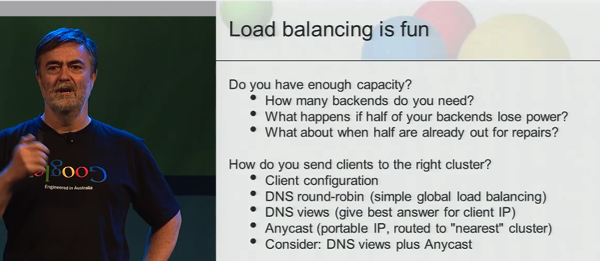
I was at PuppetConf 2013 in SF for the first time and had a great time.  After the opening Keynote by Luke Kaines, was a presentation by Google Site Reliability Engineer, Gordon Rowell.

Google’s Corporate Engineering SRE team provides infrastructure services used by many of Google’s desktops, laptops and servers. This talk gives an overview of the design philosophy, challenges, technologies and some interesting failures seen while implementing infrastructure at scale.
Speakers

Gordon Rowell

Site Reliability Manager, Google
Gordon Rowell is a site reliability manager at Google, Sydney. His team focuses on delivering services to Googlers around the world. They have migrated major internal services to run on Google technology and are currently focused on removing dependencies on the corporate network. | He enjoys the challenges of building robust systems that scale and has a particular passion for configuration management. 

The presentation is here.

Key takeaways I saw are in these slides.

NewImage

NewImage

NewImage

NewImage

How Servers does Google have? 1 Mil cumulative in July 9, 2008

Microsoft's exiting CEO Steve Ballmer said Microsoft has a million servers.

 At the Microsoft World-Wide Partners Conference, Microsoft CEO Steve Ballmer announced that “We have something over a million servers in our data center infrastructure. Google is bigger than we are. Amazon is a little bit smaller. You get Yahoo! and Facebook, and then everybody else is 100,000 units probably or less.

Google reached its million server cumulative mark in July 8, 2008.

How many servers does Google employ? It’s a question that has dogged observers since the company built its first data center. It has long stuck to “hundreds of thousands.” (There are 49,923 operating in the Lenoir facility on the day of my visit.) I will later come across a clue when I get a peek inside Google’s data center R&D facility in Mountain View. In a secure area, there’s a row of motherboards fixed to the wall, an honor roll of generations of Google’s homebrewed servers. One sits atop a tiny embossed plaque that reads JULY 9, 2008. GOOGLE’S MILLIONTH SERVER. But executives explain that this is a cumulative number, not necessarily an indication that Google has a million servers in operation at once.

When will Amazon reach a million servers?  When will Facebook?  Is it really that big of a deal.  Maybe if you are media and you are looking for a story.

To give you how clueless some people are.  Who cares how many servers.  The important thing is how many cores are there in the environment?  The number of cores and the quality of them is what is important to run services.  Not the number of servers. D'Oh.

The next thing that will hit the Data Center Companies, The Truth, The Reality of where their path leads to

I have been writing about a bunch of other things besides data centers.  In some ways what gets discussed in the media about data centers is getting old and boring.  So what if Microsoft builds a data center in Finland as part of the acquisition of Nokia's phone devices?  $250 mil spent over years is probably a data center in the 10-15MW range with 40% spend on the data center, 40% spent on the equipment and 20% for various other costs to run the data center.  Data centers are now discussed broadly in the media.  The data center media has morphed as the people have changed jobs or companies have been acquired.

What is up with the data center industry?  6 months ago I would say the big are getting bigger, the small are getting smaller, and the middle is keeping quiet as they find it harder to do business.

What do I say now?  The truth in data centers will be driving many changes in data centers.  Those who contribute to hype will decrease.  To be cost competitive, you need to save money.  But making people do more with less, is not necessarily the best way long term if designs are not well thought out.  To optimize a solution overall, you need to see the truth of what works and what doesn't.  Shaving costs can create a whack-a-mole problem.  I have heard of people who reduce their construction costs by eliminating work typically done and making it part of the operations team.  Or designs that sacrifice best practices in operation, increasing operating costs and reduces availability.

I have heard rumblings of changes.  Data Centers are not easy to run, they can be temperamental if not designed right.

Marilyn Monroe

“I'm selfish, impatient and a little insecure. I make mistakes, I am out of control and at times hard to handle. But if you can't handle me at my worst, then you sure as hell don't deserve me at my best.” 
― Marilyn Monroe
 

Here are a few more quotes of the "truth" that can be applied to data centers.

Oscar Wilde

“The truth is rarely pure and never simple.” 
― Oscar WildeThe Importance of Being Earnest


Gloria Steinem

“The truth will set you free, but first it will piss you off.” 
― Gloria Steinem


Aldous Huxley

“Facts do not cease to exist because they are ignored.” 
― Aldous HuxleyComplete Essays 2, 1926-29


Time to upgrade to Galaxy Note 3 from Galaxy Note 1, the power of the pen

In Feb 2012 I bought a Galaxy Note 1. Why because I was and still working on mobile services and we needed something different than what was the solutions for consumers.  I have no regrets with the Galaxy Note 1, but it is getting slower with SW updates.  The battery is worn down.  I have convinced others to get the Galaxy Note 2 which has better performance and battery life.

I bought a Galaxy Note 8 for Tablet experience and now rarely use the iPad.  Being able to write and replace paper notebooks feels better for the way I work and think.  The Wacom Bamboo stylus is a nice pen device.

Today Samsung announced the Galaxy Note 3 and I am ready to replace the Galaxy Note 1.

The press is pro-Phablet now.  Whereas at the beginning the media made fun of the Phablet.

Here is one review of the Galaxy Note 3.

Samsung Galaxy Note III preview

Two years ago, at a consumer electronics show in Berlin, Samsung took to the stage and unveiled the introduction to what is now a booming smartphone genre. The 5.3-inch monstrosity, called the Galaxy Note, has blossomed into one of the Korean manufacturer's biggest brands. Today the same company is unveiling the Galaxy Note 3, the second sequel in a series of supersized stylus-smitten smartphones, which is even taller, narrower and thinner than the first two of its kind. As expected, the new 5.7-inch Note not only utilizes a S-Pen but enhances its functionality and adds better hardware and components to ensure it's able to handle anything you can throw at it.

The Samsung marketing group is pushing the Note harder.

GALAXY Note 3 makes your everyday life amazing

"We introduced the original GALAXY Note in 2011 and launched a whole new smart device category. The undeniable success of the GALAXY Note strengthened our conviction that consumers want higher quality features for smart devices and they want those new features to make their lives better," said JK Shin, CEO and President of IT & Mobile Division at Samsung Electronics. "Samsung GALAXY Note 3 is a powerful, original approach that enables users to tell the stories of their lives through dynamic and seamless expressions of their passions across work, play and life experiences. With a simple click of the S Pen button, users can unlock opportunities for self-expression, features that transform everyday activities into extraordinary events and access to new experiences delivered to them on Note 3's larger screen."

Now I don't look so silly saying the ideal device for a revolutionary mobile service is the Galaxy Note.  The Note 3 looks awesome.