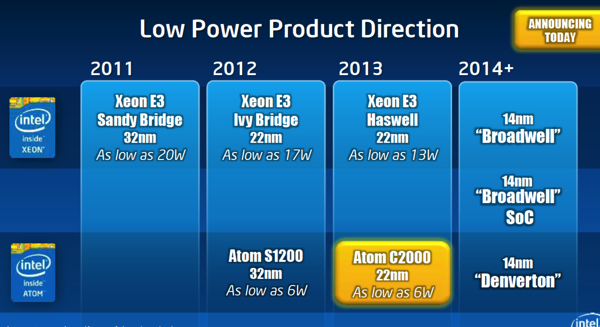
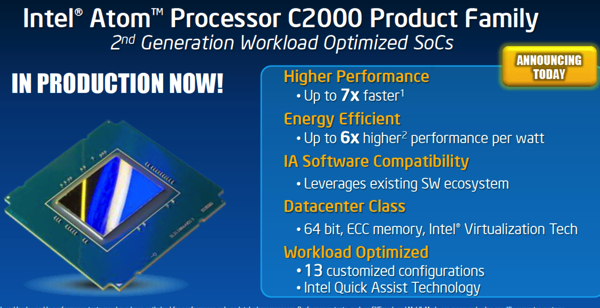
The ARM processor was claimed to be more efficient. And now the C2000 is 6x performance per watt
Doug Freedman of RBC Capital Markets reiterated an Outperform rating and a $29 price target on the shares, writing, “INTC’s new Atom low-power C2000, successor to S1200, is a very compelling offering in that it not only offers up to 6x performance/ watt (vs. S1200), but will enable newer markets leveraging prior SoC efforts in mobile (smartphone/tablet).
Thus INTC stands to pick-up ground in new markets with attractive ROI on more customized solutions [...] Performance vs. select S1200 parts are expected to be up to 7x faster, offering up to 6x higher performance per watt. The product is expected to be a best-in-class solution vs. competitive ARM solutions in the marketplace [...] We were encouraged to hear that the gross margin impact is expected to be “a wash”. To us, this implies that the margins are at least comparable to performance-based parts, and potentially better due to 22nm and cost efficiencies realized as a result of leveraging mobile resources.”
From the bear camp, Hans Mosesmann of Raymond James, reiterating an Underperform rating, wrote that “Intel introduced today an impressive number of Atom-based processor, switch, memory, and optical connectivity products/technologies for the datacenter in a move that highlights, in our view, Intel’s sense of urgency to defend its server processor supremacy.”
It is hard to fathom Intel making this big of a splash had ARM not released its 64-bit v8 architecture (for licensing) nearly two years ago with the subsequent strong design interest. Intel was at pains to explain that microservers, as a category, are small but the opportunity for adjacent markets is big. Translation: we are worried about the ARM threat and are willing to cannibalize existing low-end, highly profitable XEONs to make sure this does not happen.”

 Bill Gates
  Jeff Raikes