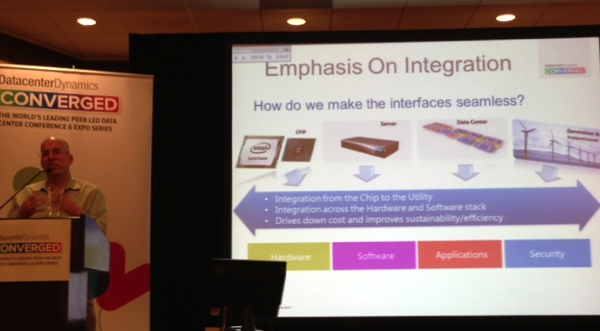
Another day at DCD Seattle 2013 talking to guys who know what is going on, a different thought leader

The term thought leader is well known in the industry.

thought leader is an individual or firm that is recognized as an authority in a specialized field and whose expertise is sought and often rewarded.[1] The term was coined in 1994 by Joel Kurtzman, editor-in-chief of the Booz Allen Hamilton magazine Strategy & Business, and used to designate interview subjects for that magazine who had business ideas which merited attention.[2]

But, in the data center industry I would use a different definition of a thought leader.  the above says the individual is recognized as an authority.  One way to interpret the recognized is the person is presenting and covered by the media.  But, just because you are recognized and covered by the media does not mean you are a thought leader.  

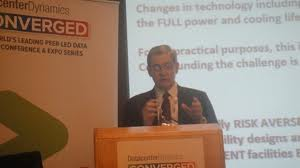
While I was at DCD I was catching up with and handful of people who I think of thought leaders.  One is Stephen Worn, CTO of DCD.
NewImage

Another was Christian Belady

NewImage

And another is Don Beaty

NewImage

But, there many more who I consider thought leaders who were not presenting and the media doesn't know about.  These guys know how to operate data centers across the world and build new ones that provide a low TCO while fitting their business models.  They are often all over the world.  These people are not making the presentations and they are quietly out of the attention of the media working on innovative solutions where the client is building a competitive advantage.

Sometimes the so-called thought leaders are the ones who enjoy getting in front of the audience telling people how good they are and what they have done.  This collects a set of people who will follow this leader, believing his words as if they are gospel.  It becomes almost a religious following.  If you try to point out to the followers that their thought leader may be wrong, you will be accused of blasphemy.  It's not as bad as a Jim Jones cult, but it is not often not worth trying to enlighten the followers.  They'll find out eventually what happens if you follow the faux thought leader for too long.

Myself I have made the mistake of believing what people present as true at a data center conference.  With experience though I learned to fact check what people say.  What is fact checking?  Here is an illustration of the Washington Post fact checking the NYTimes post by Vladimir Putin.

Russian President Vladimir Putin has an op-ed in today's New York Times urging President Obama not to strike Syria. It's a fascinating document -- a very Russian perspective translated into American vernacular, an act of public diplomacy aimed at the American public and the latest chess move in the U.S.-Russia standoff over Syria, one in which we the readers are implicated. Putin does make a number of valid and even compelling points, but there is an undeniable hypocrisy and even some moments of dishonesty between the lines.

Below, I've annotated the op-ed, line-by-line, elaborating and translating at some points, fact-checking a bit in others. Putin's writing is set off in italics and bold; my notes are in plain text.

When I see a faux data center thought leader I learn to find the facts that are not quite true.

We've reached the limit of General Purpose Operating System

Linux is much more popular on Servers than Desktops.  Windows dominates the desktop and laptop OS as the market declines.  Android and iOS are the dominant mobile OS on tablets and phones.  The Internet of Things will have OSs in all the different devices from a wide range of suppliers.  It may have been a dream of OS focused executives to dominate with an OS across devices, but with device counts now reaching billions the General Purpose Operating System that created the opportunities for DOS, Windows, and Linux needed by customers has reached its limits.

The problem is the larger the market share the harder it is to develop and test new OS releases which slows down the overall hardware development.  No one will accept an OS that slows hardware development.

It was not too long ago when users would talk about running a version of Windows or Mac OS.  Smartphones and Tablets are with people more and people talk about the device brands more the OS brands.  The developer audience will talk about a version of the OS, but end users less and less.

Being an old OS guy working on Mac OS and Windows OS (I stopped working on desktop OS with Windows XP and moved to Windows Server 2003, then stopped completely) looking at OS development is still interesting, but I don't want to work on them full time any more.  Which in some ways gives a perspective to watch from afar.

The OS is simply part of the overall solution and not as important as it was.  The user interface is what people interact with not the low level OS which is hidden much to the frustration of those who want to create a general purpose operating system across all devices.  Linux on the server appeals to those who don't' want to be bothered with a user interface.  The servers is where there is still the battle for general purpose OS between Windows and Linux but there are much less people working on server OS than mobile OSs.

Off to Iceland to see how green a data center can be

I am off to Iceland to check how green the data centers opportunity is.  I'll see how much time I have to write.  I do plan on taking my Canon 6D to take pictures.  Some of my friends have gone to Iceland, and this my first time.

Here is what shows up in a Google search of "iceland data center"

  1.  
  2. Iceland bets future on large data center development | Datacenter ...

    www.datacenterdynamics.com/.../iceland-bets-future-large-data-center-d...
     
    Mar 6, 2013 - A public-owned energy company that deals in geothermal and hydro power in Iceland's capital city Reykjavik is finalizing plans to secure a 50 ...
  3. Images for iceland data center

     - Report images
  4. IcelandData-Center Hub? - Businessweek

    www.businessweek.com/articles/2012-03-28/iceland-data-center-hub
     
    Mar 29, 2012 - On the southwestern tip of Iceland, housed in a former NATO air base, a new $700 million data center is waiting to host the world's information.
  5. Verne Global | The Smart Data Center Solution

    www.verneglobal.com/
     
    Datacenter Dynamics Converged - London. 09/19/2013. Iceland Investment Forum 2013. 08/20/2013. Verne Global Honored With Two Stevie® Awards in 2013 ...
  6. Datapipe Opens Green HPC Cloud Node in Iceland | Data Center ...

    www.datacenterknowledge.com/.../datapipe-opens-very-green-h...
    Jun 17, 2013 - Datapipe has made Statosphere, its high performance computing (HPC) cloud platform available out of Verne Global's facility, which uses ...
     
  7. Iceland Data Center

    www.icelanddatacenter.com/
     
    As energy costs increase and environmental standards tighten, Iceland Data Centerstands as the smart choice for substantial savings on secure, superior data ...

  8.  

A Day at DatacenterDynamics Seattle 2013

Today is one of those days I don't have to get on a plane to go to a data center conference.  DatacenterDynamics Seattle is in its 6th year.  

NewImage

Part of my duties is moderating a panel discussion.

Sustainable Power, Sustainable Operations, and Sustainable Design
Peter M. Curtis
President & CEO, Power Management Concepts LLC

Dave Ohara
President, GreenM3 LLC

Leonard Ruff
AIA Principal, Mission Critical Design, Callison, LLC

I'll be at the conference all day so no blogging for the rest of the day.

Is your Data Center where Dell's Fresh Air Cooling will work?

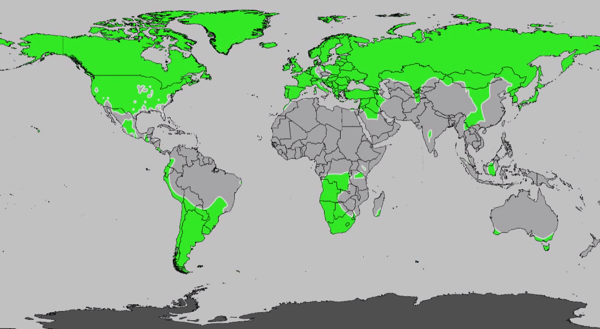
Here is a map of where Dell says Fresh Air Cooling will work with their hardware.

NewImage

The blog post is here.

  • Comments0 
  • Likes

We are proud to announce the next iteration of the Dell Fresh Air Hot House, an ongoing project at Dell with partner Intel and customer Essor Partners LLC. The Fresh Air Hot House, located in Round Rock, Texas, showcases the extreme temperature and humidity tolerances of off-the-shelf Dell Fresh Air capable hardware while performing at high workload levels in a non-air-conditioned environment.

Dell embarked on the Fresh Air design mission after hearing from our customers. They told us they were challenged for operating expenditure and data center capacity, and they needed a solution. Based on those conversations, we set out to design a server capable of performing continuously up to 35°C (95°F) and for time-based excursion operation up to 45°C (113°F) with humidity up to 90%, covering most of the environmental ranges in the world. Through years of comprehensive research and development, we found that a fresh air cooled data center using our Dell Fresh Air capable hardware could be deployed almost anywhere.

And the video is here.