Amazon's A9 creates a video that tells the story of what it is like working for the company

Here is a video about Amazon.com's A9.  This video has only 392 views and is a humorous spin on working for A9.

What is most interesting to the data center crowd is their technical operations team.

Technical Operations

Our global team keeps Product Search and other services running 24x7.


Infrastructure That Scales.

Search and several related services we support are at the core of the Amazon business: they help customers find the items they want to buy. We are always online and ready to respond. 

Our globally distributed team oversees the smooth-running of all search system operations on Amazon sites in North America, Europe and Asia; our Client Services group provides hands on support for those that depend on A9’s search systems.

NewImage

Besides our ultra-high availability frontline operations, we plan and scale with the fast-paced growth of search. We look at the data; we determine what services are needed; we implement solutions and we manage deployments. We are responsible for thousands of servers handling 100s of millions customer searches daily.

We stay agile so that we can adapt to unexpected change and exponential growth. We are ready when peak traffic surges, and we understand that yesterday’s record is going to be tomorrow’s average, so we always stay ahead with our infrastructure.

Collaborating across time and space.

The Search Operations team builds and runs the world's largest e-commerce product search. 

Our "follow the sun" operation is based in three locations: Palo Alto, Dublin, and Tokyo. Each of our teams can, during their work hours, address any issue in any locale as soon as it arises, giving it full attention.  

No matter what the volume of traffic, the conditions on the ground, or the intricacy of the systems, our services perform seamlessly for our customers, 24x7.

We manage critical capabilities—high availability, cross-platform, scalable product search and an advertising platform that serves advertisers and publishers alike—for our parent company Amazon and other clients.


Are you Ready for the 7 billion Mobile Device Future? Intel's Top Anthropologist predicts a Mobile Future with 4 insights

Intel Developer Forum was this week and I have gone 3 times but didn't go this year.

The last days keynote is here by Genevieve Bell who is an anthropologist.  Below is a video of her keynote and the presentation.

Intel Developer Forum 2013 Keynote - Genevieve Bell


To help the attendees tweet the her presentation Genevieve inserted Twitter Blue Birds to help people know what to tweet.

NewImage

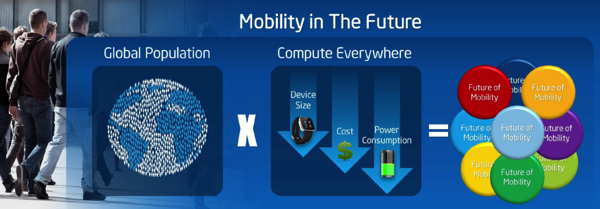
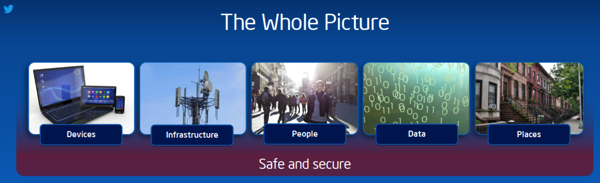
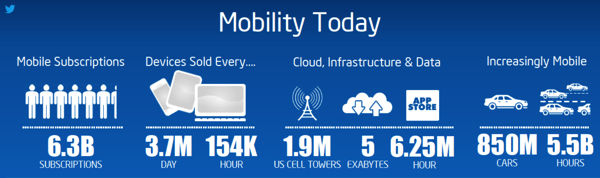
Part of why I like to blog is there are things I can say or show that is too hard to tweet.  It is so much easier to tell a story.  Here are the four insight that Genieve shared.

NewImage

One of the points made is being in the moment, in the flow.  One of the problems Windows has is association with this.

NewImage

To its credit Windows doesn't crash the way it used, but I would say the number 1 irritant is Windows Update. I can almost count on when I fire up Windows that Windows update will disrupt my flow.  Now to be fair I only use Windows once a month and too many times there is a critical update that forces a reboot.  Or I just get used to when I fire up Windows I allow 15-30 minutes at the beginning to run Windows update.  Luckily I just run Windows on parallels on my Mac.  The Mac does have updates as well, but they almost never force themselves in my flow.

NewImage

Intel just announced it was shutting down its plant in the Boston area because it is stuck in 32nm wafer fab past and Intel is getting ready for a 14 nm future.  The old way of Intel was to build big complex processors to make money.  It looks like the new way is billions of small, low cost, power efficient chips.  Huh, sounds like the ARM strategy.

NewImage

One of the things that doesn't get presented is whether Intel has figured out a future that allows the selling of these small devices, making little money on the billions of small devices because in the big picture Intel can figure out where to maximize its profit across the whole system.  Its like Google giving away Android so it can make money on advertising.

NewImage

NewImage

NewImage

OK this what i wanted to say.  Couldn't do this in a tweet.  

Another day at DCD Seattle 2013 talking to guys who know what is going on, a different thought leader

The term thought leader is well known in the industry.

thought leader is an individual or firm that is recognized as an authority in a specialized field and whose expertise is sought and often rewarded.[1] The term was coined in 1994 by Joel Kurtzman, editor-in-chief of the Booz Allen Hamilton magazine Strategy & Business, and used to designate interview subjects for that magazine who had business ideas which merited attention.[2]

But, in the data center industry I would use a different definition of a thought leader.  the above says the individual is recognized as an authority.  One way to interpret the recognized is the person is presenting and covered by the media.  But, just because you are recognized and covered by the media does not mean you are a thought leader.  

While I was at DCD I was catching up with and handful of people who I think of thought leaders.  One is Stephen Worn, CTO of DCD.

NewImage

Another was Christian Belady

NewImage

And another is Don Beaty

NewImage

But, there many more who I consider thought leaders who were not presenting and the media doesn't know about.  These guys know how to operate data centers across the world and build new ones that provide a low TCO while fitting their business models.  They are often all over the world.  These people are not making the presentations and they are quietly out of the attention of the media working on innovative solutions where the client is building a competitive advantage.

Sometimes the so-called thought leaders are the ones who enjoy getting in front of the audience telling people how good they are and what they have done.  This collects a set of people who will follow this leader, believing his words as if they are gospel.  It becomes almost a religious following.  If you try to point out to the followers that their thought leader may be wrong, you will be accused of blasphemy.  It's not as bad as a Jim Jones cult, but it is not often not worth trying to enlighten the followers.  They'll find out eventually what happens if you follow the faux thought leader for too long.

Myself I have made the mistake of believing what people present as true at a data center conference.  With experience though I learned to fact check what people say.  What is fact checking?  Here is an illustration of the Washington Post fact checking the NYTimes post by Vladimir Putin.

Russian President Vladimir Putin has an op-ed in today's New York Times urging President Obama not to strike Syria. It's a fascinating document -- a very Russian perspective translated into American vernacular, an act of public diplomacy aimed at the American public and the latest chess move in the U.S.-Russia standoff over Syria, one in which we the readers are implicated. Putin does make a number of valid and even compelling points, but there is an undeniable hypocrisy and even some moments of dishonesty between the lines.

Below, I've annotated the op-ed, line-by-line, elaborating and translating at some points, fact-checking a bit in others. Putin's writing is set off in italics and bold; my notes are in plain text.

When I see a faux data center thought leader I learn to find the facts that are not quite true.

We've reached the limit of General Purpose Operating System

Linux is much more popular on Servers than Desktops.  Windows dominates the desktop and laptop OS as the market declines.  Android and iOS are the dominant mobile OS on tablets and phones.  The Internet of Things will have OSs in all the different devices from a wide range of suppliers.  It may have been a dream of OS focused executives to dominate with an OS across devices, but with device counts now reaching billions the General Purpose Operating System that created the opportunities for DOS, Windows, and Linux needed by customers has reached its limits.

The problem is the larger the market share the harder it is to develop and test new OS releases which slows down the overall hardware development.  No one will accept an OS that slows hardware development.

It was not too long ago when users would talk about running a version of Windows or Mac OS.  Smartphones and Tablets are with people more and people talk about the device brands more the OS brands.  The developer audience will talk about a version of the OS, but end users less and less.

Being an old OS guy working on Mac OS and Windows OS (I stopped working on desktop OS with Windows XP and moved to Windows Server 2003, then stopped completely) looking at OS development is still interesting, but I don't want to work on them full time any more.  Which in some ways gives a perspective to watch from afar.

The OS is simply part of the overall solution and not as important as it was.  The user interface is what people interact with not the low level OS which is hidden much to the frustration of those who want to create a general purpose operating system across all devices.  Linux on the server appeals to those who don't' want to be bothered with a user interface.  The servers is where there is still the battle for general purpose OS between Windows and Linux but there are much less people working on server OS than mobile OSs.

Off to Iceland to see how green a data center can be

I am off to Iceland to check how green the data centers opportunity is.  I'll see how much time I have to write.  I do plan on taking my Canon 6D to take pictures.  Some of my friends have gone to Iceland, and this my first time.

Here is what shows up in a Google search of "iceland data center"

  1.  
  2. Iceland bets future on large data center development | Datacenter ...

    www.datacenterdynamics.com/.../iceland-bets-future-large-data-center-d...
     
    Mar 6, 2013 - A public-owned energy company that deals in geothermal and hydro power in Iceland's capital city Reykjavik is finalizing plans to secure a 50 ...
  3. Images for iceland data center

     - Report images
  4. IcelandData-Center Hub? - Businessweek

    www.businessweek.com/articles/2012-03-28/iceland-data-center-hub
     
    Mar 29, 2012 - On the southwestern tip of Iceland, housed in a former NATO air base, a new $700 million data center is waiting to host the world's information.
  5. Verne Global | The Smart Data Center Solution

    www.verneglobal.com/
     
    Datacenter Dynamics Converged - London. 09/19/2013. Iceland Investment Forum 2013. 08/20/2013. Verne Global Honored With Two Stevie® Awards in 2013 ...
  6. Datapipe Opens Green HPC Cloud Node in Iceland | Data Center ...

    www.datacenterknowledge.com/.../datapipe-opens-very-green-h...
    Jun 17, 2013 - Datapipe has made Statosphere, its high performance computing (HPC) cloud platform available out of Verne Global's facility, which uses ...
     
  7. Iceland Data Center

    www.icelanddatacenter.com/
     
    As energy costs increase and environmental standards tighten, Iceland Data Centerstands as the smart choice for substantial savings on secure, superior data ...

  8.